

If you’ve started Suboxone, or love someone who has, you’ve heard that sentence. At a family dinner, in a church basement, sometimes from a doctor who should know better. It sounds like common sense. It has probably killed more people than any other sentence in addiction medicine, because it talks people out of the treatment with the strongest mortality evidence we have. So this article is going to explain how the medication actually works, why the first dose is the trickiest moment of the whole process, and then take that sentence apart with the receipts, because it deserves nothing gentler.
Standard ground rule first, and it’s not a formality on this topic, Suboxone is prescription-only, every decision in this article gets made with a prescriber, and nothing here replaces that partnership. What this piece can do is make sure you walk into that conversation already understanding the machine.
The Mechanism: A Key That Fits The Lock But Only Turns It Halfway
Opioid addiction rewires the brain’s receptor system. Heroin, oxycodone, and fentanyl are full agonists, keys that turn the receptor’s lock all the way, producing euphoria, then tolerance, then a brain that can’t feel normal without them. Withdrawal and craving aren’t weakness, they’re that rewired system screaming for input.
Buprenorphine, the main ingredient in Suboxone, is a partial agonist. It fits the same lock but turns it only partway. Enough activation to shut down withdrawal and quiet cravings, not enough to produce the high that drives compulsive use. Two properties make it unusual among opioids. It binds harder to the receptor than almost anything else, so it elbows other opioids off and blocks them from working. And it has a ceiling effect, meaning past a certain dose, taking more doesn’t produce more effect, which is a big part of why overdose deaths from buprenorphine alone are rare compared to full agonists.
The second ingredient, naloxone, mostly just rides along. Taken properly under the tongue, it barely absorbs and does nothing. Its job is deterrence: if someone dissolves and injects the medication chasing a high, the naloxone hits the receptors first and triggers immediate withdrawal. It’s a tamper alarm, not a treatment.
The result, when dosed right, is a person who is not high, not in withdrawal, and not spending every waking hour negotiating with cravings. People work, drive, parent, and sit through boring meetings on stable buprenorphine doses. That “not high” part matters enormously for the myth section, so hold onto it.
Why The First Dose Is The One Moment You Genuinely Cannot Wing
Here’s the counterintuitive part nobody expects: the most dangerous way to start a medication that treats withdrawal is to take it too soon.
Remember that buprenorphine binds harder than other opioids but activates the receptor less. Now picture starting it while a full agonist, yesterday’s heroin, this morning’s fentanyl, is still sitting on your receptors. The buprenorphine shoves the stronger drug off and replaces full activation with partial activation, all at once. Your brain experiences that as falling off a cliff. Clinicians call it precipitated withdrawal, and people who’ve been through it describe it as the worst hours of their addiction, every withdrawal symptom compressed and amplified. It isn’t usually medically dangerous, but it’s traumatic enough that some people never try the medication again, which is the real cost.
So induction runs on a rule that feels backwards you have to be already in withdrawal, genuinely uncomfortable, before the first dose, because that discomfort is the proof the receptors have emptied enough for buprenorphine to help instead of harm. Prescribers score this with a checklist of objective signs and time the first dose accordingly, and the waiting period varies by which opioid someone was using and how their body clears it.
Fentanyl, which now dominates the U.S. illicit supply, made this harder. It’s short-acting in theory but lingers in tissue in heavy users, which widened the window where a first dose can misfire, and it’s a real part of why induction today is a clinician’s judgment call rather than a printed timetable. Some prescribers now use alternative starting strategies built specifically for fentanyl-era inductions. All of which is exactly why “my buddy gave me one of his strips” goes wrong so often, and why the timing conversation belongs with the person writing the prescription. The medication is the same either way. The start is where expertise lives.
Now The Myth, And The Numbers That Should End It
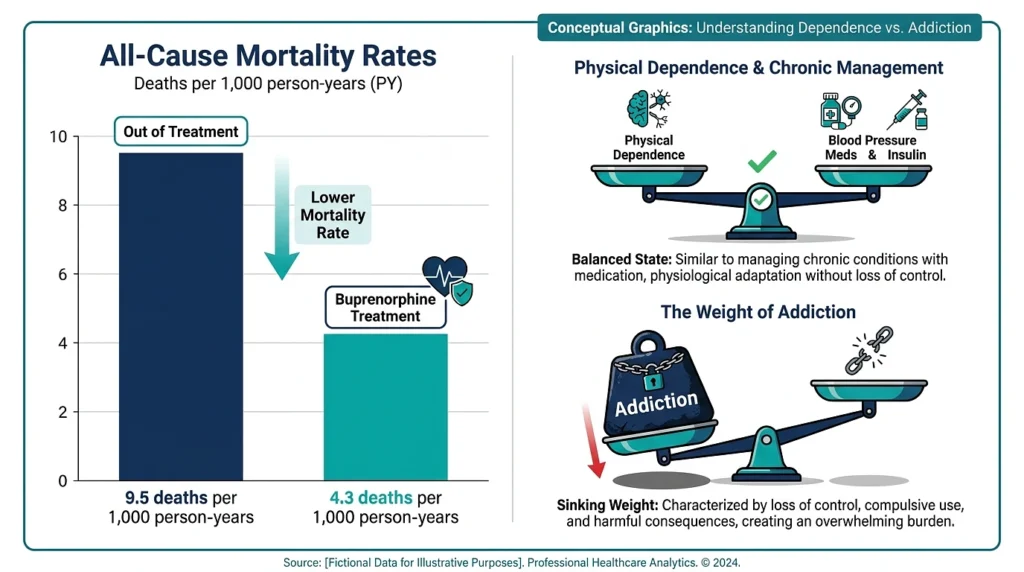
The “trading one drug for another” line rests on a real confusion between two different things physical dependence and addiction. Dependence means your body adapts to a substance, which happens with blood pressure medication, antidepressants, and yes, buprenorphine. Addiction is compulsive use despite destruction, the shrinking of a life down to acquiring and using. A person on a stable Suboxone dose is dependent the way a person on insulin is dependent. They are not addicted, because, as the NYC Health Department’s clinician fact sheet puts it flatly, taking daily medication to maintain health is not substance use disorder.
And the outcomes data isn’t close. The landmark Sordo meta-analysis in the BMJ, pooling cohorts across decades, found all-cause mortality among people in buprenorphine treatment ran 4.3 per 1,000 person-years versus 9.5 out of treatment. A larger 2021 analysis of over 749,000 people found death rates during medication treatment were less than half the rates during time off it. After a nonfatal overdose, the highest-risk population there is, an NIH-funded Massachusetts study of 17,568 survivors found buprenorphine cut opioid-related death by 38% over the following year.
Dr. John Winhusen, addiction researcher at the University of Cincinnati, answers the swap question directly: “No, we are not just replacing one drug with another”, pointing to the pharmacology above, stable receptor occupancy without euphoria versus the short-half-life spike-and-crash that drives compulsive fentanyl use.
Here’s what actually makes me angry about this myth, though. It doesn’t just live in family dinners. A 2024 survey of 409 health care professionals in Ohio found buprenorphine misinformation widespread among clinicians themselves, and correlated with unwillingness to treat opioid use disorder patients at all. Fewer than one in five people with the disorder currently receives any medication treatment. We have a medication that halves death rates, the federal government even scrapped the special X-waiver in 2023 so any prescriber with a standard DEA license can offer it, and stigma is still outcompeting pharmacology. The bottleneck isn’t science. It’s a sentence.
What Suboxone Doesn’t Do, Because Overselling It Feeds The Backlash
Honesty cuts both ways, and the medication’s advocates hurt it when they skip this part.
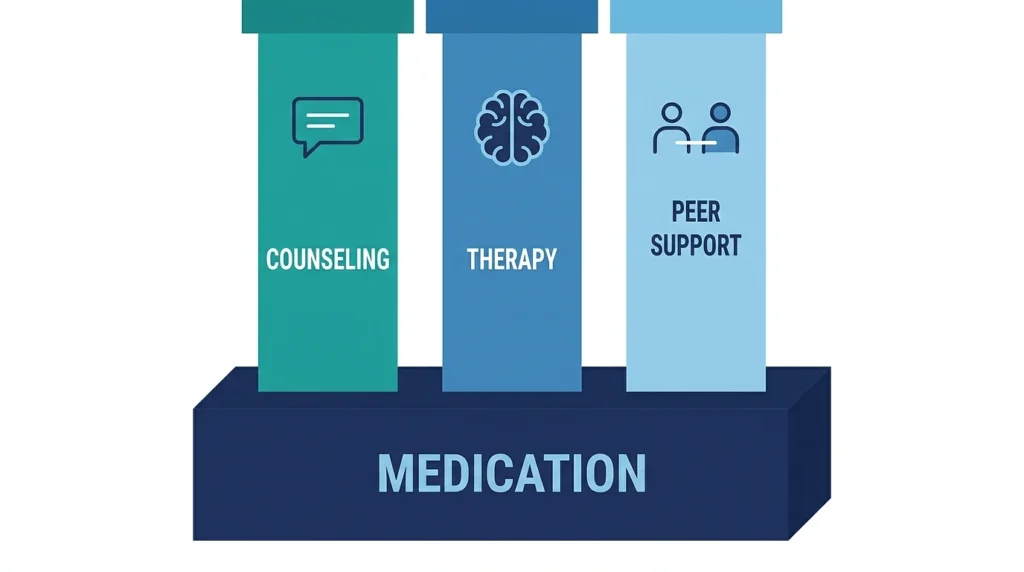
- It treats the receptor problem, not the reasons someone used. Counseling, therapy, and peer support carry the psychological support load, and the research base treats medication as the foundation of care, not the totality of it.
- Side effects are real if usually manageable: constipation, headache, nausea, insomnia, sweating. Most fade; persistent ones are a dose conversation with the prescriber, not a reason to quit cold.
- Stopping is its own medical project. The Sordo data showed mortality risk climbs sharply in the weeks right after leaving treatment, which is the strongest argument that any taper should be slow, planned, and supervised rather than declared one frustrated morning.
- There’s no fixed graduation date. Some people take it for a year, some for many years, and the evidence favors staying on it as long as it’s working over racing toward an abstinence deadline set by someone else’s opinion.
The thin version of articles like this one usually closes with an invented success story, a “John” who found his way back in three tidy paragraphs. You don’t need John. The 749,000 people in the mortality data are the story, and they didn’t get to be composite characters.
If any of this is personal for you or someone you love, the conversation to have is with a prescriber, and SAMHSA’s free, confidential helpline at 1-800-662-4357 runs around the clock and can point you to treatment nearby. The dinner-table pharmacologists can be answered with one line, and you’re welcome to it: the medication keeps people alive at twice the rate of going without it, and staying alive is the entire point.

