


Only if it is running at full speed. And that qualifier turns out to be the entire subject.
Running a pool pump around the clock at high speed wastes energy and money, and most residential pools only need 6 to 8 hours of daily running to stay clean and balanced. But there is a piece of physics underneath pool pumps that makes the hours question almost beside the point, and once you see it, the argument everyone has about runtime looks like the wrong argument.
Why 24 Hour Running is Unnecessary
Turnover is The Target, And It is a Volume Rather Than a Clock
Turnover is the time needed to circulate a volume of water equal to your entire pool desk through the filter once. You only need to turn the total volume over once or twice a day. The residential standard is one complete turnover per eight hours, with saltwater pools typically targeting two per day because the salt cell needs regular circulation to generate chlorine.
The arithmetic is simple. Pool volume divided by turnover hours divided by 60 gives your minimum flow in gallons per minute. A 20,000 gallon pool over eight hours needs about 41.7 GPM.
Everything past your turnover target is water you have already cleaned, moved around again at your expense.
The Cost Difference is Immediate
Cutting run time from 24 hours to 8 reduces daily electricity use by roughly 66%, which is straightforward arithmetic on a pump that draws the same wattage every hour it operates. On a single speed motor pulling 1,500 to 2,000 watts continuously, those sixteen extra hours are pure expense.
Chemistry Does Not Need Round The Clock Circulation
Chlorine distribution and filtration happen effectively during a few focused cycles rather than through constant motion. A properly dosed pool with adequate turnover holds its balance perfectly well between run periods, which is why the six to eight hour guidance exists in the first place.
The Affinity Law, And Why Speed Beats Hours
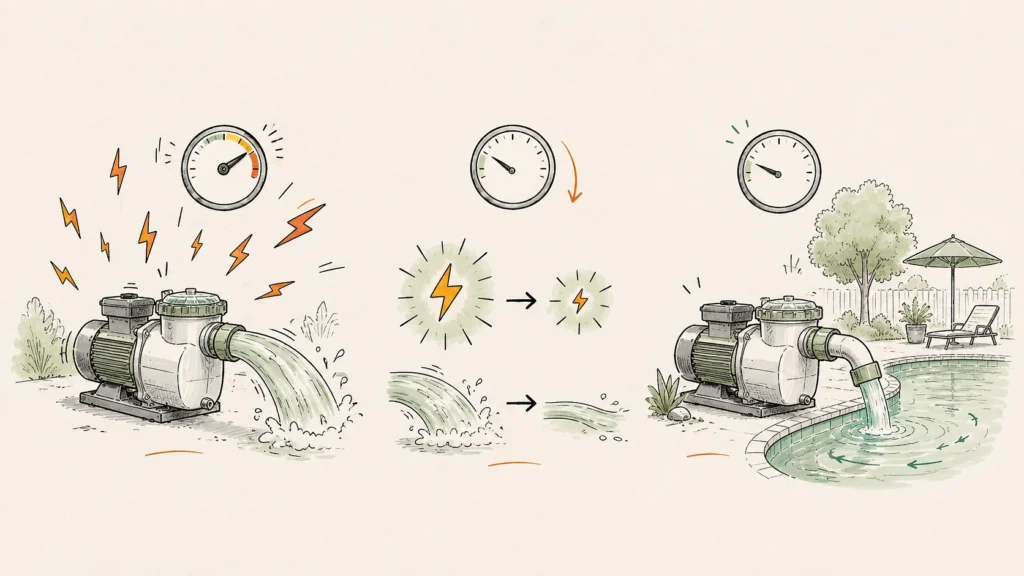
The Relationship is Cubic, Not Linear
Energy needed to move water through pipes scales with the cube of the flow rate. In practice: halve the pump speed and flow halves, but power consumption drops to roughly one eighth.
That is fluid dynamics rather than a marketing claim, and it is the single most useful fact a pool owner can hold.
What it Does To The Runtime Question
Run a single speed pump at 3,450 RPM for eight hours and you have used a great deal of electricity. Run a variable speed pump at 1,200 RPM for twelve and you may have used considerably less.
Every hour shifted from 3,000 RPM down to 1,500 RPM is worth roughly eight times the saving of simply switching the pump off for that hour. Which produces the counterintuitive headline correction: a variable speed pump running long hours at low speed can cost less than a single speed pump running only five.
So the wasteful thing was never the hours by themselves. It was the speed those hours were run at.
| Season or setup | Recommended run time | Reasoning |
|---|---|---|
| Summer | 8 to 12 hours daily | Heavy bather load, warm water and strong sun accelerate algae growth and consume chlorine faster |
| Winter | 4 to 6 hours daily | Algae grows slowly in cold water and the pool is not in use |
| Variable speed, any season | Low speed for around 12 hours rather than high speed for 24 | The cube relationship makes long and slow the cheapest way to hit turnover |
| Single speed | Start at 6 hours, increase in half hour steps if water clouds | Every hour is expensive with no low speed option available |
The variable speed row is where the real money is. A tuned multi speed schedule averages around 350 watts across the day against 1,500 to 2,000 for a single speed motor, which works out to roughly $286 a year versus $530 on a 20,000 gallon pool at around $0.16 per kWh.
The Upgrade Mistake That Cancels the Savings
A common and expensive error is replacing a single speed pump with a variable speed model and then leaving it on the highest preset. That delivers something like 15 per cent savings instead of 65. The hardware does not save money on its own, the schedule does, and it is worth paying an installer to tune it in the first season if the programming is unfamiliar.
For context on the purchase, a quality variable speed pump runs $1,200 to $2,000 installed, putting payback somewhere in the two to four year range depending on your rate and previous run hours. The US Department of Energy now requires variable speed motors on most new residential pumps of 1 horsepower or larger, so when your current pump fails you are likely upgrading regardless.
Constraints That Override The Efficiency Logic
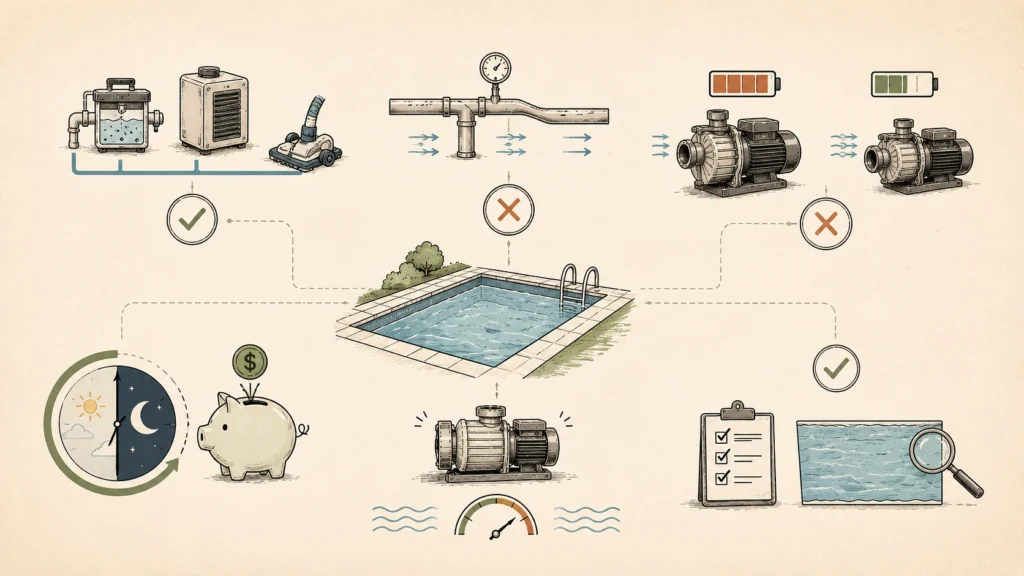
A few things trump pure energy optimisation, and ignoring them causes real problems.
- Downstream equipment has minimum flow requirements. Salt cells, heaters and in floor cleaning systems each need a certain flow to function, and running below it means no chlorine generation or a heater that will not fire. Check the specification on every attached piece before finalising a schedule.
- Your plumbing caps effective flow whatever the pump is capable of, so a larger pump does not automatically move more water.
- Oversized pumps waste energy even on variable speed and push water through the filter too fast, which reduces filtration quality.
- Rate structure matters. On a time of use tariff, shifting low speed running into cheap overnight hours is free money.
- Let the water tell you. If it clouds after a reduction, add half an hour at a time rather than jumping back to the old schedule.
The real story here is that pool owners have spent decades arguing about hours when the variable controlling the bill is RPM. Hit your turnover target at the lowest speed that achieves it, adjust the hours by season, and the twenty four hour question mostly answers itself.
If you share your pool size in gallons and your pump type, single speed or variable speed, I can work out your exact potential savings and put together a custom daily schedule.

