


There’s a reason the watch a man buys after his first big promotion is so often a Rolex, and it isn’t just marketing. The brand really does run a ladder. One catalog, a rung for nearly every budget between a good used car and a small house, and a design language consistent enough that the £5,900 watch and the £40,000 one are recognizably siblings. You can climb the whole thing over a working life without ever leaving the crown.
What the ladder metaphor hides, and what almost every article like this one politely skips, is that Rolex no longer lets you climb it at will. The steel sports models everyone wants are allocated, not sold, and your authorized dealer decides who gets one. So this guide does two jobs. The traditional one, matching watches to career stages, and the honest one, telling you which rungs you can actually reach by walking into a store with money.
Starting Out: The Oyster Perpetual Is The Whole Brand In One Watch
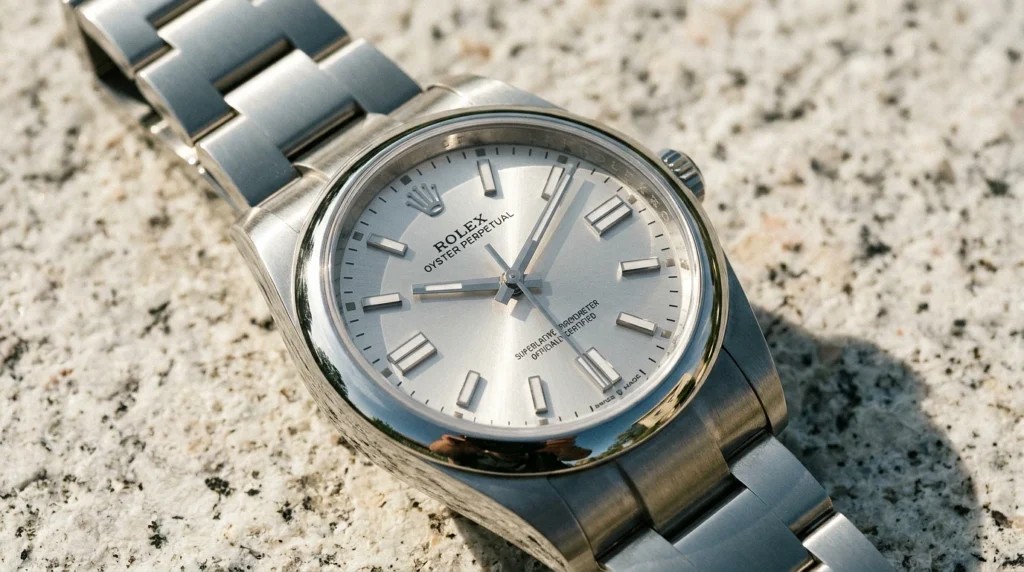
Skip the old advice about the “Oyster Date,” which hasn’t been a current model in years. The real entry point today is the Oyster Perpetual, and calling it entry-level undersells what you’re getting. It’s a time-only watch built on the same Oystersteel case architecture, the same in-house chronometer-certified movement family, and the same bracelet quality as everything above it. What it lacks is a date window and pretense.
On Rolex’s own UK price list, the Oyster Perpetual 41 in Oystersteel is £5,900, with the smaller sizes starting at £5,250 for the 31mm. That’s serious money, and it’s also, by a wide margin, the cheapest way to own the thing Rolex actually sells, which is a hundred years of the waterproof Oyster case. The line even got a birthday present this year: for the Oyster’s centenary, Rolex introduced a yellow Rolesor version and a new Jubilee gold alloy, the first time in ages the humble OP has been the news.
The Air-King and the Datejust round out this tier. The Datejust in steel is the single most versatile watch the company makes, jeans on Saturday, a suit on Monday, and nobody has ever looked at one and thought less of its owner. If your career is young and the budget is real but finite, the honest advice is a steel Datejust or an OP with the dial color you actually love, and no apologies to anyone.
One practical note that belongs in this section because this is when you’ll learn it: these models you can generally buy. Walk in, try on, pay, leave wearing it. Hold that thought.
Climbing: The Explorer, And A Moment Of Silence For The Milgauss

The original draft of this genre always recommends two watches here, the Explorer and the Milgauss, and one of them no longer exists. Rolex discontinued the Milgauss in 2023, ending the run of its charming anti-magnetic lightning-bolt oddball, so if the green-crystal scientist’s watch calls to you, that’s now a pre-owned purchase, and prices reflect its new scarcity.
The Explorer remains, and it might be the best value in the sports catalog. This is the lineage that went up Everest with the 1953 expedition, a three-hander with no fuss, no bezel to argue about, and a case that slides under any cuff. It’s the sports Rolex for people who don’t need the room to know they’re wearing one. Rolex also added an entirely new model line in 2025, the Land-Dweller, its first genuinely new family in over a decade, which tells you the middle of the catalog is where the company is spending its ambition right now.
This tier is also where the allocation game begins, mildly. Explorers come and go from display cases. You may wait, but you won’t wait years.
Mid-Career: The Core Sports Models, And The Truth About Buying Them

Here’s where every version of this article lists the Submariner, the Sea-Dweller, and the GMT-Master II, and the listing is fine. The Sub is the most influential dive watch ever made. The Sea-Dweller is its heavier professional sibling, and, small correction to the usual copy, they are not near-identical in size: the Sea-Dweller runs 43mm to the Submariner’s 41mm, and on the wrist that difference is not subtle. The GMT-Master II earns its place in any collection because a second time zone is the one complication a working traveler genuinely uses, and the two-tone bezels are the most charismatic objects Rolex makes.
Now the part the celebratory articles skip. You cannot, in any normal sense, walk into an authorized dealer and buy a new steel Submariner, GMT, or Daytona. These models are allocated to established clients, and the waiting lists, where they officially exist at all, run long, opaque, and heavily influenced by your purchase history at that boutique. This is not a complaint, it’s a market description, and it changes the strategy. The realistic paths are three: build a relationship with a dealer over years and purchases, buy pre-owned and pay the market’s premium over retail, or want the watches nobody’s fighting over. There’s no shame in any of the three, but nobody should plan a promotion gift around a watch the store won’t sell them.
And the Daytona, the traditional summit of this section, is the steepest case of all. Rolex’s chronograph is the brand’s flagship sports watch, the one with Paul Newman’s ghost attached and a movement Rolex rebuilt from scratch as recently as 2023, and at retail it is functionally a rumor. Pre-owned is how most Daytonas actually change hands, at prices that make the list price look like a typo.
Retirement: The Day-Date, Because The Day Of The Week Is Now The Point
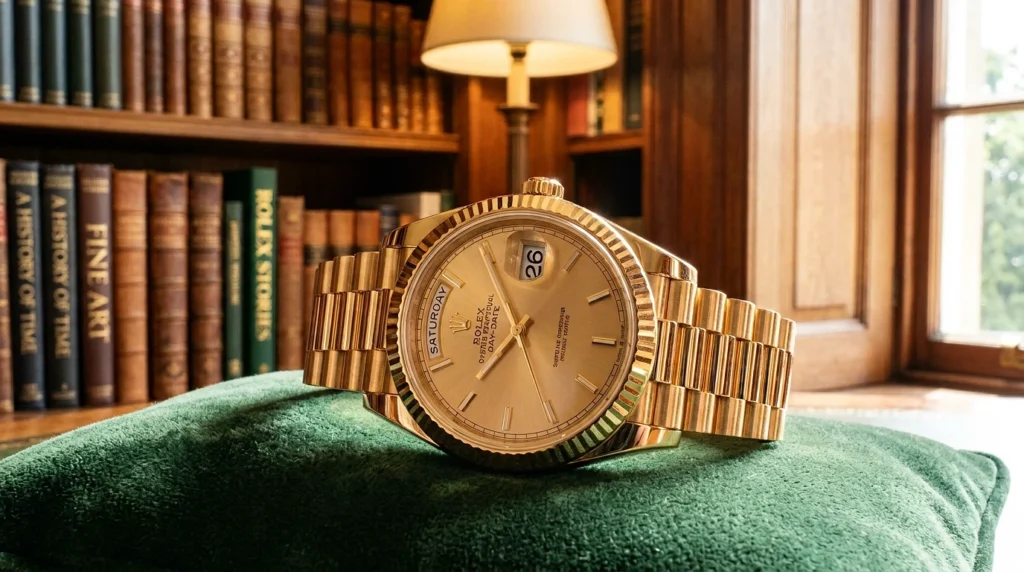
The Day-Date has been the finish-line Rolex since 1956, when it became the first wristwatch to spell the day of the week out in full, and there’s a wonderful retirement joke buried in that complication, it exists for people whose Tuesdays feel like Saturdays. It comes only in precious metals, gold or platinum, always on the President bracelet built for it, and the current Day-Date 40 runs the calibre 3255 with a 70-hour power reserve. Yellow-gold references typically sit in the low-to-mid forty-thousands in dollars, which is to say several Oyster Perpetuals deep, and platinum climbs from there. White gold is the connoisseur’s version, all the weight and none of the announcement.
The Sky-Dweller, with its annual calendar and dual time zone, is the alternative for the retiree who still crosses oceans, and the old advice about revisiting the Submariner or GMT in gold holds up, a gold sports Rolex is a completely different animal from its steel twin, heavier, warmer, and unbothered about being noticed. This is also, frankly, the stage of life when the allocation game gets easier, because decades of relationship and a precious-metal budget are exactly what the boutique was waiting for. There’s something almost too neat about that: the ladder finally offers you every rung at the moment you’ve stopped needing the climb to mean anything, and you’re free to just enjoy what the years bought.
Buy the one that makes you check your wrist when you already know the time. That’s the entire secret, at every salary.

