


The salesman dipped a probe into a glass of my tap water and the little meter screamed 240. He let the number sit there between us, nodding slowly, the way you’d nod at an X-ray. Then he dipped it into water from his $2,800 filtration system 12. “That,” he said, “is what your family is drinking.” What he didn’t mention is what the meter actually measures, which is dissolved solids, which in most tap water means calcium and magnesium, the same minerals sold in bottled mineral water at a premium. His machine had removed the minerals. The scary number was mostly nutrition.
I didn’t buy the machine, but I did go home and spend a genuinely absurd number of evenings learning how water filtration actually works, and here’s the conclusion this whole article unpacks: the science is small, stable, and almost embarrassingly simple, and the price tags are doing their best to hide that from you. There are only four mechanisms in the entire consumer filtration world. Everything on the shelf, from the $25 pitcher to the $3,000 whole-house tower, is one or more of those four in different packaging, and once you know them, plus one boring acronym, you can out-shop every showroom in the country.
The Whole Science: Four Mechanisms
Physical Straining:
The simplest one water passes through a barrier with holes smaller than the stuff you want caught. Sediment filters do this for sand, rust, and grit, rated in microns, and finer versions catch cysts and other microorganisms. It’s a sieve. A precise, well-engineered sieve, but a sieve, and it does nothing about anything dissolved.
Activated Carbon:
The workhorse of the industry, and the entire reason cheap filters work as well as they do. Activated carbon is carbon processed to be fantastically porous, a single gram carrying a surface area measured in football fields, and contaminants stick to all that surface as water passes through. Carbon is superb at chlorine and its by-products, which is to say it’s superb at taste and smell, and well-made solid carbon blocks can also be engineered to reduce lead and various organic chemicals. Its honest limits: it largely ignores dissolved minerals, salts, nitrates, and fluoride, and a saturated carbon filter stops working without announcing it, which is why replacement schedules are the least glamorous and most important spec on the box.
Reverse Osmosis:
The heavy artillery. Water is pushed against a membrane with openings so small that essentially only water molecules pass, leaving dissolved metals, salts, and most everything else behind to be flushed away. RO is the mechanism that genuinely earns the phrase “removes almost everything,” and it comes with equally genuine costs: it’s slow, it sends a portion of water down the drain as reject, it needs its pre-filters and membrane maintained, and it strips the harmless minerals along with the harmful ones, which is exactly how my salesman got his impressive 12.
Ion Exchange and UV:
The specialists. Ion exchange swaps unwanted ions for benign ones, which is how water softeners trade hardness minerals for sodium, and it’s useful against certain metals. Ultraviolet light doesn’t remove anything at all; it scrambles the DNA of bacteria and viruses so they can’t reproduce, which makes it the tool of choice for microbiologically risky water, typically wells, and pointless for treating chlorinated city water that arrives already disinfected.
That’s it. That’s the science, all of it, and nothing in the showroom transcends it. The $2,800 tower was a sediment filter, carbon, and an RO membrane, three of the four mechanisms, available in an under-sink unit for a fraction of the price. The rest of the money was buying cabinetry and the demonstration.
The Boring Acronym That Beats Every Brochure
Here’s the single most valuable shopping fact in this article. Independent bodies certify filters to numbered NSF/ANSI standards, and the certifications say exactly what a unit is proven to do, contaminant by contaminant. The map is short: Standard 42 covers aesthetics, chlorine, taste, odor. Standard 53 covers health claims, lead, cysts, specific chemicals, each one listed individually. Standard 58 covers reverse osmosis systems, 55 covers UV, and 401 covers a list of emerging contaminants like trace pharmaceuticals.
The trick is that certification is per-contaminant, not per-vibe. A filter “tested to NSF standards” in the marketing copy is a very different creature from a filter “certified to NSF/ANSI 53 for lead reduction” on the datasheet, and the second phrasing is the only one that means anything. So the entire luxury question collapses into one move: ignore the front of the box, find the certification listing, and read which standards and which contaminants the unit actually carries. A $30 pitcher certified for the thing in your water beats a $500 system certified for nothing in particular, and this is not a close call.
The Tricks the Price Tags Play
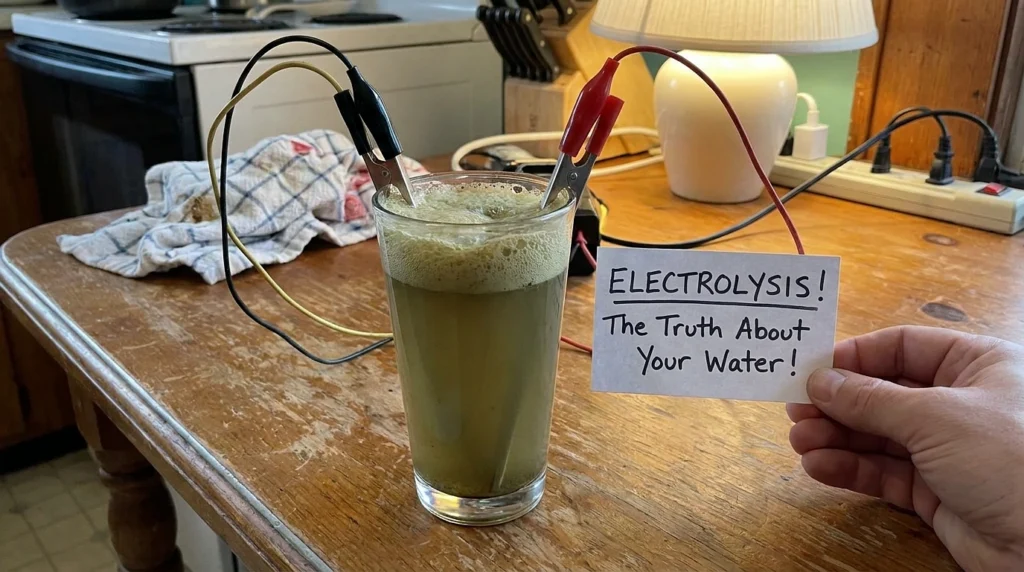
Knowing the four mechanisms also inoculates you against the sales floor, because the expensive pitches are surprisingly repetitive. The TDS meter demo you already met: a number that mostly measures minerals, deployed as if it measured danger. Its cousin, the electrolysis demonstration, where a device turns your tap water an alarming swampy color, is a chemistry parlor trick driven largely by the minerals in the water reacting with the device’s own electrodes. Then there’s the vocabulary tier: alkaline, ionized, structured, hydrogen-enriched, terms that decorate the priciest machines and attach to health claims the evidence doesn’t support. None of those words names a filtration mechanism. When a water product’s pitch is about what it adds rather than what it removes, you’ve left filtration and entered the supplement aisle.
The subtler trick is the razor-blade model: a reasonably priced unit locked to proprietary replacement cartridges at extraordinary markups. Since replacement cadence is where filtration lives or dies, the honest comparison between two systems is never the sticker price, it’s the certified performance divided by the yearly cartridge cost, and running that math in the aisle reshuffles the entire shelf.
Match the Filter to Your Water, Not to Your Anxiety

The final simplification, and the one that saves the most money you’re not filtering “water,” you’re filtering your water, and you can find out what’s in it before spending anything. If you’re on a municipal supply, your utility publishes an annual water quality report, free, listing what was detected and at what levels. If you’re on a well, an inexpensive lab test does the same job and is genuinely worth doing, since wells are where the microbial and nitrate surprises live.
Then the matching is almost mechanical. Chlorine taste and odor: certified carbon, and a pitcher or faucet unit is honestly enough. A specific health contaminant like lead: a carbon block or RO unit certified to Standard 53 or 58 for that exact contaminant. Hard water scale: a softener, which is a comfort purchase, not a safety one. Well water with biological risk: UV plus appropriate pre-filtration. Nothing detected and the water tastes fine: the correct system is possibly none, a sentence no showroom will ever say out loud.
The salesman’s machine, I later worked out, would have been the right purchase for approximately none of what was in my water, which contained no lead, no nitrates, nothing but chlorine and those scandalous minerals. A certified carbon block under the sink fixed the taste for about two percent of his asking price, and the meter, if he ever dipped it again, would still scream 240, because the minerals are still there. I’ve made my peace with that. They were never the problem. The number was just the loudest thing in the room, and loud, as it turns out, is the one thing the science never is.

