


Ceiling beam systems offer a striking combination of aesthetic appeal and acoustic performance, making them a popular choice in modern commercial interiors. One example is the MAXISLAT ceiling beam system, a lightweight, fire-rated beam system built for exactly this kind of application. Before specifying a system like this, it helps to understand both how it’s installed and what to consider at the design stage.
Understanding Ceiling Beam System Basics
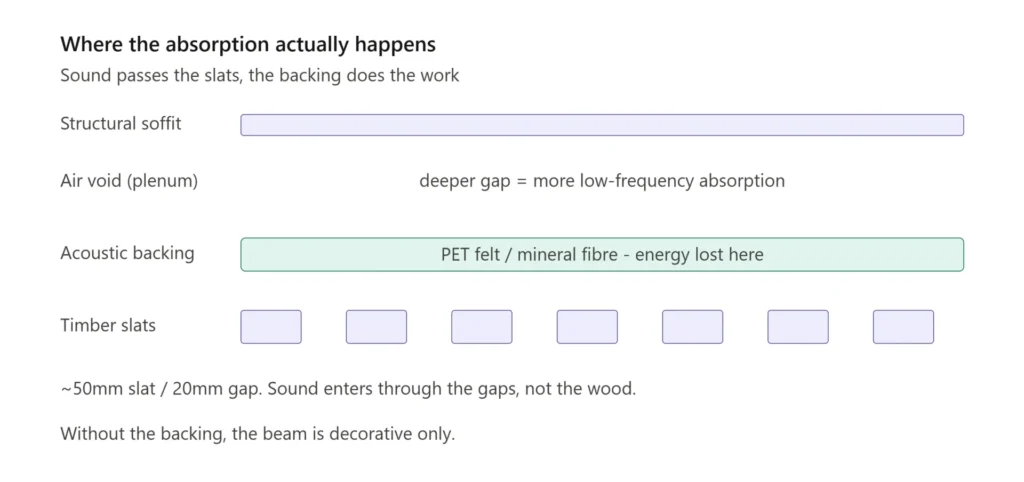
Ceiling beam systems consist of prominently placed beams used to enhance a room’s architectural design, add acoustic performance, or both. Systems like MAXISLAT are lightweight and fully finished off-site with wood-style laminates, designed to create bold visual features such as feature ceilings, rafts and screens without adding structural load or requiring heavy structural support.
Installation Process of Ceiling Beam Systems
Installing a ceiling beam system is a careful process that starts with an assessment of the space to determine beam size, spacing and layout. Installers measure and mark the ceiling to ensure each beam is positioned correctly and symmetrically, then fix suspension brackets or a cleat system, often onto a Unistrut grid, to hold the beams securely in place. Because systems like MAXISLAT are supplied fully finished and ready to install, there’s no on-site cutting, sealing, painting or staining required; the beams arrive factory-finished and are simply lifted into position.
Read the Fire and Acoustic Data as Assembly Numbers, not Component Numbers
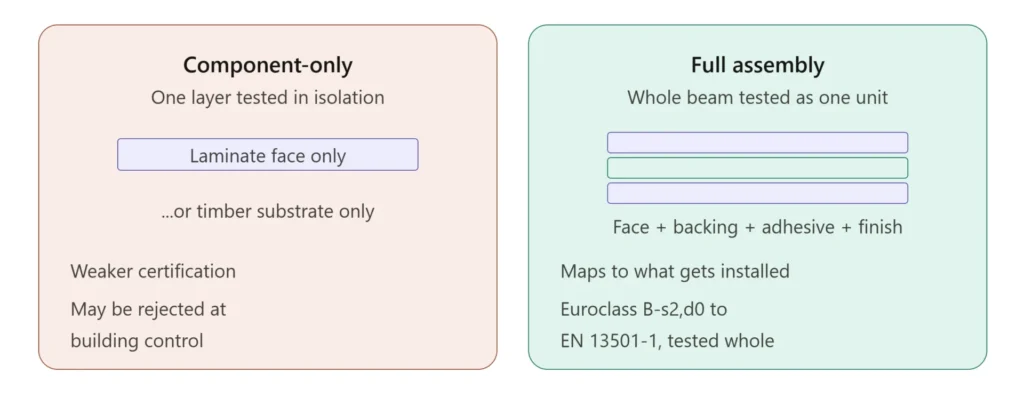
There is a second technical trap and it shows up most often on fire performance, but the same principle applies to acoustic data. A beam system can advertise that it’s components meet Euroclass B-s2,d0 when only the laminate face has been tested or only the timber substrate, not the assembled beam with backing, adhesive and finish layer together.
EN 13501-1 lets you test either way. Vtec publishes assembly testing, the full beam plus backing plus finish, tested as one unit to EN 13501-1 and classified Euroclass B-s2,d0. That’s the only test that maps to what actually gets installed. Component-only certification is weaker and, on a contested project, may be rejected at building control.
For acoustic data, the same logic holds. ISO 354 reverberation room testing measures a specific configuration: the slat profile, the gap width, the backing thickness, the air gap to the soffit above. Change any of those at install and the αw class on the data sheet no longer applies. The number you saw on the brochure was the number for a specific build-up. The number you get in the room is the number for the build-up you actually installed.
The Install Detail That Quietly Costs you a Class
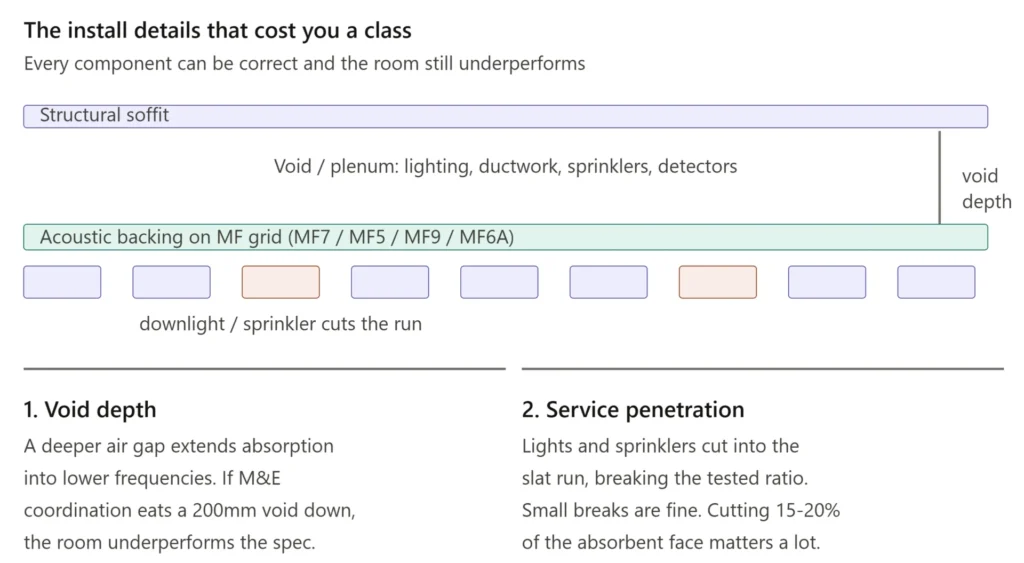
Slatted beam systems hang from the structural soffit, usually on a metal framework. In the UK that’s typically an MF ceiling grid: MF7 primary channels suspended off the soffit on steel angle, MF5 top hats forming the secondary grid and MF9 connecting clips joining the two, with MF6A perimeter channel at the walls. The void between the beams and the soffit, the plenum, is where the lighting, ductwork, sprinklers and detectors sit.
That void depth is part of the acoustic equation. A larger air gap behind a porous absorber extends absorption into lower frequencies. A backing tested at a 50 mm air gap records a different low-frequency curve than the same backing tested tight to the soffit. If the original specification assumed a 200 mm void and the M&E coordination ate into that, the room sounds worse than the αw value on the spec promised, even though every component is correct.
The other quiet cost is service penetration. Lights, sprinkler heads and access panels cut into the run of slats, breaking the slat-to-gap ratio that was tested. Small breaks don’t matter. A reception lobby with recessed downlights cutting through fifteen or twenty percent of the absorbent face matters quite a lot.
Considerations Before Specifying
There are several factors to weigh up before specifying a ceiling beam system. Firstly, consider the overall design theme of the space and choose a finish that complements the existing decor; systems like MAXISLAT offer thousands of standard laminate and colour combinations, plus bespoke options. Acoustic performance is another key consideration, particularly in commercial settings prone to noise, where an acoustic backing option can be added. Fire safety should also be checked carefully: all of Vtec Group’s slat, beam and acoustic systems, including MAXISLAT, are classified Euroclass B, tested as fully assembled units to EN 13501-1 rather than on individual materials alone. Finally, cost and lead times should be factored into project planning from the outset.
Benefits of Ceiling Beam Systems
Ceiling beam systems aren’t just about aesthetics; they also contribute to the environmental quality of a space. Beams can help diffuse light and reduce glare, and with an acoustic backing option they improve sound performance by reducing echo and reverberation. This makes them a strong choice for settings where sound management matters, such as auditoriums, offices, hotels and other commercial venues.
What to Check Before you Sign off
A short list, ordered by what most often goes wrong on real projects:
- Ask for the assembly fire certificate, not component certificates. EN 13501-1 testing of the full assembled beam, with finish and backing, classified Euroclass B-s2,d0 or better.
- Ask for the αw value at the specific configuration you are installing, with the named backing thickness and the air gap depth it was tested at. Don’t accept a single advertised “Class A” figure without the build-up it was measured at.
- Confirm the slat-to-gap ratio in your chosen configuration. If services penetrate more than roughly fifteen to twenty percent of the absorbent face, ask the acoustician what the realistic in-room performance becomes.
- For commercial projects under M&E coordination, check the void depth post-coordination, not on the architect’s original section. The drop ceiling level changes during fit-out more often than the acoustic spec gets revisited.
- Check that the manufacturer offers CAD-led integration for lighting and HVAC cut-outs. Cutting on site without the modelling damages the slat regularity and almost always shows visually.
The systems that get this right are unfussy to specify and forgiving to install. The systems that get it wrong are the ones where the buyer pays for the ceiling that was on the brochure and ends up with the ceiling that was on the data sheet’s worst-case row. The difference is not in the wood, it’s in what sits behind it and what the void around it looks like once the services are in.
Maintenance and Longevity
Ceiling beam systems are generally low-maintenance, though regular inspections help ensure their longevity. Any visible wear should be addressed promptly, and cleaning should be done with non-abrasive products to preserve the factory finish, particularly in environments prone to dust. Having the system professionally installed also increases the likelihood of lasting durability, as installers ensure every aspect of the fit-out meets the manufacturer’s specification and current fire safety regulations.

