


So you’ve booked the consultation and you’re walking in assuming it’s basically a formality, they run some scans, somebody quotes you a price and you pick a date. That’s not what it is. A consultation is a screening built to find reasons to tell you no, and a real chunk of people who go in fully expecting laser surgery come back out having been told they can’t have it, or not yet, or not this version of it.
The ones who get turned away are the reason the safety numbers look as good as they do.
A Cornea Too Thin For The Correction You Want Ends It Before Anything Else Gets Discussed
Reshaping a cornea means taking tissue out of it. Every diopter of correction costs you microns, and whatever’s left underneath has to hold its shape for the next fifty years. If it can’t, you get ectasia, progressive bulging and thinning of the cornea, and that is considerably harder to live with than the nearsightedness you walked in with.
The working numbers go roughly like this. A normal cornea runs about five hundred forty to five hundred fifty microns through the center. The FDA-suggested floor for what stays underneath is two hundred fifty microns, though plenty of surgeons hold themselves to three hundred because they’d rather carry the cushion. Percentage of tissue altered generally stays under forty percent. A lot of surgeons also want preoperative thickness above five hundred microns, and I’d flag that the evidence for that particular cutoff on its own is thinner than how confidently you hear it repeated.
So why can’t a clinic just tell you over the phone whether you qualify?
Because thickness only means anything measured against how much correction you need. A thin cornea with a mild prescription is often perfectly workable. A thick cornea with a very high prescription can still fail the arithmetic. The two numbers are useless apart.
Most Post-LASIK Ectasia Is Keratoconus That Was Already Sitting There
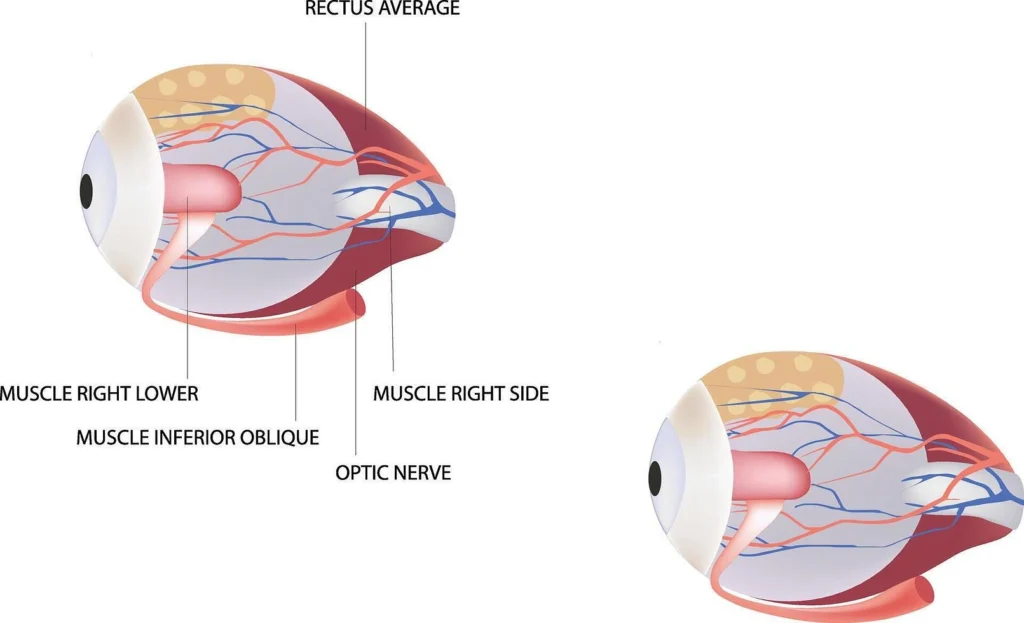
The topography map is the real gatekeeper, and this is the finding that should reorganize how you think about the risk.
Corneal tomography images the front and back surfaces both, and it’s still the most accepted screening method there is. What it mostly exists to catch is keratoconus before somebody operates on top of it. Around one in two thousand people have it naturally, and the dangerous version is subclinical, sometimes called forme fruste, meaning no symptoms yet and it can slide past basic testing if nobody is genuinely looking.
Here’s the part almost nobody hears. The laser didn’t conjure the disease out of nothing. It removed the tissue that was holding a weak cornea together. Ectasia after LASIK is now largely understood as progression of something that was already present and undetected.
Which is why an irregular topography map outranks every other disqualifier on the list, and why a clinic without proper tomography isn’t screening you. They’re guessing with expensive equipment.
Everything Else That Gets You Deferred Rather Than Declined
Stability accounts for most of it. If your prescription moved noticeably in the past year you’re a moving target, correcting to a moving target guarantees you drift back, and in one review of canceled candidates unstable refraction was the single leading reason among the lower-risk patients. Age matters here mostly through that, which is why the early twenties are often just too early.
Past that, the list runs through significant dry eye, which is usually a defer rather than a no because surgery reliably makes dry eye worse before better. Autoimmune and connective tissue conditions, so Sjögren’s and lupus and rheumatoid arthritis, because they impair healing and wreck the ocular surface. Active eye disease, meaning glaucoma, uveitis, a significant cataract, herpes simplex or zoster keratitis, blepharitis, anything infected or inflamed. Pregnancy and breastfeeding, where the hormones move your refraction and you simply wait it out. And very high prescriptions where the tissue budget doesn’t stretch, in which case the honest move is a referral toward implantable rigid contact lenses instead of forcing the laser to do a job it can’t.
PRK Is The Standard Answer For Thin Corneas And Contact Sports, Not The Budget Version Of LASIK
The marketing wants these read as good, better and best. They’re three different tools, and your cornea usually picks for you.
LASIK cuts a hinged flap, lifts it, reshapes the tissue underneath with an excimer laser, then lays the flap back down. The flap is why recovery is so fast, you’re often seeing functionally by the next morning without much discomfort. The flap is also its one structural weakness, because it never fully heals back to original strength. That’s a lifelong consideration if you take hits to the face for work or for fun.
PRK skips the flap. It removes the surface layer, reshapes the cornea directly, and lets the epithelium grow back across several days. No flap means no flap complications and more corneal strength preserved, which is exactly why it’s standard for thinner corneas, for contact sports, and for military and law enforcement candidates. The cost is genuinely unglamorous. Several uncomfortable days, and vision that sharpens over weeks instead of overnight.
SMILE uses a femtosecond laser to carve a small lens-shaped piece of tissue inside the cornea and pull it out through a tiny incision. No flap, less disruption to the corneal nerves that drive a lot of post-op dry eye, and in principle a stronger structural result than LASIK. The tradeoffs are a narrower range of treatable prescriptions and more awkward enhancements later, since there’s no flap to lift if you need a touch-up.
If you’ve got the thickness and no contraindications, all three will probably land you somewhere similar visually. The choice gets made by your cornea and your life, not by which one launched most recently.
The FDA’s Own Study Found 43% Picked Up A New Visual Symptom And 98% Were Still Satisfied
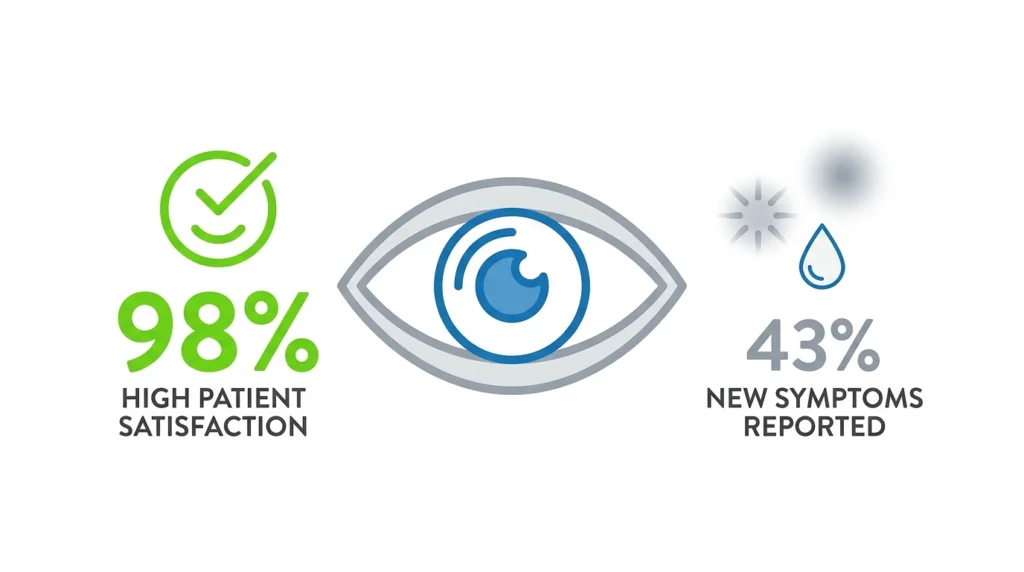
This is where the marketing and the actual research part ways, and the research is far more useful to you.
The FDA, the National Eye Institute and the Department of Defense ran the LASIK Quality of Life Collaboration Project, producing the PROWL-1 and PROWL-2 studies across five hundred thirty-four patients, published in JAMA Ophthalmology and summarized by the American Academy of Ophthalmology. Both halves of it are true simultaneously, which is why it gets cherry-picked in both directions.
Satisfaction landed in the ninety-six to ninety-eight percent range. Dissatisfaction with vision ran one to four percent, dissatisfaction with the surgery itself one to two percent. Overall prevalence of visual symptoms actually went down after surgery, and that surprises people, because glare and halos and starbursts and ghosting were already common before surgery among contact lens and glasses wearers and nobody ever mentions that part.
And yet plenty of people picked up something new. Among participants who had no such symptoms going in, forty-three percent in PROWL-1 and forty-six percent in PROWL-2 reported at least one new visual symptom at three months. Around twenty-eight percent with normal tear scores at baseline had mild, moderate or severe dry eye at that same mark. Under one percent reported symptoms bad enough to interfere with daily life.
So most people come out better off and genuinely thrilled, a meaningful minority pick up a halo or a dryness they didn’t have, usually mild and usually easing across three to six months, and a very small number end up with something that bothers them for good. If a clinic tells you it’s risk-free, they are contradicting a government study their own industry helped run. That tells you plenty about the clinic.
Laser Surgery Does Not Stop Reading Glasses At Forty Or Cataracts Later
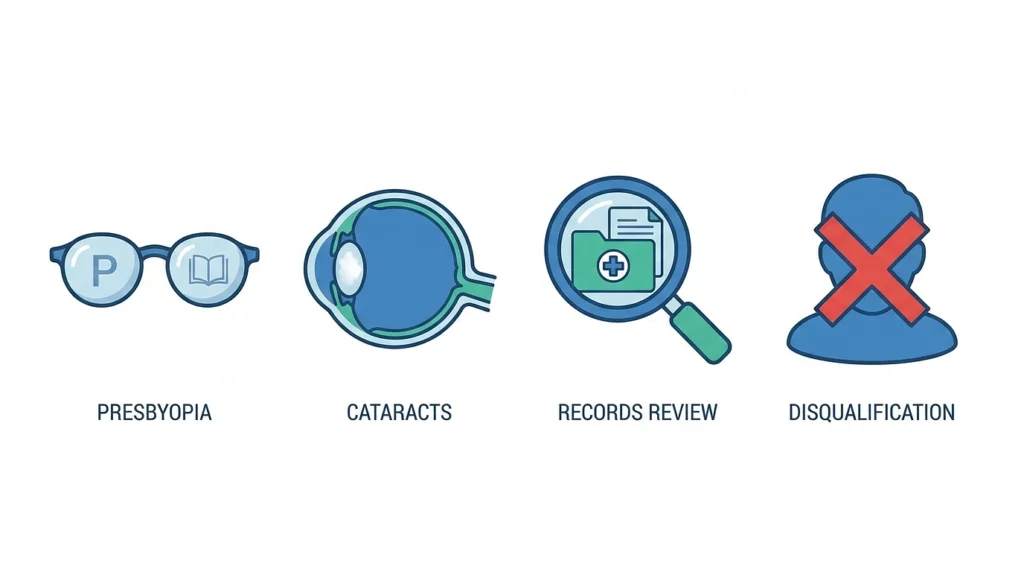
Presbyopia is the lens inside your eye stiffening with age, and corneal surgery doesn’t touch it. Fixing your distance vision at thirty-two buys you no exemption from readers at forty-five, and anyone implying otherwise is selling.
Cataracts are the same lens with a different problem, still on the way. Laser surgery doesn’t prevent it, and it does make the lens calculations for future cataract surgery trickier, so keep your surgical records somewhere permanent. A surgeon will genuinely want them decades from now.
If you’re very nearsighted, your raised risk of retinal detachment and myopic degeneration comes from the shape of your eyeball, and reshaping the front surface changes none of it. Dilated exams stay on the schedule.
Existing dry eye gets treated before surgery or it gets worse after. There is no third option there. And no result is guaranteed either, enhancement rates are real, so the possibility of a second procedure should be priced and discussed before you agree to the first.
Ask them what they found that gave them pause, and what would make them decline to operate on you. A surgeon with a real screening practice has that answer ready, because they turn people away most weeks. Someone who says there’s nothing either hasn’t looked properly or isn’t planning to tell you. Getting disqualified stings for about a week, and it also means the system did exactly what it was built to do.

