


The rules changed shipping from the USA to Europe on 1 July 2026, and a lot of shipping advice written before that date is now wrong.
Until 30 June 2026, parcels valued at €150 or less entered the EU free of customs duty. That exemption is gone. In its place sits a temporary flat customs duty of €3 per item, introduced under Council Regulation (EU) 2026/382 and scheduled to run until 1 July 2028, when the EU Customs Data Hub comes online and normal tariff-based duties take over.
What did not change is the thing most Americans get wrong in the other direction. Import VAT has applied from the first euro since July 2021. There is no small-parcel VAT exemption and there has not been one for years.
The EU’s One Customs Rule
A Single Customs Territory With One Entry Point
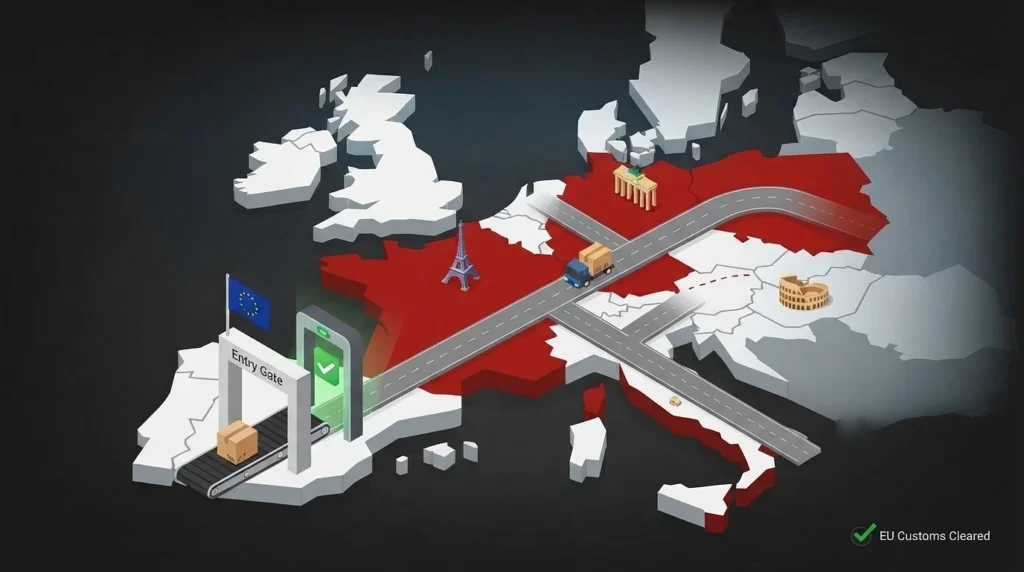
The European Union operates as a single customs territory under the Union Customs Code. A parcel arriving from the USA clears customs in the first member state it enters, and once cleared it moves freely to any other member state without further border formalities.
That is genuinely simpler than shipping to twenty seven separate countries. It also means the clearance experience depends heavily on which country the parcel lands in first, which is why carrier routing matters more than people expect.
Every Commercial Item Needs a Declaration
There is no informal threshold. Every commercial consignment requires an electronic customs declaration carrying the intrinsic value, a goods description and a tariff code.
Intrinsic value is a term worth knowing precisely. It means the price of the goods alone, excluding shipping, insurance and other fees. A $140 item with $30 shipping has an intrinsic value of $140, which keeps it inside the low-value regime.
Bad descriptions and wrong tariff codes are the most common cause of clearance delays. “Gift” and “sample” are not descriptions and customs authorities treat them as red flags.
The VAT That Differs by Country
Customs procedure is centralised. VAT is not. The applicable rate is set by the destination country where the recipient lives, and the spread across the EU is wide.
| Destination | Standard VAT rate |
|---|---|
| Luxembourg | 17 per cent, the EU’s lowest |
| Germany | 19 per cent |
| Netherlands, Spain, Belgium | 21 per cent |
| Denmark, Sweden | 25 per cent |
| Hungary | 27 per cent, the EU’s highest |
That is a ten point spread on identical goods. The same $200 order costs meaningfully more to receive in Budapest than in Luxembourg City, and neither the seller nor the buyer can choose which rate applies. It follows the recipient’s address.
The €22 Exemption is Long Gone
The old rule exempting parcels under €22 from import VAT was abolished on 1 July 2021. Advice referencing it is five years out of date, and the assumption that small parcels slip through is the single most common source of surprise charges.
IOSS is What Prevents The Surprise
The Import One-Stop Shop lets sellers register once in the EU and collect the correct destination-country VAT at checkout for consignments valued at €150 or under.
For a buyer, an IOSS-registered seller means the VAT is settled before the parcel ships, the customs declaration references the IOSS number, and the package moves through clearance without being held for payment. It is the difference between a smooth delivery and a text message demanding money from a carrier.
The €3 Duty, And The Detail That Catches Sellers Out
It is Per Item, Not Per Parcel
This is the most commonly misreported point in coverage of the change, so read it carefully.
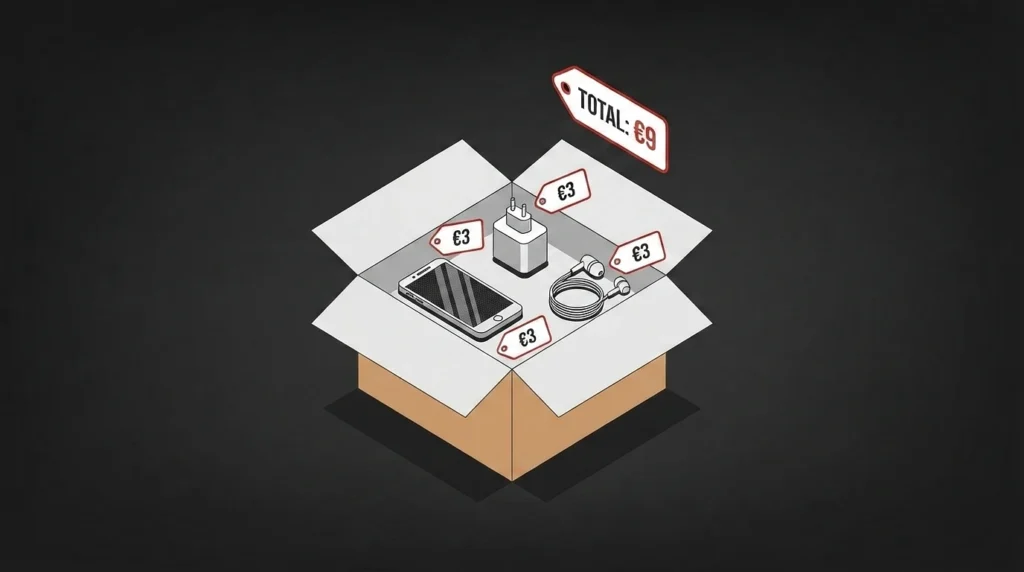
The €3 applies per item by tariff classification, not once per parcel. A parcel containing a smartphone, a charger and a pair of earphones contains three distinct tariff headings and attracts €9 in duty. Multiple identical units of the same heading attract the duty per unit.
For a seller shipping multi-item orders from the USA, that turns a predictable €3 into an unpredictable multiple, and it is worth modelling before setting checkout pricing.
What is in Scope And What is Not
- In scope: goods in consignments up to €150 sold in distance sales to EU consumers, regardless of VAT scheme.
- Not in scope: B2B imports by VAT-registered businesses, which continue under standard tariff rules.
- Not in scope: genuine consumer-to-consumer parcels between private individuals, under existing thresholds.
- Unchanged: consignments over €150, which were never covered by de minimis and continue to attract normal customs duty by tariff classification.
- Excluded: goods benefiting from preferential trade agreements or Customs Union measures.
One Correction Worth Making
The European Commission is explicit that the €3 duty is levied on businesses, meaning the seller, importer or their representative, rather than being collected from consumers at the door. The Commission has stated plainly that it is not a tax on consumers.
In practice the cost usually reaches the buyer anyway, priced into the goods or the shipping stories. But the legal liability sits with the trader, which matters if you are the one selling rather than the one receiving.
A separate Union handling fee has been proposed to cover customs processing costs. As of now the amount and application date remain undetermined, with autumn 2026 given as the point for that decision. It is a fee rather than a customs duty, and it is not yet in force.
Who Pays What on Arrival
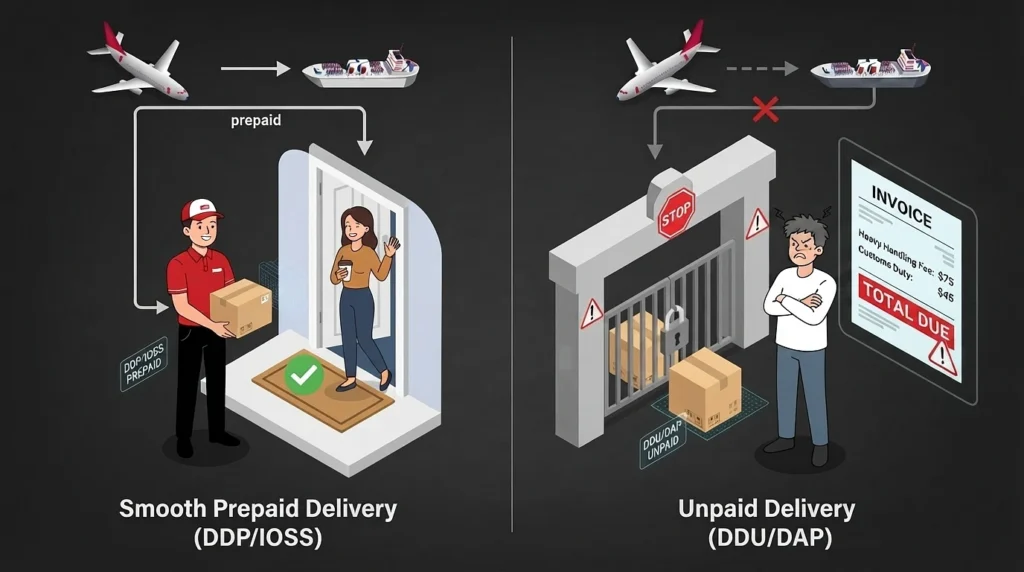
Everything above resolves into one practical question, and the answer depends entirely on how the shipment was set up before it left the USA.
Prepaid, Meaning DDP or IOSS
If the US merchant collected the destination-country VAT and handled the duty at checkout, the recipient pays nothing on arrival. The parcel clears and delivers normally.
This is what any competent cross-border retailer should be offering, and its absence at checkout is a reasonable reason to buy elsewhere.
Unpaid, Meaning DDU or DAP
If nothing was prepaid, the sequence runs like this.
- The carrier or national postal operator holds the parcel at the border.
- They calculate the destination country’s VAT on the goods, and depending on the country, on duty and shipping as well.
- They add a handling or clearance fee, typically €15 to €30, which is the carrier’s charge for fronting the tax and doing the paperwork.
- They demand payment from the recipient before releasing the parcel for delivery.
That handling fee is where the real irritation lives, since it is frequently larger than the tax itself on a modest order. A €40 item into Germany carries roughly €7.60 in VAT and can arrive with a €20 clearance charge attached.
The Practical Checks Before You Ship or Buy
Ask the seller whether they are IOSS registered and whether checkout is DDP. Confirm the declared intrinsic value is accurate, since undervaluation is exactly what these reforms were designed to catch. Count the distinct product types in a multi-item order, because each one carries its own €3. And check the destination country’s VAT rate rather than assuming a European average, since the gap between 17 and 27 per cent is real money.
If you share the destination country, the type of item and its total value in USD, I can work out the estimated VAT and duty you are likely to face.

