


Most people choose a dentist by opening a map, filtering by distance, and booking whichever practice has parking and an evening slot. If that is what you did, you are in the overwhelming majority and the practice you ended up with is probably fine.
The question is whether fine is what you want for a relationship that runs twenty or thirty years and involves your children.
Ask Whether You Will See The Same Dentist Every Visit
This is the question I would put first, ahead of price, ahead of location, ahead of the technology page on their website.
Some practices assign you a dentist. Others book you with whoever has availability that week. Both are legitimate business models and neither is advertised, so you have to ask, and the answer changes what you get from every subsequent appointment.
Here is why it matters more than it sounds like it should. Dentistry is mostly about noticing change. Is that shadow on the X-ray new. Is that gum recession worse than last year or the same. Has that crack in the molar moved. A dentist who has looked at your mouth eight times can answer those. A dentist reading your notes for the first time is working from somebody else’s description of what things looked like, which is not the same thing at all, and in a busy practice they have about four minutes to do it.
For adults with healthy mouths this rarely bites. For children, for anyone with gum disease, for anyone whose teeth are heavily restored already, it bites constantly.
The Six-Month Rule is Weaker Than Everyone Assumes
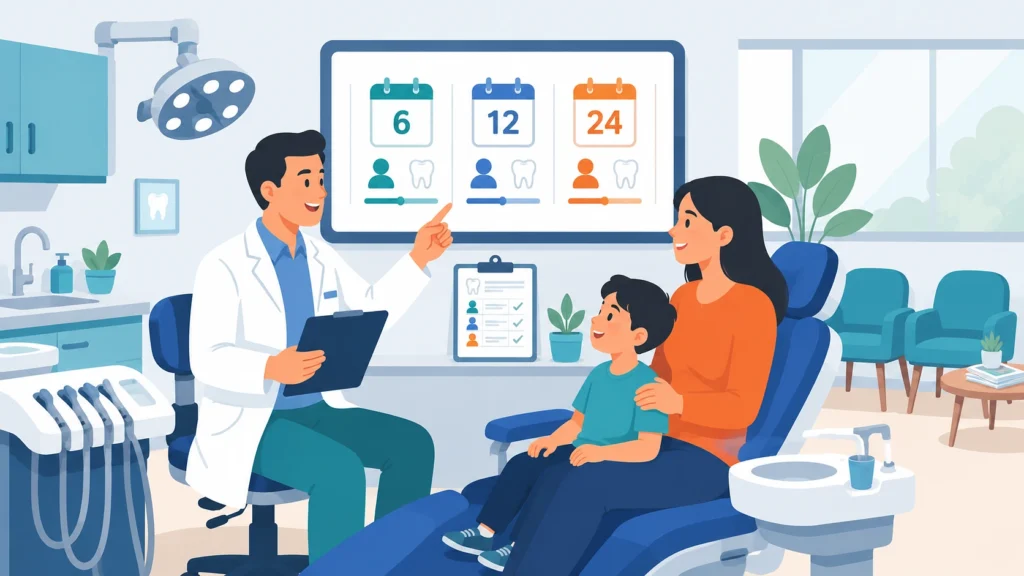
Worth knowing before you build your family’s schedule around it.
Six-monthly checkups became standard practice a very long time ago, well before anyone tested whether six months was the right number, and for most of the intervening centuries did test it. When it finally got a proper trial, a four-year randomised study in UK dental practices comparing six-monthly against 24-monthly against risk-based recall, the Cochrane assessment found little to no difference between risk-based and six-monthly recall in tooth decay, gum bleeding or oral health quality of life. Against 24-monthly, moderate-certainty evidence again showed probably little to no difference.
I am not telling you to go every two years. Plenty of people genuinely need six months or less, and the trial was in adults who were already regular attenders, which is a specific population.
What it does mean is that the interval is not the thing doing the work. Somebody assessing your actual risk and adjusting accordingly is the thing doing the work, and that requires a dentist who knows you. Which brings you back to the first question.
On Children Specifically
Most adults with dental anxiety got it as children. That is worth taking seriously when you are choosing, because the downside of getting this wrong is not one unpleasant appointment.
It is an adult who avoids dentists for a decade and then needs a lot of work that a filling would have prevented.
I would weight the child experience heavily in the decision even if you are the one who needs the crown. Watch how staff talk to children in the waiting room. Ask what a first visit looks like for a nervous five-year-old. Some practices are genuinely good at this and some are enduring it, and it is usually obvious within ten minutes.
Distance is a Tiebreaker
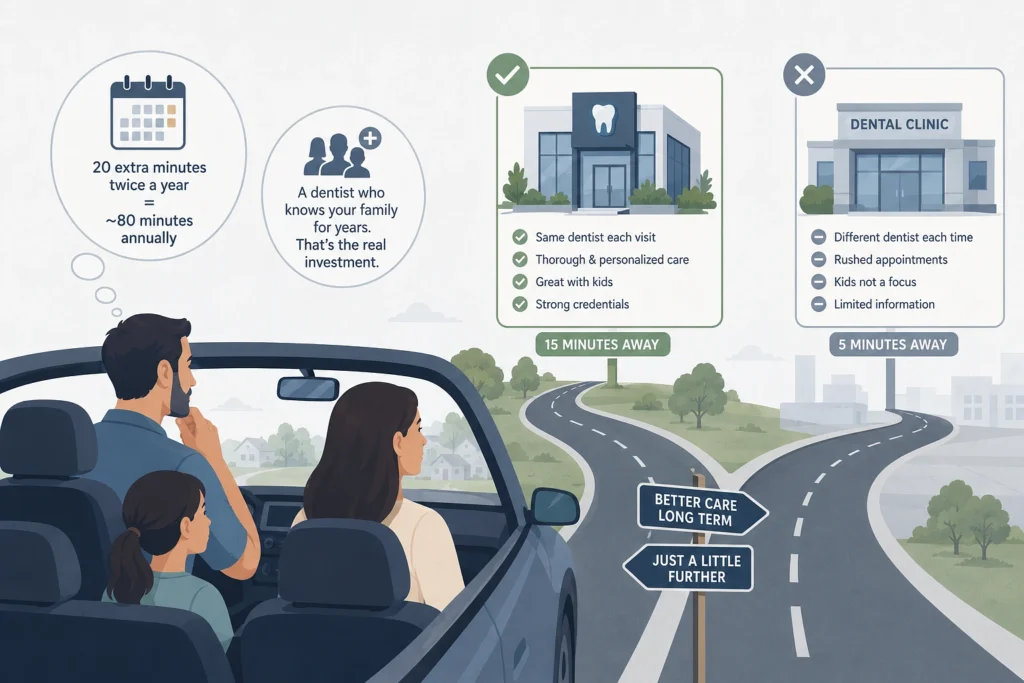
Not nothing. A practice you can actually get to is a practice you actually attend, and attendance matters for anyone with real disease risk.
But it should break ties between practices that already passed the questions above, rather than being the filter you apply first. Twenty extra minutes twice a year is roughly eighty minutes annually. That is not a real cost when weighed against a decade of someone knowing your family’s mouths.
If the good practice is forty-five minutes away through traffic, that calculation changes. Most of the time it is not forty-five minutes. It is fifteen more than the nearest one.
Credentials, Briefly
Board certification where relevant, membership of a body like the American Dental Association, and specialization that matches what your family actually needs are more useful signals. Check any listed affiliation against your own state or country’s licensing body, because a website citing associations from somewhere else entirely is either serving a different market or has borrowed its copy.

