


A friend of mine kept repainting the back of his house. Three times across four years. Every monsoon season the render above the kitchen window would bubble, then streak, then peel off in sheets you could lift with a fingernail. He blamed the paint. Then the painter. Then the paint again.
The real issue was a 40-centimeter run of gutter pitched the wrong way by maybe two degrees. Water pooled at one end in heavy rain, spilled against the wall behind it, and soaked into the render every storm for four years straight. By the time someone bothered to climb up and look, the fascia board behind that section had gone soft enough you could push a screwdriver into it without much effort. The repair bill — replacing the rotten fascia, redoing the affected render, treating the masonry, and finally installing a gutter system that actually drained — came in north of $8,000.
He’d spent maybe $600 on paint jobs trying to fix a $200 gutter problem.
That’s how most gutter failures go. Not dramatic. Not obvious. Just slow water in places water was never supposed to be.
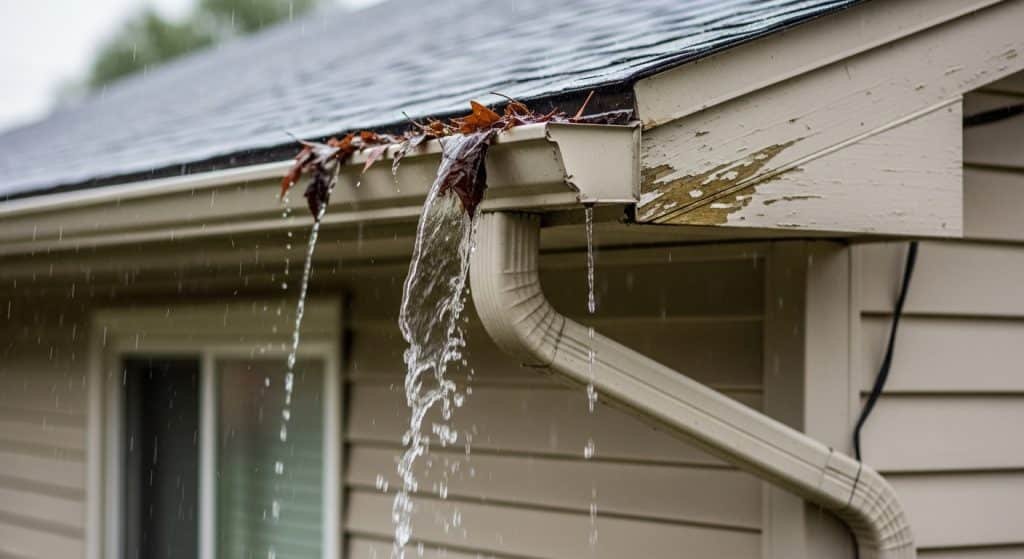
What Actually Fails First (And It Isn’t What You Think)
Most gutter-damage articles begin at the roof and work down. Wrong order. Roofing material is built to take a lot of water before it shows any sign of trouble, which is why the roof is usually the last thing to visibly fail. The stuff that goes first is everything next to where the gutter is dumping water it shouldn’t be.
From the houses I’ve looked at after gutter problems, the failure sequence usually runs like this:
- Fascia and soffit boards. These sit directly behind and beneath the gutter. If water is escaping at a joint or backing up behind a blockage, this wood gets it first. Rot here is silent — you can’t see it from the ground until the fascia starts visibly sagging, by which point it’s been wet for months.
- The render or paint on the exterior wall directly below the overflow. Bubbling, streaking, efflorescence pulling salt out of the masonry.
- The ground at the base of the wall. Soil that should be sloped away from the house starts holding water instead. You’ll see moss, algae, or just a permanently damp patch.
- Then the bigger stuff — foundation movement, interior wall damp, mold inside the wall cavity, roof structure problems.
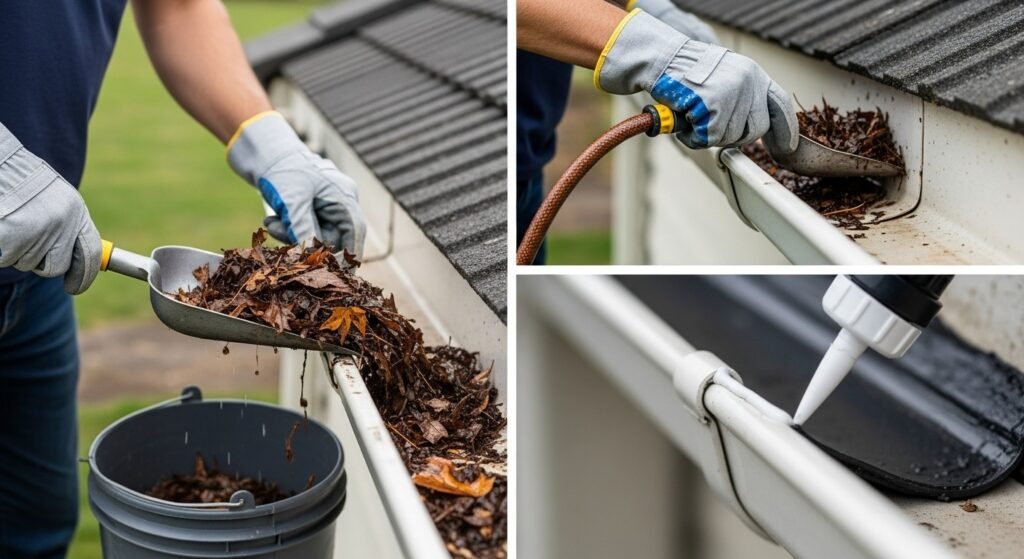
By the time you’re at step four, the bill has four zeros in it. Step one or two, it’s a Saturday afternoon with a ladder.
The Joint Problem Nobody Mentions
Here’s what gets skipped in 90% of the gutter advice you’ll read online: the weak point on most residential gutter systems isn’t the gutter itself. It’s the joints.
Site-welded steel gutters and the cheap PVC clip-together systems share the same flaw — every joint is a potential leak. A 12-meter run down one side of a typical house might have four, five, sometimes six joints. Every one of those is a place where sealant degrades under UV, where thermal expansion pulls the seam apart a little each summer, where leaves and grit collect and hold moisture against the seal until it gives up.
In tropical and monsoon climates, this happens faster. A lot faster. Intense UV, sudden swings between scorching sun and downpour, and the sheer volume of water moving through during a heavy storm all put joints under stress a standard mild-climate gutter system was never built to handle.
This is where the รางน้ำฝน สำเร็จรูป approach — prefabricated, modular gutter systems engineered for the actual flow rates and weather you get in this region — matters more than people give it credit for. Not because seamless or prefab systems are immune to problems. They’re not. But cutting the joint count from six down to one or two on a single run, and using components designed specifically for monsoon flow volume rather than adapted from temperate-climate designs, removes the most common failure mode before it can develop. The math is straightforward. Fewer joints, fewer places to fail. A properly specified prefab system on a typical residential run might have a single factory-formed corner and the downpipe connection — that’s it.
I’m not telling you to rip your existing gutters off the house tomorrow. But if you’re already replacing them, or building, or noticing leaks at joints that keep coming back no matter how many times you re-seal them — that’s the conversation worth having.
The 20-Minute Inspection
You don’t need a contractor for this. A ladder, a phone with a flashlight, and a willingness to actually look.
What I check, roughly in this order:
- Walk the perimeter during or right after heavy rain. Look for water sheeting off the gutter anywhere it shouldn’t be. Overflows show themselves immediately when it’s actually raining. Trying to diagnose a gutter on a dry day is harder than people think.
- Check the fascia from below. Run a hand along it. Soft spots, discoloration, peeling paint that wasn’t there last year — all signs water has been getting where it shouldn’t.
- Look at the ground directly under each downpipe outlet. It should be dry-ish a few hours after the rain stops. If it’s holding water, the drainage at the base isn’t working, and that water is going somewhere — usually into the foundation soil.
- Check joints visually. Rust streaks at the seams on steel gutters. White calcium deposits on PVC. Visible separation at any joint. Sagging anywhere along the run.
- Look up at the inside of the gutter if you can. Debris is obvious. Standing water two days after the rain stopped means the pitch is wrong somewhere.
The whole thing takes about 20 minutes, maybe 30 if you’re being thorough. Twice a year — once before monsoon season, once after — catches almost every problem before it costs real money.
What This Actually Costs to Get Wrong
The cheapest version of getting this wrong is a few hundred dollars of paint and minor render repair. The expensive version is foundation work, which on a residential property in this region runs somewhere between fourteen thousand and forty thousand dollars depending on what’s involved. Interior mold remediation sits in the middle — anywhere from two thousand to nine thousand depending on how far the damp has traveled inside the wall cavity.
The gutter system itself, replaced properly, is the smallest number on that list by a wide margin.
Worth thinking about the next time you’re standing in the rain looking at a wall that’s started bubbling again.

