


Last month my niece texted me “uwu” and I stared at my phone for a solid two minutes like it was a ransom note.
I’m not new to the internet. I’ve survived every slang wave since people unironically typed “roflcopter.” But this one had me stuck, because I genuinely could not tell whether she was being sweet, being sarcastic, or gently informing me that I am old. I asked my group chat. Three friends gave me three different answers with total confidence. That’s when I realized this tiny three-letter face deserves a real breakdown, because UwU might be the single most tone-dependent thing anyone can send you, and getting it wrong in either direction is embarrassing.
So here’s the full decoder, and because I refuse to write another vibes-only slang article, every claim comes with receipts.
First, What UwU Actually Is (and Isn’t)
Let’s get the basics nailed down, because half the confusion starts here. Doesn’t stand for anything. It’s not an acronym. It’s a face. The two u’s are closed, contented eyes, and the w is a little mouth, the kind you see on a pleased anime character or a cat that just got the couch spot it wanted.
And this thing has real history. According to the documented record on Wikipedia, the emoticon goes back to at least April 11, 2000, when a furry artist used it on an art site, with another early appearance in a 2005 anime fanfiction, before it spread across Tumblr around 2014 and became a full internet subculture. It’s even earned a spot in actual reference books: Collins Dictionary lists it as slang for “an expression of admiration for something that is considered cute,” and the Royal Spanish Academy’s word observatory defines it as an emoticon showing happiness or tenderness.
So the letters themselves are innocent. A closed-eye smile. That’s it. The trouble, and the reason you’re reading this article, is everything people have loaded onto that smile since.
The Sincere Version: Yes, Sometimes It Really Is Just Cute
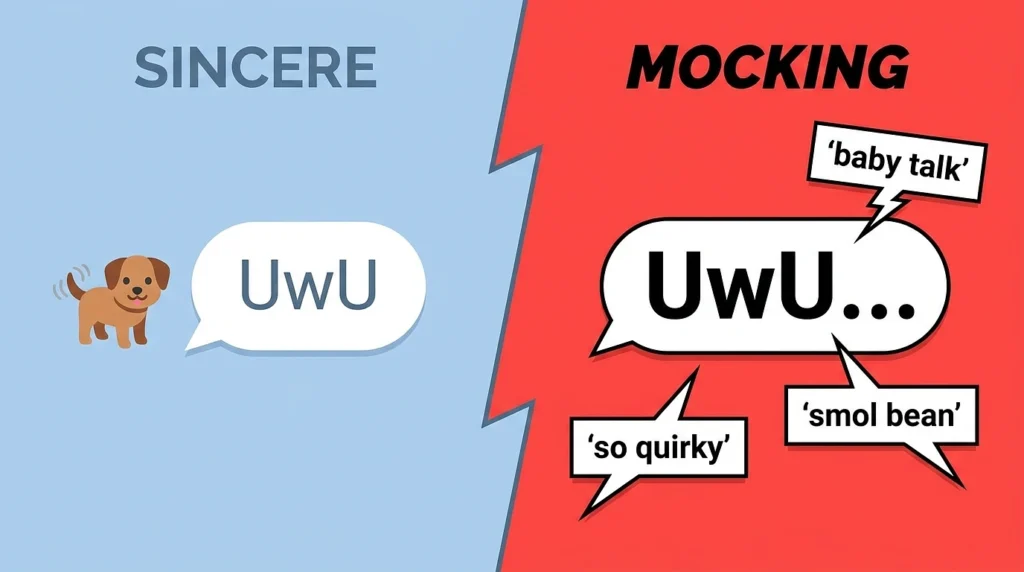
Here’s the scene. Someone sends a photo of a puppy asleep in a shoe. The reply comes back: “uwu.” Case closed. That’s the original, honest usage, and it’s still everywhere, especially in anime fandoms, gaming circles, and communities built around all things kawaii.
Used sincerely, UwU is basically the text version of the involuntary noise you make at a baby animal. It signals warmth, affection, softness, the “aww” reflex compressed into three keystrokes. When it shows up in these habitats, from a person who talks like this normally, there’s no hidden blade. They saw a cute thing. They felt a cute feeling. They typed the cute face.
The sincere version has tells:
- It’s reacting to something genuinely adorable, a pet, a kid, a cozy photo, a kind gesture.
- The sender lives in cute-adjacent internet spaces and uses this register all the time.
- Nothing in the conversation is tense, so there’s no irony fuel lying around to burn.
If all three boxes check, relax. You just got complimented, or at least warmly cooed at.
The Ironic Version: Cute as a Costume
Somewhere in the last decade, the internet did what the internet always does to sincere things: it started performing them with one eyebrow raised. Ironic UwU is when someone deploys maximum cuteness at a moment that is not cute at all, and the mismatch IS the joke. Your buddy loses his fantasy football matchup by forty points and posts “uwu.”
This is the same comedic engine behind saying “I’m thriving” while visibly not thriving. The cuteness is a costume the misery is wearing, and both sender and receiver are supposed to know it. When the emoticon’s own documentation notes that excessive usage can be deployed specifically to annoy the recipient, you’re seeing the same principle: the sweetness turned up so loud it flips into comedy or provocation.
The tell for ironic UwU is contrast. Cute face, un-cute situation. If the content of the message and the softness of the emoticon are pointing in opposite directions, you’re looking at irony, and the correct response is to play along, not to offer sympathy for the emoticon.
The Insult Version: When the Cute Face Has Teeth
And then there’s the one that stings.
UwU as an insult works by mimicry. Someone types it AT you, usually paired with mock-baby talk, to paint you as soft, whiny, cringey, or terminally online. Complain about something in a gaming lobby and get “don’t cry” back, and make no mistake, you were just condescended to. The sender is doing an impression of you as a delicate little anime character, and the impression is not flattering. Slang references note this exact usage: alongside warmth and affection, the emoticon gets used to be condescending or smug, and there’s a whole “uwu girl” stereotype that people invoke as shorthand for a person being performatively, annoyingly precious.
Here’s what makes the mocking version recognizable, and honestly, once you see the pattern you can’t unsee it:
- It’s aimed at you rather than at a cute thing, usually right after you expressed a feeling or complaint.
- It arrives with babytalk garnish, stretched vowels, deliberate misspellings, “oh no did someone get upset”.
- The relationship context is competitive or hostile, a debate, a game, a comment section, not a cozy chat.
The cruel genius of it is deniability. It’s just a smiley face, right? Except everyone involved knows exactly what tone it carried, which brings us to the uncomfortable science of why you can’t always be sure.
Why Your Brain Is Bad at This (It’s Not Just You)
Here’s my favorite part, because there’s actual research explaining why my niece’s three letters short-circuited me.
In 2005, psychologists Justin Kruger and Nicholas Epley published a now-famous set of experiments in the Journal of Personality and Social Psychology showing that people dramatically overestimate their ability to both convey and detect tone in text. Without gesture, emphasis, and intonation, sarcasm and sincerity flatten into the same letters. In the American Psychological Association’s coverage of the study, recipients were confident they’d correctly read the tone of messages about 90 percent of the time, and they were nowhere close to that in reality. The researchers called the culprit egocentrism: you “hear” your own intended tone when you write, and you project your own mood onto what you read. The British Psychological Society summed up the practical damage: sarcastic messages fall flat constantly because senders forget the receiver can’t hear the voice in their head.
The Field Guide: How to Tell Which One You Just Received
Check the Target
What is the emoticon pointed at? A cute thing means sincere. A bad situation means ironic. You, personally, right after you expressed an emotion, means you should prepare for the possibility that it’s a jab.
Check the Sender
History beats everything. A friend who says “uwu” about every dog photo is being sweet. Someone who has never once typed it, suddenly typing it during a disagreement, did not just discover a love of cute emoticons.
Check the Garnish
Sincere usually travels light. Mocking UwU brings props: babytalk, dramatic ellipses, quote-tweets, “oh nooo.” The more theatrical the packaging, the less sincere the contents.

