


The 10% figure is right. Two things around it are usually wrong, and both of them cost people money.
It is 10% of gross income, not of expenses, and it covers everything the car costs you, not just the loan payment. Health insurance, fuel, maintenance and repairs all sit inside that 10% alongside the payment. Get those two details wrong and you can follow the rule faithfully while still buying too much car.
That comes from the 20/4/10 rule, which is the framework this whole conversation traces back to: 20% down, no more than four years financed, and total transportation costs at 10% of gross monthly income or under. The loan structure greatly influences your financial future. Whether you choose a dealer financing plan, a bank loan, or a personal loan, opt for a fixed interest rate to ensure predictable payments and simplify monthly budgeting
Working The Number Properly
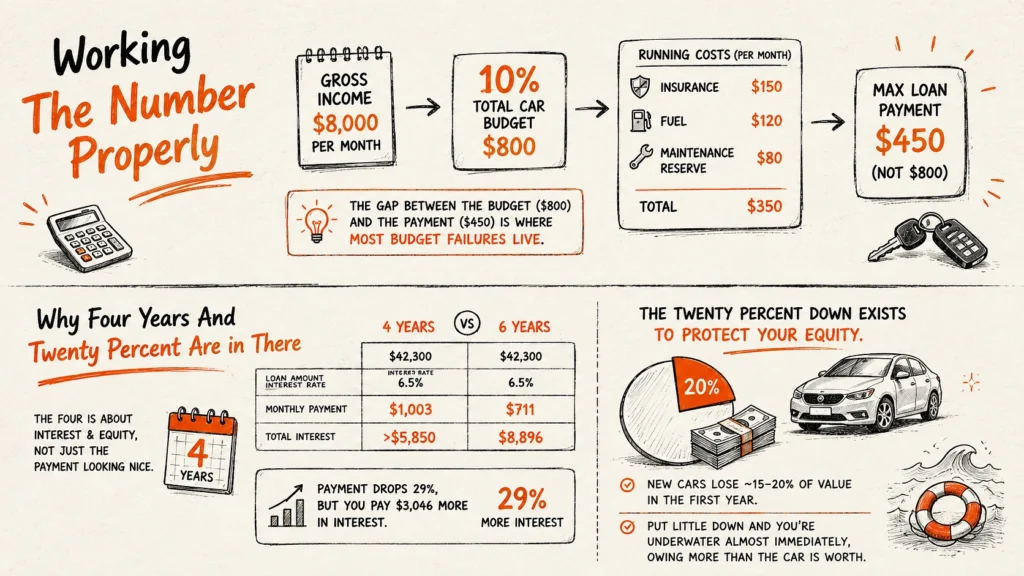
Say a household brings in $8,000 gross a month. 10% gives a total car budget of $800.
Now subtract the running costs before you get anywhere near a dealership. If insurance, fuel and a maintenance reserve come to $350, the loan payment can be at most $450. Not $800. That gap between the two numbers is where most budget failures live, because people shop against the ceiling and then discover the running costs on top.
Why Four Years And 20% Are in There
The four is about interest rate and equity rather than about the payment looking nice.
On an average new car loan of roughly $42,300 at 6.5%, a four year term produces a payment near $1,003 and total interest above $5,850. Stretch it to six years and the payment falls to $711, a 29% drop that feels like relief, while the financing cost climbs to $8,896. You have paid an extra $3,046 to make the monthly number smaller.
The 20% down exists because a new car loses roughly 15 to 20% of its value in the first year. Put little down and you are underwater almost immediately, owing more than the car is worth.
The Problem is That Almost Nobody Can Follow it in 2026
Here is where I have to be straight rather than reciting a rule at you.
Run the arithmetic against current prices and the rule stops describing most people’s reality. A household spending $996 a month on transportation, which is roughly average for a used vehicle once insurance and fuel are counted, would need about $120,000 a year in income to satisfy the 10% guideline.
For a new car it is worse. At an average new vehicle price of $50,400 with 20% down and a 48 month loan at around 8%, total transportation costs approach $1,500 a month, requiring something like $175,000 a year.
Median US household income was about $83,730 before tax.
| The rule expects | The market delivers |
|---|---|
| 48 month loan | Average new car loan maturity around 66 months |
| Payment inside a 10% total transport budget | Average new car payment $772, with 20% of 2025 new loans over $1,000 |
| 20% down, positive equity from day one | 31% of Q1 2026 trade-ins carried negative equity, averaging $7,183 |
| Vehicle priced to fit median income | Average new vehicle over $50,000 |
That negative equity number is the one I would sit with. 31% of trade-ins underwater is the highest share for any quarter since early 2021, and when that debt gets rolled into the next loan, the next payment starts higher. It is how people end up three cars deep in a cycle they never chose.
So What Number Should You Actually Use?
If 10% of gross is genuinely unreachable where you live and work, twelve to 15% is the realistic band advisors are now suggesting, and that is a defensible trade rather than a failure. For a household on $70,000, that lands around $700 to $875 a month for all transportation costs.
There is a second guideline worth knowing because it uses take-home rather than gross. Edmunds suggests keeping the payment itself under 15% of take-home pay for a new vehicle, or 10% for a used one or a lease. That is a different measurement of a similar idea, and it is often easier to apply because most people know their take-home better than their gross.
What matters is that you pick one and apply it to the total cost rather than the payment in isolation.
The Pressure That Makes People Abandon The Number

Nobody blows their budget on a spreadsheet. They blow it in a chair at a dealership at seven in the evening.
The mechanism is almost always the same, and it is worth naming so you can spot it happening.
- The conversation gets moved to monthly payment. Once you are discussing $711 versus $780, the price of the car has quietly stopped being the subject.
- Term length becomes the adjustment lever. A 72 or 84 month loan makes an expensive car look affordable without making it cheaper.
- Negative equity gets rolled forward rather than paid off, which hides an existing problem inside a new loan.
- Add-ons arrive after you are emotionally committed, when another twenty dollars a month sounds like nothing against a number you have already accepted.
The defence is deciding your total transportation figure before you go, in writing, and treating the payment as an output of that number rather than an input.
Is it Ever Sensible to Break The Rule?
Yes, in specific situations, and pretending otherwise would be useless advice.
A promotional low APR changes the maths on term length considerably. Someone with strong savings may reasonably put less than 20% down rather than empty an emergency fund, since cash for a medical bill or a job gap usually matters more than hitting an exact percentage. And where reliable transport is genuinely required for work and cheap vehicles are scarce, a higher percentage may simply be the cost of being employed.
What is rarely sensible is breaking two parts of the rule at once. A long term and a small down payment together is the combination that produces the underwater trade-ins in the table above.
Before You Sign Anything
Work out your gross monthly income and take 10% of it. Subtract a real insurance quote for the specific car, not a guess, plus fuel for your actual mileage and something for maintenance. Whatever is left is your payment ceiling.
Then check that number against the loan term rather than accepting the term that makes it fit. If the only way to reach your ceiling is 84 months, the honest reading is that the car is too expensive for you right now, and a cheaper car is a better answer than a longer loan.
None of this is financial advice tailored to your circumstances, and a credit union or a financial counselor can look at your actual numbers in a way an article cannot. But the framework is simple enough to run yourself in about ten minutes, and doing it before you walk in is worth more than any negotiation tactic you will read about afterwards.

