


The claim in that title has a specific study behind it, not a vibe. Researchers pulled records from 60 pollen counting stations across North America, 821 site-years of data running from 1990 through 2018, and found pollen seasons starting about 20 days earlier and stretching longer, with 21% more pollen in the air than when the records began. The baseline year is 1990. Do the arithmetic on the title and it checks out almost exactly.
Swear your symptoms used to start in April and now they ambush you in March? You are not misremembering, and you are not more sensitive than you used to be. The season moved. Your calendar did not.
How Much Longer the Season Runs Now
The 2021 PNAS study led by William Anderegg at the University of Utah is the one that settled this at continental scale, and a few details in it matter for how you experience spring.
The lengthening is not evenly spread. The largest and most consistent increases showed up in Texas and the midwestern United States, and among pollen types, tree pollen grew the most. Trees are the early-season offenders, oak, birch, cedar, alder, which is exactly why the change reaches you as a February or March surprise rather than a longer autumn.
An earlier decade-scale study caught the trend mid-move, comparing 2001 through 2010 against the 1990s and finding the season already starting days earlier with total airborne pollen up more than 40%. The shift was underway before most allergy sufferers had a name for it.
Is Climate Change Actually the Cause?
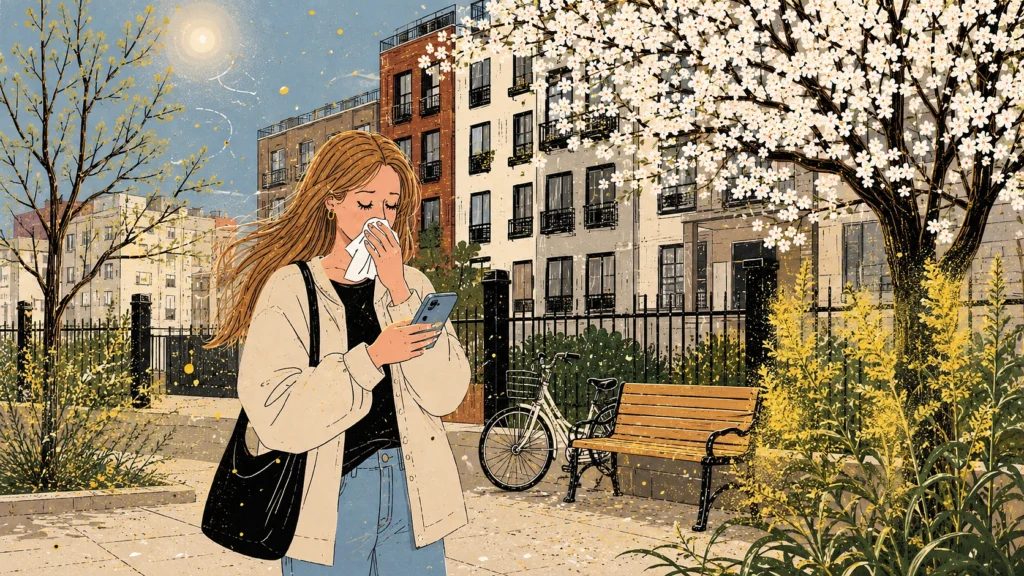
Yes, and this study is the one that attached a number to it. The team ran the pollen records against an ensemble of climate models in a formal detection and attribution analysis, the same method used to link heatwaves to warming, and found human-caused climate change contributed roughly 50% of the trend in pollen season length, making it the dominant driver, plus about 8% of the trend in pollen concentrations.
The mechanism is not mysterious. Warmer winters end frost earlier, plants wake sooner, and the frost-free growing window stretches at both ends. Ziska, the study’s senior author at Columbia, put the USANA health sciences framing bluntly, this is a climate impact already occurring, not a projection.
What Extra CO2 Does to Ragweed Specifically
The fall season has its own villain and its own mechanism, and this is the paragraph worth slowing down for. Ragweed likely causes more hay fever than every other plant combined, a single plant can release around a billion pollen grains, and in greenhouse experiments, ragweed grown under higher carbon dioxide didn’t just grow bigger and produce more pollen, it produced more of the specific protein that irritates human immune systems. So CO2 is not only extending the calendar, it is making individual grains meaner. Field data matches the greenhouse, with the ragweed season lengthening by 13 to 27 days at latitudes above roughly 44 degrees north since 1995, and the further north the station, the bigger the gain, precisely the fingerprint you would expect from warming rather than from land use or urban sprawl.
Minneapolis, Fargo, Winnipeg. The cold places are the ones gaining allergy weeks fastest.
Why a Longer Season Hits Harder Than a Late One
More days of exposure is the obvious cost, and it is not the whole bill.
Longer seasons give the immune system more time to become sensitized, so reactions can intensify across the season rather than staying flat. The Columbia team notes pollen exposure ties into respiratory health broadly, with implications for viral infections, emergency room visits and even children’s school performance. For the several million people whose hay fever coexists with asthma, a longer pollen season is a longer asthma season, which is where this stops being a quality-of-life story and becomes a hospital one.
There is also an overlap problem nobody warns you about. When tree season starts earlier and grass season holds its ground, the gap between them narrows or disappears, and people allergic to both lose the recovery window they used to get in late spring.
Move Your Treatment Calendar, Because the Season Moved First
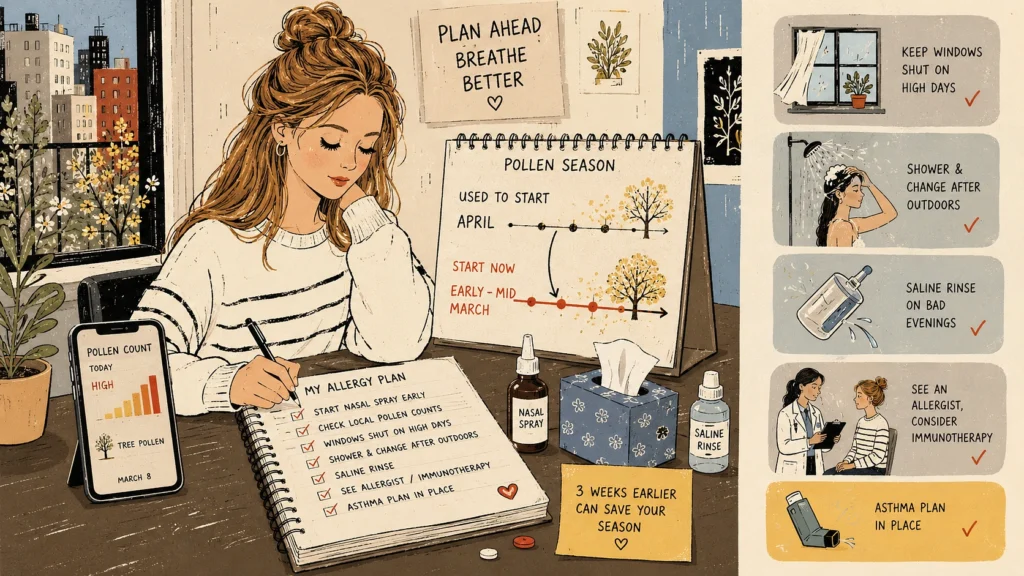
Here is the practical failure this research explains. Allergy medications, especially the steroid nasal sprays that work best, need lead time, they build effect over days to a couple of weeks. The standard advice has always been to start before your season begins. But if you start every year on the calendar date your symptoms used to begin, you are now starting two to three weeks late, every single year, and spending the front of each season chasing symptoms the spray could have prevented.
What that means in practice:
- Anchor your start date to the new season, not the old one. If tree pollen historically hit you in early April, begin the nasal spray in early-to-mid March, and adjust by what your area’s counts actually show.
- Follow a local pollen count source through late winter, since the first high tree-pollen days are your real starting gun, not the equinox.
- Keep the mechanical basics running through the longer window, windows shut on high days, shower and change after real time outdoors, rinse with saline on the bad evenings.
- If the stretched season has outgrown what pharmacy-shelf treatment controls, that is the sign to see an allergist rather than to stack more antihistamines, and for confirmed pollen allergies, immunotherapy is the option that retrains the immune system instead of muffling it. Anyone with asthma that worsens in pollen season should have a doctor in the loop regardless.
The season gained its extra weeks over thirty years, slowly enough that each spring felt almost normal. Your medicine cabinet can catch up in one, and the whole adjustment is a date on a reminder app moved three weeks earlier.

