


The life of a peasant farmer in ancient China was shaped by the land. Most farming families did not live near royal palaces, great walls, or crowded capital cities. They lived in small settlements surrounded by fields, paths, irrigation channels, grazing areas, and woodland. Their world was local. A farmer might spend most of his life within walking distance of his village.
The word “peasant” can give the wrong picture if it is taken to mean that every farmer was poor, powerless, or owned no land.
Rural families stood at different levels. Some owned a useful plot and one or two animals. Some rented fields from a landlord. Some worked as hired laborers. Others lost their land after debt, crop failure, war, or heavy taxation. A few successful families gained more land and became local landowners.
This article mainly describes farming life during the Qin and Han periods, from the late third century BCE to the early third century CE.
It also uses wider evidence from early imperial China when it helps explain daily work. There was no single ancient Chinese farming life. A rice farmer in the warm south faced different tasks from a millet or wheat farmer in the colder north.
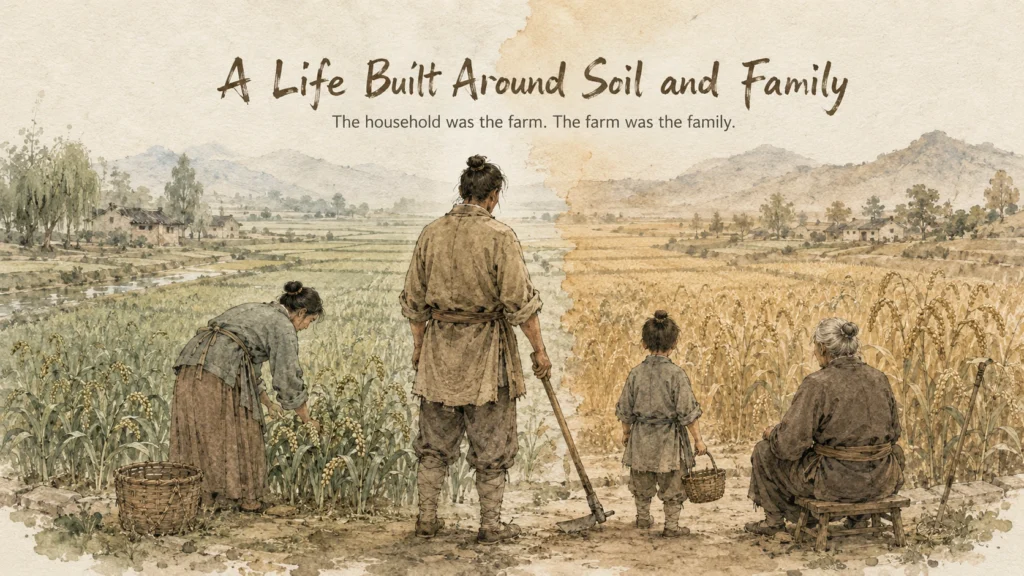
The basic farming unit was usually the household. Men, women, children, and older relatives all had work. The farm was not simply a workplace. It was the family’s food source, tax base, home, storehouse, and hope for the future.
facts about the farmer’s world
- Most work was done by family members.
- The seasons controlled the pace of life.
- Northern farmers often grew millet, wheat, barley, beans, and hemp.
- Southern farmers depended more heavily on rice.
- Weather could decide whether a household ate well or went hungry.
- Taxes, military service, and forced labor tied the village to the state.
- A farmer’s life could change quickly after a flood, drought, illness, or war.
The Village Before Sunrise
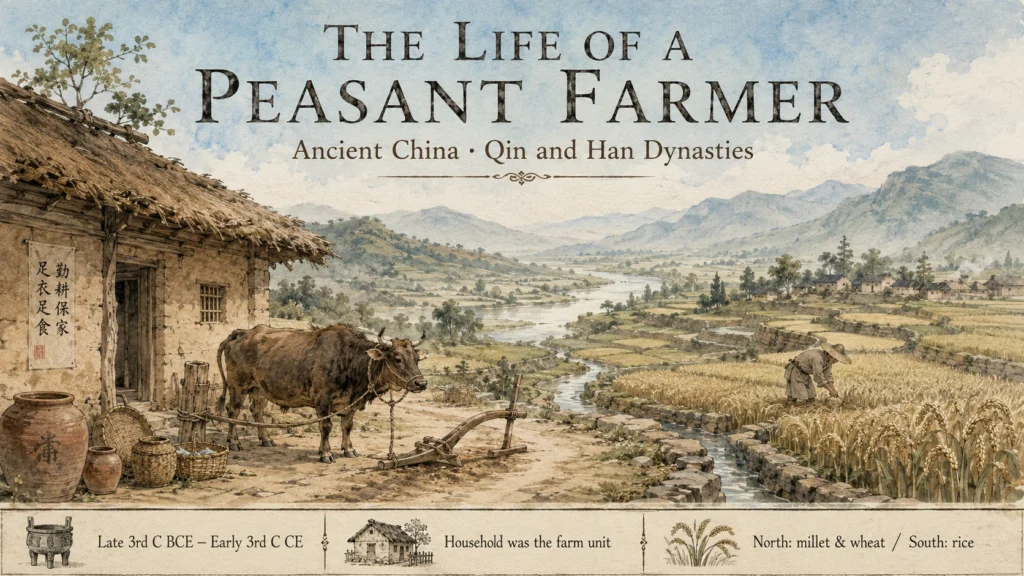
A peasant household often began work before sunrise. There were no clocks on the wall and no alarm sounds. People judged time by light, animal behavior, meal routines, stars, and familiar changes in the sky. Roosters, dogs, oxen, and human voices helped wake the settlement.
The first person awake might stir the cooking fire. A fire that had been covered with ash during the night could sometimes be brought back with dry grass or small sticks. Starting a fresh fire took time, so keeping hot coals alive was useful.
Breakfast was usually plain. A northern family might eat a warm grain porridge made from millet. A southern household might eat rice or rice gruel. Beans, greens, pickled vegetables, or scraps from an earlier meal could be added. Meat was not an everyday food for most poor farmers.
Before leaving for the fields, family members checked tools, baskets, ropes, animals, seed, and food. The farmer might carry a hoe, spade, sickle, wooden rake, or another tool suited to the day’s work. Metal edges were valuable and had to be cared for. A broken tool during planting or harvest could cost the family time it could not afford to lose.
Farmers did not normally walk into empty fields alone. Paths filled with neighbors heading to nearby plots. People heard animals, carts, water, tools, and conversation. The village woke as a group because many tasks had to begin at the same time.
A possible morning routine
- Stir the fire and prepare grain porridge.
- Feed chickens, pigs, dogs, or cattle.
- Check the ox, harness, ropes, and cart.
- Carry tools, seed, water, and food to the fields.
- Inspect channels, field edges, and signs of animal damage.
- Begin heavy work before the strongest heat.
The House Was Simple but Full of Purpose
The home of a farming family was usually built from materials found nearby. These could include packed earth, wood, reeds, clay, straw, and tile. The exact form depended on climate, wealth, local custom, and available resources.
Packed earth walls could be made by pressing soil inside wooden frames. When properly built and maintained, such walls could be strong. Poorer homes might have thatched roofs. Families with greater means could use fired tiles. A tiled roof lasted longer but cost more.
The house was not filled with separate rooms for every activity. Sleeping, cooking, weaving, tool repair, storage, and family talk could happen in closely joined spaces. Storage mattered greatly. Grain had to be kept dry and protected from rats, insects, dampness, theft, and fire.
Some homes had a courtyard where grain could be dried, tools repaired, vegetables prepared, and animals watched. Chickens might move freely around the yard. A pig might be kept in a pen. Dogs could guard the property. Farm waste, ash, straw, and animal manure were not useless rubbish. They could be gathered for fuel, building repair, bedding, or fertilizer.
Han tombs have produced clay models of houses, mills, pigpens, wells, towers, and farm buildings. These models were made for burial rather than daily use, but they still show that people saw the household as a working system. Food production continued from field to storage, mill, kitchen, and animal pen.
Common parts of a farm household
- A cooking place with a fire or stove.
- Sleeping mats or raised sleeping areas.
- Baskets, jars, and wooden containers.
- A yard for drying and sorting crops.
- Storage space for grain, seed, and tools.
- Pens or shelters for useful animals.
- A well or access to a shared water source.
- A small family shrine or space for ritual acts.
The Farmer’s Land Was Rarely a Perfect Square
Modern pictures often show ancient farmers standing beside neat, flat, open fields. Real farmland was less orderly. A family’s plots might be divided into several pieces. One piece could lie near the house, another beyond a stream, and another near land used by a different household.
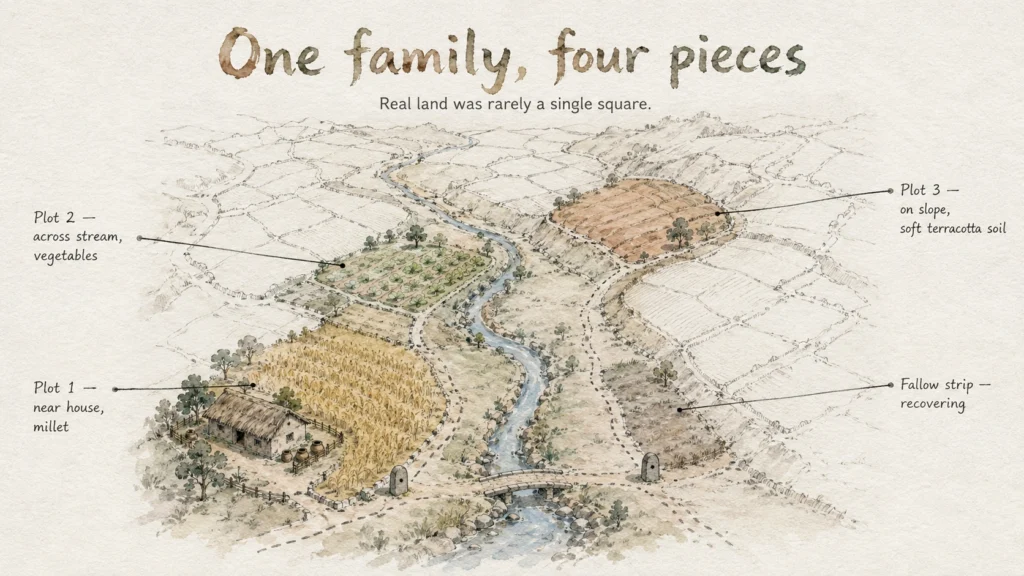
Boundaries might be marked by paths, ridges, ditches, trees, stones, or shared memory. Arguments over water and field edges were possible. A damaged ridge could let water escape from a rice field or flood a neighbor’s crop.
Some families owned their land. Some rented it. Some worked land controlled by a wealthy household. Ownership could change through inheritance, sale, debt, marriage arrangements, government action, or force.
A small plot could support a household in a good year if the soil was useful, labor was available, and taxes were manageable. The same plot could fail after poor rain, locusts, illness, or loss of an ox. This is why land size alone does not tell the whole story.
A family also needed access to water, seed, tools, fuel, manure, labor, storage, and transport. A farmer with more land than he could work was not necessarily secure. A smaller farmer with healthy relatives, good soil, and reliable water might be in a better position.
Questions that shaped the value of land
- Was the soil deep or thin?
- Did the field hold too much water or too little?
- Could an ox reach and work the plot?
- Was the land close enough for daily care?
- Did the family control the water channel?
- Was the field open to flood, wind, or animals?
- How much tax, rent, or crop share had to be paid?
Northern and Southern Farmers Lived Different Farming Lives
Ancient China covered a huge area with many climates. It is misleading to speak as if all farmers planted the same crops in the same way.
In the north, especially around the Yellow River region, farmers often grew millet. Millet could survive with less water than rice and had been important in northern China for thousands of years. Wheat became more common over time, though people had to learn the best ways to grow, grind, cook, and use it. Barley, beans, hemp, and vegetables could also be planted.
Northern fields faced dry weather, dust, strong winds, sudden floods, and soil loss. The Yellow River was both useful and dangerous. Its water and silt supported farming, but changes in the river could destroy settlements and fields.
In the south, rice farming became central in many wet areas. Rice required careful water control. Fields had to be leveled, flooded, drained, weeded, and watched. Warm conditions could allow strong yields, but they also brought insects, disease, heavy rain, and the risk of water damage.
Farmers in river valleys, hill country, dry plains, and wet lowlands had different knowledge. A method that worked in one place could fail in another.
Regional farming patterns
| Region | Common crops | Main concerns | Typical labor needs |
| Northern plains | Millet, wheat, barley, beans, hemp | Drought, wind, flood, soil loss | Plowing, sowing, hoeing, reaping |
| Southern wet areas | Rice, vegetables, beans | Water control, insects, heavy rain | Field flooding, transplanting, weeding, harvesting |
| Hill country | Mixed grain, trees, vegetables | Thin soil, erosion, steep slopes | Terracing, carrying, soil repair |
| River valleys | Grain, vegetables, fruit | Flooding, channel care | Irrigation work, bank repair, drainage |
Preparing the Ground Took Strength and Judgment
Before seed could be planted, the ground had to be made ready. This work might include clearing weeds, removing stones, breaking hard soil, repairing ridges, spreading manure, and guiding a plow.
A poor household without an ox had a serious disadvantage. Human labor could loosen soil with hoes and spades, but it took much more time and strength. A family might borrow or rent an animal. Two households might share one. Such agreements helped both sides, but they could also cause tension when every farmer needed the animal during the same short planting period.
Plows changed over time and differed by region. Some had wooden bodies with iron parts. Iron tools could cut soil more effectively than plain wooden tools, but iron was not free or easy for every family to obtain. A farmer had to protect valuable metal parts from rust, loss, and damage.
Good plowing was not simply a matter of walking behind an animal. The farmer had to judge depth, moisture, field shape, and direction. Soil that was too wet could become heavy and damaged. Soil that was too dry could be hard to break. Working at the wrong moment could waste labor.
A farmer also watched the color, smell, and feel of the soil. Long experience taught families which parts of a field dried first, where water stood, and where crops grew weak.
Signs a farmer watched before planting
- The softness of the soil underfoot.
- The amount of water in nearby channels.
- The direction and strength of seasonal winds.
- New plant growth along paths and field edges.
- Insect activity.
- The behavior of birds and animals.
- The date of earlier successful plantings remembered by older relatives.
Planting Was a Race Against Time
Planting could not be delayed without reason. A family had to act when soil, temperature, and moisture were suitable. Plant too early and seed might rot or fail in cold ground. Plant too late and the crop might not mature before cold weather, dry conditions, or heavy rain.
Seed was one of the household’s most important stores. Grain kept for planting could not be eaten unless the family accepted the risk of having nothing to sow. During hunger, this choice became painful. Eating seed might keep people alive for a few more weeks, but it could ruin the next season.
Farmers selected seed from earlier harvests. Healthy, full grains were more useful than damaged ones. Seed had to be kept away from dampness, pests, and fire. Families with poor storage lost more than food. They lost the start of the next crop.
Sowing methods varied. Seed could be scattered by hand or placed in rows or small holes. Row planting made weeding easier and could reduce wasted seed. Rice might be raised in a small seedbed and later moved to flooded fields. Transplanting required many hands during a narrow period.
Planting was often a family event. Adults handled heavy or skilled tasks. Children carried seed, scared birds, fetched water, or helped cover planted ground.
Planting problems and household answers
- Too little seed: borrow grain, plant less land, or use lower quality seed.
- No ox: share an animal, rent one, or prepare soil by hand.
- Late rain: delay sowing and risk a shorter growing season.
- Damaged channels: join neighbors in repair work.
- Illness in the family: ask relatives for help and return the labor later.
- Birds eating seed: place children in fields to make noise and keep watch.
Water Could Save a Family or Ruin It
Water management was one of the hardest parts of farming. Too little water weakened crops. Too much could wash away seed, drown roots, break ridges, spread disease, and leave mud over useful land.
Farmers dug and cleaned ditches, repaired banks, and guided water through small channels. Large canals could be state projects, but their daily value depended on local care. A blocked side channel could still leave a farmer’s plot dry even if a large canal passed nearby.
Rice farming required close control. Water depth had to change as plants grew. Fields might need flooding at one stage and draining at another. A broken wall between plots could undo days of work.
Water also created social rules. A household upstream could take more than its share. Night watering may have been used where supply was limited. Villages needed customs, agreements, or official orders to decide who received water first.
Government officials understood that irrigation affected tax income. Productive fields produced grain for households and the state. Some rulers supported canal building, flood control, and settlement of unused land. Yet official projects could also demand heavy labor from the same farmers they were meant to help.
Water duties in a farming settlement
- Clear weeds and mud from channels.
- Repair field walls after rain.
- Open or close small water gates.
- Watch for leaks during the night.
- Settle disputes between neighboring plots.
- Carry water to gardens or animals.
- Help repair shared banks before flood season.
Weeding Was Quiet Work with Great Value
After planting, a farmer could not simply wait for harvest. Weeds competed with crops for water, light, and soil strength. Insects, birds, rodents, and grazing animals also threatened the field.
Weeding was slow, repeated work. Family members used hoes or pulled weeds by hand. In rice fields, workers could spend long hours bent over or standing in water. In dry fields, they faced dust and heat.
This part of farming receives less attention than plowing or harvest because it seems less dramatic. In practice, poor weeding could greatly reduce the crop. A family with too few workers might prepare a large field but fail to care for it. More planted land did not always mean more food.
Children could help by pulling weeds, carrying baskets, watching animals, and scaring birds. Older people who could no longer manage heavy plowing still offered useful judgment. They could sort seed, guard drying grain, repair baskets, prepare food, or teach younger workers.
Farmers also watched plants for changes. Yellow leaves, weak stems, bite marks, strange spots, and slow growth were warning signs. They did not know modern plant science, but they had close knowledge built through repeated observation.
Daily crop care included
- Pulling weeds before they spread seed.
- Breaking hard surface soil after rain.
- Repairing ridges and channels.
- Checking for insect damage.
- Keeping cattle and pigs away from fields.
- Scaring birds from young grain.
- Moving water where plants were weak.
Harvest Was Hope Mixed with Fear
Harvest was the most important period of the farming year. It was a time of relief because months of labor had produced visible grain. It was also dangerous because a mature crop could still be lost to rain, wind, fire, theft, animals, or delay.
Families worked long hours. Neighbors and relatives might help one another. Grain had to be cut, gathered, tied, carried, dried, threshed, cleaned, measured, and stored. Every stage involved loss. Heads could fall to the ground. Birds could take grain. Damp bundles could rot.
Sickles were commonly used for cutting stalks. After cutting, grain had to be separated from straw and husks. Methods included beating, trampling, or using simple tools. The grain was then tossed or shaken so moving air could carry away lighter material.
Harvest did not mean the grain was fully the family’s own. Rent, tax, debt, seed needs, animal feed, ritual use, and household food all claimed a share.
A farmer looking at a full storage jar might still be worried. He had to estimate how many mouths the grain would feed and how long it had to last. A generous harvest could create security. A weak one could begin a path toward debt.
Where the harvest went
| Use | Why it mattered |
| Household food | Kept the family alive until the next harvest |
| Seed grain | Made the next planting possible |
| Tax payment | Met the household’s duty to the state |
| Rent or crop share | Paid a landlord where land was rented |
| Debt payment | Repaid borrowed food, seed, tools, or money |
| Animal feed | Kept work animals and livestock alive |
| Ritual use | Supported offerings to ancestors and local powers |
| Market sale | Bought salt, iron, cloth, oil, and other goods |
Food Was Plain and Closely Guarded
The daily diet of a peasant farmer depended on region, season, and wealth. Grain formed the base. Millet porridge was common in northern areas. Rice was central in much of the south. Wheat could be ground or prepared in several ways as its use grew.
Vegetables added flavor and needed nutrients. Families ate beans, greens, onions, gourds, roots, and other local plants. Pickling and drying helped food last beyond the growing season.
Meat was limited for poorer families. Pigs were important because they could eat household scraps and provide meat, fat, bone, hide, and manure. Chickens supplied eggs as well as meat. Dogs were used for guarding and were also eaten in some periods and places. Fish helped families living near rivers, lakes, canals, and ponds.
A family did not kill a useful animal without thought. An ox was far more valuable alive as a source of farm power. A pig could be saved for a feast, ritual, sale, or emergency.
Salt was needed but might have to be bought. Cooking oil, wine, sauces, spices, and better cuts of meat were signs of greater comfort. Food quality changed through the year. Meals could be fuller after harvest and thin by late winter or early spring.
Common peasant foods
- Millet, rice, wheat, or barley.
- Beans and bean products.
- Cabbage, mustard greens, onions, and gourds.
- Wild plants gathered near fields and woods.
- Pickled or dried vegetables.
- Fish from local water.
- Eggs when available.
- Pork or chicken on special days.
- Grain wine during rituals or celebrations.
Hunger Was Never Far Away
Hunger was not limited to years of total famine. A household could face several levels of shortage. Meals might become thinner. Adults might eat less so children could eat. Better grain might be saved for seed while people consumed rougher food.
Families gathered wild plants, roots, nuts, or fallen grain. They sold cloth, animals, tools, or household goods. They borrowed from relatives, merchants, landlords, or moneylenders. Each answer solved an immediate problem while possibly creating a later one.
Debt was especially dangerous. A farmer who borrowed grain before harvest might have to repay much more afterward. If the crop failed again, he could lose land. Once land was lost, the family might become tenants or laborers.
Hunger also weakened the body. A poorly fed worker could not perform heavy farm labor well. Illness then reduced labor further. This created a hard circle: less food caused less work, which caused less production, which caused still less food.
Famine could force people to leave home. Families moved toward towns, richer regions, public grain stores, or areas less affected by disaster. Some sold their labor. In the worst cases, households broke apart.
Warning signs of a household crisis
- Seed grain is used for food.
- The work animal is sold.
- Tools are pawned or exchanged.
- Meals are reduced to thin porridge.
- Children stop helping because of weakness or illness.
- Land is offered as security for a loan.
- Family members leave to seek paid work.
- Taxes or rent remain unpaid after harvest.
Clothing Came from Labor Inside the Household
A farmer’s clothing had to be useful rather than impressive. Hemp was an important fiber for ordinary cloth. Silk was strongly linked with China, but fine silk clothing was beyond the daily reach of many poor farmers.
Rural women often carried major responsibility for making cloth. The process began long before sewing. Fibers had to be grown or obtained, cleaned, prepared, spun, woven, cut, and joined. Each stage took time.
Clothing was repaired again and again. A torn garment was not quickly thrown away. Cloth could be patched, changed for a younger family member, made into wrapping, or used for another household need.
Summer clothing had to allow movement in heat. Winter clothing required layers and padding. Poor families were at risk during cold weather if they lacked enough cloth, fuel, or dry shelter.
Footwear also wore out. Farmers might use sandals made from straw or plant fiber. Working in mud, water, rough ground, and stubble damaged feet. Cuts could become serious because daily work continued even when a person was hurt.
Clothing tasks within the household
- Grow or purchase fiber.
- Prepare hemp or silk thread.
- Spin thread during spare hours.
- Weave cloth on a household loom.
- Sew simple garments.
- Patch worn knees, sleeves, and hems.
- Make sandals from straw or fiber.
- Store winter clothing away from dampness and pests.
Women’s Work Held the Farm Together
The common image of a male farmer alone in a field hides much of rural life. Women worked in fields, cared for children, prepared food, raised animals, carried water, gathered fuel, processed grain, made cloth, cleaned, repaired, and took part in family rituals.
The amount and type of field labor done by women varied. During planting and harvest, nearly every available worker could be needed. Rice transplanting, weeding, gathering, sorting, and carrying were major tasks.
Women also managed work that turned crops into usable food. Grain had to be dried, stored, hulled, ground, and cooked. Vegetables had to be preserved. Animals needed daily care. Cloth production could continue after field work ended.
Pregnancy and childbirth did not remove the need for labor. A woman’s health could decide the strength of the whole household. Death during childbirth or serious illness placed children and farm work at risk.
Marriage usually moved a woman into her husband’s family. She entered a household with its own rules and senior members. Her position often improved after bearing children, especially sons, though personal experience differed greatly.
A realistic view of women’s work
- Field labor was only one part of their contribution.
- Food preparation required many hours before cooking began.
- Cloth making was skilled economic work.
- Childcare happened beside other tasks, not apart from them.
- Older women could hold strong authority within the household.
- Widows faced special risks but could also manage family property in some cases.
- Women’s labor affected whether the household had food, clothing, and goods to trade.
Children Learned Through Work
Peasant children were not kept apart from adult labor for most of the day. They learned by watching, carrying, copying, and being corrected. Their duties grew with their strength.
A young child could watch chickens, gather sticks, carry messages, pick weeds, or scare birds. An older child could lead an animal, help plant seed, collect manure, carry water, or care for younger brothers and sisters.
Work taught practical knowledge. Children learned where water gathered after rain, how to hold a tool, which plants were useful, how grain should smell when dry, and how to notice an animal’s illness.
Formal schooling was limited for poor rural families. Education required time, teaching, writing materials, and freedom from daily labor. A talented boy might receive some instruction if his family had means or local support. Yet most peasant children learned the skills needed for household survival rather than the classical texts required for official service.
Childhood still included play, stories, songs, imitation games, festivals, and friendships. Children made toys from simple materials. They watched traveling sellers, performers, officials, soldiers, or religious figures when such people passed through the settlement.
Tasks suited to children
| Approximate ability | Possible tasks |
| Very young child | Watch animals, gather small sticks, carry messages |
| Growing child | Pull weeds, scare birds, collect vegetables |
| Stronger child | Carry water, help plant, gather manure |
| Older child | Lead an ox, use small tools, guard crops |
| Skilled teenager | Plow, harvest, weave, trade, or manage animals |
Older People Were Working Libraries
Age could weaken the body, but it did not remove a person’s value. Older relatives remembered earlier floods, droughts, planting dates, family agreements, field boundaries, debts, marriages, and disputes.
Their knowledge was practical. An older farmer might know that one corner of a field always held water too long. An older woman might judge whether stored grain was becoming damp. Such knowledge could prevent loss.
Grandparents also watched children, prepared food, sorted seed, repaired small objects, guarded animals, and carried out ritual duties. Their presence allowed stronger adults to spend more time in the fields.
Respect for parents and ancestors became a major moral theme in ancient Chinese thought. Daily reality did not always match the ideal. Poor households under pressure could face conflict over food, authority, inheritance, and labor. Still, senior family members often held an important position.
Knowledge passed by older relatives
- The best planting time for local soil.
- Signs of changing weather.
- Safe and unsafe wild plants.
- Family ownership and boundary memories.
- Methods of storing seed.
- Stories about past wars and famines.
- Ritual words and family customs.
- Ways to settle arguments with neighbors.
Animals Were Wealth, Labor, and Food
Farm animals were closely tied to household survival. Oxen pulled plows and carts. Pigs turned scraps into useful meat and manure. Chickens produced eggs. Dogs guarded homes and fields. Horses were valuable but were not ordinary possessions for every peasant family.
An ox represented stored wealth and future labor. Losing one to disease, theft, accident, or forced state use could be as serious as losing part of the harvest. The household had to feed the animal even when food was scarce.
Animals also required time. They had to be watered, fed, cleaned, watched, and treated when hurt. Children often helped with these duties. Manure was gathered because it could improve soil or be mixed with other material.
Pigs fit well into a farm household. They could be raised in a small space and fed waste that humans could not use. Han burial models often include pigpens and farm structures, showing the close link between animals and household production.
Animal ownership also showed social standing. A household with several cattle, carts, pigs, and poultry had more choices than a family with no animals.
Value of common farm animals
- Ox: plowing, hauling, manure, wealth.
- Pig: meat, fat, manure, sale value.
- Chicken: eggs, meat, feathers, quick breeding.
- Dog: guarding, hunting in some areas, warning against strangers.
- Horse: travel, military use, status, fast transport.
- Water buffalo in suitable regions: wet field labor and hauling.
Taxes Reached Into the Farmer’s Storehouse
The ancient Chinese state depended heavily on rural production. Farmers supported government through taxes, labor service, military duty, and other demands.
Tax systems changed between rulers and periods. Payments could involve grain, cloth, coins, or labor. A tax that looked moderate in an official rule could feel heavy after a bad harvest. Collection practices also mattered. Honest and careful officials could reduce abuse. Harsh or corrupt agents could make the burden worse.
Farmers had to produce more than their own families consumed. Part of the crop supported officials, soldiers, court life, public works, transport, and state storage.
Records and population registration helped the government know who owed tax and service. Registration could bring protection and legal standing, but it also made households visible to officials.
A poor family might sell grain after harvest to obtain coins for a tax payment. When many farmers sold at once, prices could be low. Later, the same family might need to buy grain back at a higher price. This placed the farmer in a weak market position.
State demands placed on rural households
- Grain tax.
- Payments in cloth or coin.
- Military service for eligible men.
- Labor on roads, walls, canals, palaces, or government buildings.
- Transport of supplies.
- Registration of household members.
- Provision of animals, carts, food, or lodging in some situations.
Forced Labor Could Take a Farmer Away at the Worst Time
Governments needed workers for large projects. Peasants could be ordered to build roads, repair canals, move supplies, work on defensive walls, or take part in other public tasks.
These projects could help the empire. Roads improved movement. Canals supported irrigation and transport. Flood banks protected fields. Yet the timing of service was critical. A farmer taken away during planting or harvest left more work for the rest of the family.
Travel itself was costly. A laborer needed food, clothing, and physical strength. Conditions could be harsh. Injury, disease, and death were real risks. A family might not know exactly when the worker would return.
The famous walls of ancient China were not made by one ruler or in one period. Different states and dynasties built and repaired defensive works. To the farming household, however, the key issue was simple: state building projects consumed rural labor.
The same was true for military service. A man who became a soldier was no longer available to plow, repair channels, or harvest grain. His absence affected every person at home.
Effects of labor service on a farm
- Less labor during key seasons.
- Greater work for women, children, and older relatives.
- Risk of injury or death away from home.
- Food and travel costs.
- Delayed repair of fields and buildings.
- Possible new knowledge gained from travel.
- Contact with people from other regions.
Landlords, Debt, and the Loss of Independence
Not every peasant farmer remained an independent small owner. Economic pressure could move land into the hands of wealthy families.
A small farmer faced greater risk because one failed harvest could destroy his savings. A rich landowner could survive a bad year by drawing on stored grain, money, tenants, and several plots in different places.
When a peasant borrowed, land might serve as security. If repayment failed, ownership could pass to the lender. The former owner might stay on the same field as a tenant. His daily labor looked similar, but his legal and economic position had changed.
Some families placed themselves under a powerful landowner for protection from taxes, officials, bandits, or war. This could reduce one danger while creating dependence.
Large estates could use tenants, hired laborers, servants, and enslaved people. The balance differed across time and region. Ancient rural society was not a simple system of equal farmers under one fair government.
A common path toward land loss
- A crop fails.
- The household borrows grain or money.
- Interest or repayment increases the burden.
- A second problem prevents repayment.
- Tools, animals, or part of the land are sold.
- The family rents land it once owned.
- More of each future harvest goes to the landlord.
The Village Needed Cooperation
A farming village was not merely a collection of separate homes. Families depended on one another.
Shared work was especially useful when speed mattered. Planting, transplanting, harvesting, threshing, flood repair, and house building could require more hands than one household possessed.
Labor could be exchanged rather than paid for with money. One family helped another at harvest, expecting help in return. This system worked best when trust was strong and households had roughly equal power.
Villagers also shared paths, wells, channels, grazing spaces, shrines, mills, and market travel. Shared resources created reasons for cooperation and argument.
Reputation mattered. A household known for refusing to return labor might struggle to find help later. A family known for honesty could gain support during illness or disaster.
Village life also brought pressure to follow local customs. Marriage choices, funerals, boundary disputes, and tax duties were rarely private matters.
Examples of village cooperation
- Repairing a broken irrigation bank.
- Sharing an ox during plowing.
- Harvesting a widow’s field.
- Guarding crops at night.
- Carrying a sick neighbor.
- Building a house after fire damage.
- Traveling together to market for safety.
- Watching children while adults work.
Markets Connected the Farm to a Wider World
Most peasant households tried to produce much of what they needed, but full independence was rare. Farmers still needed salt, iron, better tools, cooking goods, medicine, pottery, and items they could not make at home.
Local markets allowed rural families to sell grain, vegetables, animals, eggs, cloth, baskets, fuel, or other goods. They could then purchase necessities or pay taxes and debts.
A market visit was also a source of news. Farmers heard about prices, official orders, war, road conditions, illness, marriages, missing people, and events in nearby settlements.
Prices could work against small farmers. They often sold soon after harvest, when grain was common and prices were lower. They bought during shortage, when prices were higher.
Travel to market took time away from farm work. Goods had to be carried by people, animals, carts, or boats. Bad roads, theft, tolls, and weather added risk.
What a farmer might take to market
- Extra grain.
- Vegetables or fruit.
- Eggs and chickens.
- A pig or young animal.
- Hemp cloth.
- Baskets, mats, rope, or sandals.
- Firewood or charcoal.
- Herbs or gathered plants.
What the household might buy
- Salt.
- Iron blades or repairs.
- Pottery.
- Oil.
- Medicine.
- Needles.
- Better seed.
- Ritual goods.
Ancestors Remained Part of Family Life
Many ancient Chinese households believed that dead family members still mattered. Ancestors could be honored through offerings, words, and ritual acts.
A poor family could not perform ceremonies like a royal court or wealthy clan, but simple acts still carried meaning. Food, drink, incense, or respectful speech might be offered. Graves needed attention when families had the means to care for them.
Ancestor respect strengthened family identity. It reminded living members that they belonged to a line reaching into the past. It also supported the authority of parents and senior relatives.
Farmers also responded to local spirits, natural powers, and seasonal customs. They sought good weather, healthy children, safe animals, and full grain stores. Ritual did not replace farm work. It stood beside it as another way of facing uncertainty.
A family could plow carefully and still lose everything to drought. Ritual gave people a language for hope, fear, duty, and loss.
Rural ritual concerns
- Asking for rain.
- Giving thanks after harvest.
- Honoring family ancestors.
- Protecting children from illness.
- Marking births, marriages, and deaths.
- Caring for graves.
- Seeking safety before travel.
- Responding to flood, drought, or disease.
Festivals Brought Relief from Constant Work
Peasant life was hard, but it was not joyless. Seasonal festivals, weddings, shared meals, market days, music, stories, and religious events broke the routine.
A festival meal might include food normally saved for special use. Families wore cleaner or better clothing. Children watched performances and received small treats when the household could afford them.
Wine made from grain appeared in rituals and celebrations. Music could come from drums, bells, flutes, singing, or simple household instruments. Traveling performers brought stories and entertainment to places far from large cities.
These events also served practical purposes. Young people met possible marriage partners. Families renewed ties. Debts or disputes could be discussed. Goods were traded. News spread.
Celebration depended on the harvest. A poor year produced smaller feasts and greater worry. Even then, ritual dates gave shape to time and reminded families that life included more than daily labor.
Sources of enjoyment in village life
- Shared meals.
- Storytelling after work.
- Songs used during group labor.
- Children’s games.
- Weddings.
- Seasonal festivals.
- Market performances.
- Visits from relatives.
Illness Could Become an Economic Disaster
A farming household depended on physical labor. Illness was therefore both a health problem and an economic problem.
A sick farmer could not plow. A sick mother could not prepare food, care for children, process grain, or weave. A sick child needed care from someone who would otherwise be working.
Treatments included herbs, food changes, rest, heat, massage, ritual action, and advice from experienced relatives or healers. Wealth affected access to skilled treatment.
Many dangers were common: infected cuts, broken bones, fever, stomach illness, childbirth problems, parasites, snake bites, animal injuries, and breathing trouble from smoke.
Homes with poor airflow could fill with cooking smoke. Water sources could become dirty. Working barefoot or in thin sandals exposed feet to cuts. Rice farmers spent long periods in wet fields where insects and skin problems were common.
There was no modern hospital system for the average peasant. A serious injury could permanently reduce the family’s ability to farm.
- Tool injuries.
- Falls from carts, banks, or trees.
- Animal kicks and bites.
- Fever and infection.
- Unsafe water.
- Smoke inside the house.
- Poor diet during food shortage.
- Childbirth complications.
- Exhaustion during planting and harvest.
War Passed Through the Farmer’s Field
Even a farmer who wanted no part in politics could not escape war. Armies needed grain, animals, carts, roads, and soldiers. Fields could be trampled. Stores could be seized. Houses could be burned.
Young men might be drafted. Officials could demand supplies. Retreating soldiers, rebels, or bandits might take what remained.
War also disrupted planting. A family that fled during spring could not return in autumn and expect a crop. Irrigation systems broke when communities scattered. Abandoned fields filled with weeds.
Some farmers joined rebellions because taxes, hunger, debt, official abuse, or local violence had become unbearable. Others joined because they were forced or because an armed group offered food.
Dynastic histories often describe emperors and generals, but the rural cost of war was carried by unnamed households. A victory for one ruler could still mean ruin for villages crossed by the army.
How war harmed farming life
- Workers were drafted.
- Oxen and carts were taken.
- Seed grain was eaten or seized.
- Channels and banks were neglected.
- Fields were burned or trampled.
- Families fled without harvesting.
- Markets closed or became unsafe.
- Disease spread among moving populations.
Natural Disaster Tested Every Part of Society
Flood, drought, locusts, frost, storms, and disease could destroy a farm. A household’s chance of survival depended on storage, family ties, local leadership, transport, and government relief.
Granaries could reduce suffering if grain had been stored and honestly managed. Officials might lower taxes, release grain, move food, or support repair work. Such help was uneven. Corruption, transport problems, war, and delay could make relief fail.
A disaster was rarely only natural. A flood became worse when banks were not maintained. A drought became deadlier when taxes remained high. Locust damage became famine when grain stores were empty or merchants raised prices.
Poor households suffered first because they held smaller reserves. Wealthy families could buy food, move away, or wait for prices to improve.
The farmer therefore judged government by local results. An emperor’s claim to rule meant little if officials took grain during famine or failed to repair essential waterworks.
Household answers to disaster
- Use stored grain.
- Ask relatives for help.
- Gather wild food.
- Sell animals or tools.
- Borrow against the next harvest.
- Move temporarily.
- Seek work on a larger estate.
- Join public relief labor.
- Appeal to local officials.
Social Rank Was Higher in Theory Than in Daily Power
Traditional Chinese social thought often placed farmers below scholars and above artisans and merchants. Farming was praised because it produced food and supported the state.
This praise did not mean farmers held real political power. Officials could speak of agriculture as the foundation of the empire while still collecting heavy taxes or demanding labor.
The farmer’s honored place was partly a moral idea. Rulers wanted stable households that worked the land, paid tax, raised children, and caused little disorder. A rooted farmer was easier to register and tax than a wandering laborer.
Merchants could be ranked lower in moral writing yet live far more comfortably than peasants. A successful trader might own land, lend money, wear fine clothing, and influence officials.
The difference between stated honor and lived power is important. Ancient societies often praised the people whose labor they depended on without giving those people equal control.
The farmer’s social position
- Praised as a food producer.
- Needed by the state.
- Burdened by tax and labor duties.
- Respected when stable and successful.
- Vulnerable when poor or indebted.
- Rarely able to influence high policy.
- Sometimes able to rise through wealth, education, or family success.
A Full Year in the Life of One Imagined Household
Consider a fictional Han farming family living in northern China. The household contains an older couple, their adult son and his wife, three children, and an unmarried younger brother. They own a modest plot, one ox, several chickens, and a pig.
In early spring, the men repair the plow and inspect the fields. The women check stored seed, patch clothing, and prepare food for long workdays. Everyone helps clear weeds and repair field edges.
When the soil is ready, the ox pulls the plow. The younger brother guides it while the adult son controls the plow. Children carry seed and watch for birds.
During summer, the family weeds, repairs channels, gathers fuel, cares for animals, and watches the sky. The mother and daughter work with hemp when field duties allow. The grandmother prepares meals and watches the youngest child.
A storm damages one field. The family asks neighbors to help repair a broken bank. In return, they promise labor at a neighbor’s harvest.
In autumn, all available hands gather the grain. The yield is fair but not rich. Some grain is set aside for tax. Some repays seed borrowed the year before. The best grain is saved for planting.
During winter, field work slows but household work continues. Tools are repaired. Cloth is woven. Animals are fed. The family attends local gatherings and performs ancestor rites.
By late winter, the grain store looks smaller than expected. Meals become thinner. The family delays killing the pig because it may be needed for sale. They enter spring tired but still owning their land and ox. In peasant terms, that counts as a successful year.
Lessons from this example
- A fair harvest did not create luxury.
- Every family member added useful labor.
- Neighbor support reduced risk.
- Tax and debt took grain before the next season.
- Winter was not a period without work.
- Keeping land, seed, and an ox was a major sign of security.
Small Details That Reveal the Farmer’s Real Life
The most useful picture of peasant life often comes from small details rather than famous events.
A clay model of a mill shows that grain had to be processed after harvest. A model pigpen shows how animals fitted into the home. An iron sickle points to harvesting skill and the value of metal. A storage jar points to fear of dampness, rats, and shortage.
These objects also correct romantic pictures. Farming was not a peaceful life of simply living close to nature. It involved repeated physical strain, careful planning, family pressure, risk, and state demands.
At the same time, peasants were not helpless people without knowledge. They understood local soil, weather, water, seed, animals, preservation, tools, and labor. Their knowledge was based on close contact with the same land across many years.
A farmer who could not read an official document might still possess knowledge that an educated city official lacked. He knew which soil would crack, which bank would fail, and which seed would survive poor rain.
Unique insights from ordinary objects
- A repaired tool shows that replacement was costly.
- A patched garment shows the value of cloth.
- A grain jar shows the need to plan months ahead.
- A child’s small tool shows early training in labor.
- A pigpen shows how waste became food and manure.
- A well shows the importance of shared water.
- A mill shows that harvested grain was not yet ready to eat.
How to Read Ancient Farming Evidence Carefully
No historian can follow one ordinary Han farmer through every hour of his life. Most peasants left no personal diaries. Evidence comes from official texts, laws, tax records, farm writings, tomb objects, art, archaeology, and later comparisons.
Each source has limits. Officials wrote from the viewpoint of government. Moral writers described how people should behave, not always how they did behave. Tomb models may show ideal households rather than poor ones. Agricultural manuals may record best practice rather than common practice.
Good historical writing therefore separates firm evidence from reasonable reconstruction. It should not claim that every farmer ate the same breakfast, owned an ox, lived in the same house, or followed the same routine.
Archaeological evidence is especially useful because it shows tools, buildings, seeds, animal remains, storage systems, and signs of labor. Yet even archaeology favors objects that survived. Wood, cloth, food, and ordinary speech often disappeared.
Tips for judging a claim about ancient farmers
- Check the dynasty and region.
- Ask whether the evidence concerns rich or poor households.
- Separate official ideals from daily practice.
- Compare written evidence with physical objects.
- Avoid treating northern and southern farming as identical.
- Notice when a source describes a crisis rather than a normal year.
- Be cautious when a modern writer gives exact daily details without evidence.
The Farmer’s Greatest Skill Was Managing Risk
The central task of a peasant farmer was not simply growing crops. It was managing risk with limited resources.
The household had to decide how much grain to eat, save, sell, or pay. It had to decide whether to borrow, buy an animal, repair a roof, plant a risky crop, or send someone to market.
These choices were linked. Selling an ox could provide food today but reduce next year’s harvest. Eating seed prevented immediate hunger but damaged future planting. Sending a child to work increased labor but reduced any chance of schooling.
Success did not always mean becoming rich. It often meant avoiding disaster. A household that finished the year with enough seed, healthy workers, useful tools, and control of its land had achieved something important.
This helps explain why rural families valued caution, family duty, storage, hard work, and reliable relations with neighbors. These were not empty moral ideas. They were methods of survival.
Main risks managed by the household
| Risk | Household response |
| Crop failure | Store grain, plant mixed crops, borrow, gather wild food |
| Labor shortage | Use family labor, exchange work with neighbors |
| Animal loss | Share, rent, or borrow draft power |
| Tax demand | Sell grain, cloth, or animals |
| Illness | Shift duties among relatives |
| Flood or drought | Repair water systems, move, seek relief |
| Debt | Sell goods, rent land, seek extra work |
| War | Hide stores, flee, join stronger groups |
What Modern Readers Often Get Wrong
One common mistake is to imagine all peasants as slaves. Many were legally free farmers, though freedom did not protect them from debt, taxes, forced labor, or powerful landowners.
Another mistake is to picture every farmer as completely self sufficient. Rural households produced much of what they used, but they still needed markets, metal workers, salt sellers, potters, healers, officials, and neighbors.
A third mistake is to assume that farming methods were simple because they were old. Ancient farmers made careful decisions about soil, water, seed, timing, tools, and labor. Their equipment was less powerful than modern machinery, but their work still required skill.
It is also wrong to describe peasant life as nothing but suffering. Hardship was common, yet people formed families, celebrated, told stories, helped neighbors, raised children, and took pride in good work.
The opposite romantic picture is equally false. Rural life was not naturally calm or healthy. Hunger, injury, taxes, disease, violence, and family conflict were real.
Better ways to understand ancient farmers
- See them as skilled workers, not simple background figures.
- Recognize differences in wealth and legal position.
- Study women’s labor as part of farming.
- Include food processing, storage, and cloth making.
- Connect taxes and war to the farming calendar.
- Treat cooperation and conflict as parts of village life.
- Remember that survival itself could be a major success.
The Lasting Importance of the Peasant Farmer
Ancient Chinese civilization rested on rural labor. Cities, armies, courts, roads, temples, workshops, and government offices depended on food and taxes produced in farming areas.
The farmer rarely appeared as the hero of official history. His name was usually not recorded. Yet the empire could not survive without households that planted, weeded, harvested, stored, transported, and paid.
Peasant labor also changed the land. Generations of farmers built ridges, channels, terraces, paths, wells, field walls, and settlements. They selected seed, raised animals, and passed local knowledge to their children.
Their work supported more than survival. Grain taxes fed soldiers and officials. Hemp and silk supported clothing and trade. Animals supplied transport, food, and fertilizer. Rural markets linked villages to towns and distant regions.
The life of a peasant farmer in ancient China was therefore both ordinary and central. It was ordinary because millions lived through similar cycles of work, family care, fear, and hope. It was central because nearly every part of the state depended on that work.
Final understanding
- The family was the main labor group.
- Farming changed greatly by region.
- Water control was as important as soil.
- Women and children performed essential work.
- Harvest did not belong fully to the household because tax, rent, and debt claimed shares.
- Land loss could turn an owner into a tenant.
- Cooperation gave villages protection against labor shortages and disaster.
- Small farmers carried much of the cost of government and war.
- Their knowledge was practical, local, and highly skilled.
- The survival of ancient China depended on people whose personal names were rarely written down.
Conclusion
A peasant farmer in ancient China lived according to a demanding cycle. He prepared soil, planted seed, controlled water, removed weeds, guarded crops, gathered grain, paid taxes, repaired tools, and began again. Around him, his family carried out equally important work.
The household’s safety depended on many things it could partly control, such as storage, effort, cooperation, and careful planting. It also depended on forces it could not control, including weather, war, disease, government policy, and official behavior.
The farmer was neither a powerless figure in every situation nor a free person with full control over his future. He had knowledge, family ties, tools, customs, and choices. Yet those choices were narrow when grain was short or taxes were due.
The clearest way to picture his life is not as one long scene of plowing. It was a chain of connected duties. A damaged roof could spoil seed. A sick ox could delay planting. A labor order could weaken the harvest. A good neighbor could save a field. A well stored jar of grain could keep a child alive until spring.
Ancient Chinese farmers built their lives from small acts repeated across seasons. They repaired, carried, watched, saved, exchanged, planted, and endured. Their work rarely entered grand historical records, but it formed the base beneath emperors, armies, cities, and dynasties.
That is the most important fact about the peasant farmer’s life: he stood near the bottom of political power, but close to the foundation of the whole civilization.

