


The ledger nobody shows you at the free consultation:
| The number | |
|---|---|
| Follicular units in the average donor zone | About 12,500 |
| Share of those safely harvestable in a lifetime | 40 to 50 percent |
| So, realistic lifetime graft budget | Roughly 6,000 to 7,000 |
| Grafts needed to cover advanced baldness | Up to 37,500 |
| Patients who end up needing a second procedure | 33.1 percent |
| Patients who need a third | 9.6 percent |
| Does surgery stop the hair loss itself | No |
Look at row three against row four. That gap is not a marketing problem or an attitude problem, it is arithmetic hair, and the entire hair transplant industry runs on how well each clinic explains it to you or doesn’t. Charles Medical Group lays the supply side out plainly in their realistic expectations breakdown the donor zone at the back of the head is only about a third the size of the area that can go bald, so demand outruns supply before anybody picks up a punch.
A Transplant Relocates Hair. It Does Not Treat The Disease.
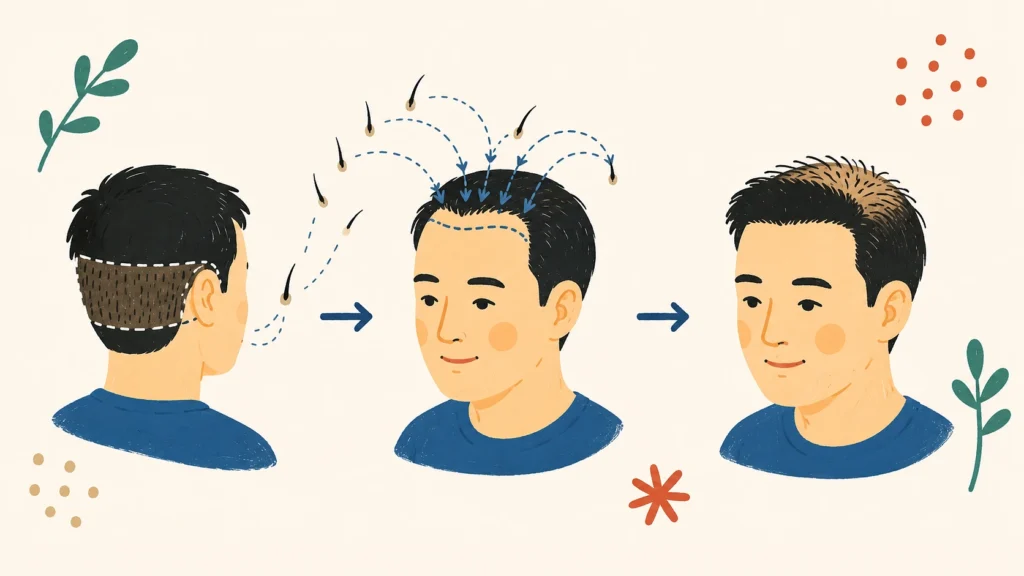
This is the single most misunderstood thing about the procedure and I want to be blunt about it, because the misunderstanding is what wrecks results five years down the road.
Male pattern loss is DHT slowly shrinking follicles that are genetically sensitive to it. The hair on the back and sides mostly isn’t sensitive, which is why a surgeon takes from there. Move those follicles up top and they keep their programming, so they grow. Great. Permanent, even.
But the native hair sitting right next to them still has the original programming, and it keeps thinning on schedule. Nothing about the surgery changes that. Clinical guidance on this is not subtle, one hair restoration practice puts it flatly transplanted hair is permanent, surrounding native hair continues to thin without medical management, and a transplant does not halt progression.
So picture a guy at 28 who gets 2,500 grafts into a receding hairline. Looks fantastic at month twelve. Now it’s year four, and the native hair behind that new hairline has kept miniaturizing, and he’s got a strip of dense transplanted hair with a thinning zone opening up behind it. That’s not a failed surgery. The surgery worked. He treated a symptom and skipped the disease, and now the shape of his loss makes the good work look strange.
The Donor Math, Worked Out Like A Bank Account

Think of the donor zone as an account you can never deposit into. Reputable surgeons hold lifetime extraction to 40 to 50 percent of donor capacity, not out of caution for its own sake but because pull more than that and the back of your head starts looking thin and see-through, which is its own cosmetic problem that no second surgery can fix.
Run the ledger for a real person:
- Total account, average patient around 12,500 follicular units.
- Safe lifetime withdrawal: roughly 6,000 to 7,000 grafts.
- Session one at age 27, hairline and temples 2,500 spent. Balance, 4,000 or so.
- Session two at 35, because the crown opened up 2,200 spent. Balance, under 2,000.
- Session three at 44, if pattern loss keeps going you are scraping the account, and whatever the mirror needs at 50 is coming out of nothing.
And here’s what makes the early overspending so costly. The American Hair Loss Association describes the supply situation in their donor management piece with a line I think every 25 year old should read twice: there is never enough donor supply to meet the true demand. Never. Not for anyone. So the surgeon’s job is allocation, not generosity, and a clinic that offers you a huge first session is spending money you’ll want later.
The ISHRS position on timing follows straight from this, and it’s the reason good surgeons will tell a young patient no. Their guidance is to defer surgery until at least age 25 and start medical therapy first to stabilize the loss, because at 22 nobody knows yet where the pattern is headed. Aggressive extraction in young patients is one of the leading causes of running dry decades later.
What Density Can A Transplant Actually Give You?
Somewhere around 40 to 50 percent of your original density, and that is the honest ceiling, not a low-effort result.
Two things cap it. The account math above, obviously, since covering a large area at full density would blow the whole budget on the frontal third. But there’s a biology limit too: every transplanted follicle needs oxygen and nutrients from the surrounding tissue until it builds its own blood supply, and packing grafts too tightly makes them compete for that supply, which kills yield.
Here’s the part that saves people from disappointment, though. The eye reads coverage, not counts. Once you get past roughly half the original density in a given zone, most people looking at you cannot tell the difference, because hair mostly works by blocking light from hitting scalp. So the realistic target isn’t the head you had at 19. It’s a frame that looks like hair rather than skin, and that’s genuinely achievable for a lot of patients.
The crown is the exception worth flagging. It’s a swirl, so it needs more grafts to look right, it takes longest to show, and on a limited budget good surgeons deprioritize it. If a clinic promises you a full crown and a full hairline on one modest donor supply, they’re describing a head they cannot build.
The Medication Conversation You Can’t Skip
Since surgery doesn’t touch the underlying loss, something has to, and that’s where finasteride and minoxidil come in. Clinical write ups describe medical therapy after a transplant as non-negotiable for protecting the native hair, and the logic is airtight: keep the hair you still have, and the transplanted hair has something to blend into for decades instead of standing alone.
Now, honestly. This is where I’d push back on how casually some clinics hand out prescriptions. Finasteride works by blocking DHT systemically and it comes with a real side effect discussion, sexual side effects being the one most men have heard about and worry over, and that discussion belongs with a physician who examines you, knows your history, and follows up. Not with a package coordinator over WhatsApp. Ask about it, weigh it honestly, and make the call with a doctor.
What I’d say plainly is this if you are not willing to consider ongoing medical treatment, you should think hard about whether surgery makes sense at all, because you’re buying an island and letting the water rise around it.
Who Shouldn’t Get One, At Least Not Yet
Not every scalp is a candidate, and a good consultation is partly a screening.
- Diffuse unpatterned alopecia, where the donor zone itself thins all over. There’s no reliably permanent hair to move, which makes it a contraindication rather than a challenge.
- Low donor density, under about 50 follicular units per square centimeter, which meaningfully limits what any surgeon can accomplish regardless of skill.
- A donor zone already showing miniaturization, above roughly 10 to 15 percent on tracheoscopy, which suggests the safe zone may not be as safe as it looks.
- Young patients with active, unmapped loss. Not permanently disqualified, just too early, and the wait usually pays for itself.
A clinic that finds every single person who fills out the form to be an excellent candidate is not running a screening. It’s running a sales funnel.
The Question That Exposes A Clinic Mill
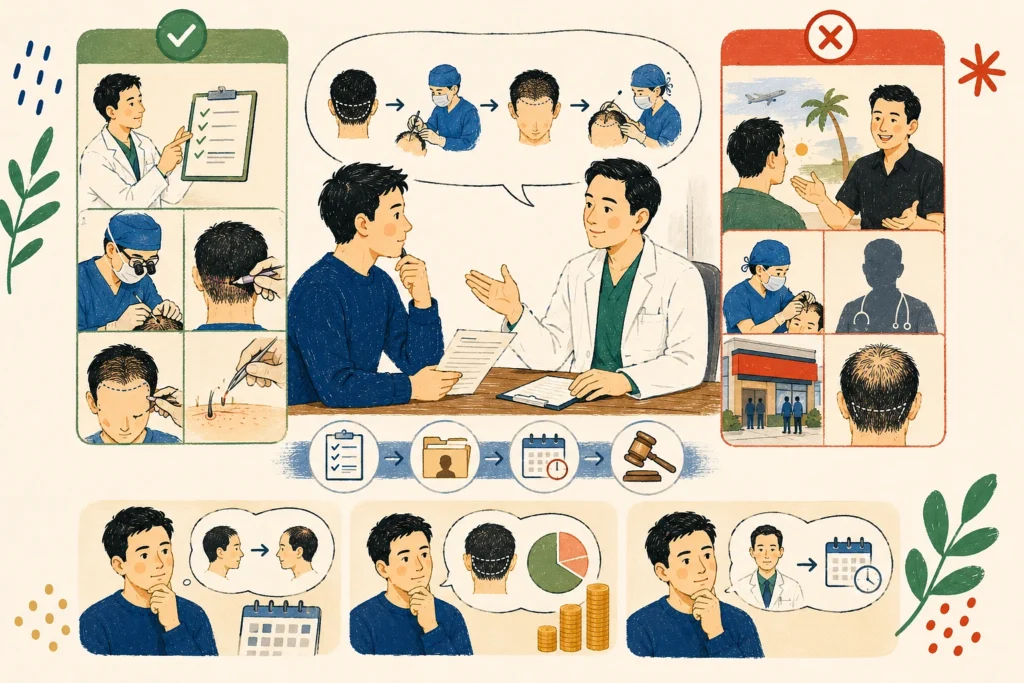
Ask this, in writing, and read how they answer:
“Which specific steps will the licensed physician personally perform, and which will technicians perform?”
That’s it. That question does more work than any before and after gallery, and here’s why it lands where it does.
The ISHRS ran a consumer campaign called Fight the FIGHT specifically because non physicians performing hair restoration surgery had become a global problem, and their buyer beware alert on medical tourism describes clinics where technicians perform surgery under the cover of a licensed doctor’s name, a setup patients rarely find out about until something goes wrong. The society’s 2025 practice census found 59.4 percent of member surgeons reporting black market clinics in their own cities, up from 51 percent in 2021, and this is not only a Turkey story despite the headlines, there are documented cases across Europe and the US.
The steps that should be physician work are specific, and they’re the ones that determine your result: the diagnosis, the hairline design, the extraction of grafts, and the incisions where every graft will sit. Angle, depth, direction, density, all decided in that incision phase. A “token doctor” clinic answers the question with something warm and vague, our expert team, our experienced staff, our doctor supervises. A real clinic answers with a name, a license number, and a list of steps.
And I’ll be honest, the thing that gets me about this whole corner of the industry is who it targets. Turkish authorities shut down dozens of unaccredited Istanbul clinics in 2024, places running procedures in the $600 to $1,000 range, and the patients getting hurt were mostly guys who couldn’t afford to be wrong. Botched work, permanent scarring, a wrecked donor zone, and repair surgery that costs multiples of the original and cannot always undo the damage. There’s no gentle way to say that.
Three More Questions Worth Sending In The Same Message:
- What’s your plan for my hair loss over the next ten years, not just this session?
- What’s your estimated lifetime graft budget for me, and how much of it does this session spend?
- Who do I see for follow up, and what happens if the yield is poor at month twelve?
A clinic that all four clearly is worth your money even at a higher price. A clinic that dodges them is telling you exactly what it is, and I’d take the answer seriously.
None of this is medical advice, and your scalp deserves an in person exam by a board certified physician who can measure your actual donor density instead of guessing from a photo you emailed. But walk in holding the ledger at the top of this page, and you’ll have a very different conversation than the one the sales script was written for.

