


$8. That’s a dozen red roses at a major supermarket in August.
$23. Same dozen, same supermarket, the week before Valentine’s Day.
Nothing about the rose changed. It’s the same hybrid tea variety, grown on the same farm in Colombia, flown into the same Miami warehouse, trucked to the same cooler. The USDA has tracked supermarket prices for a dozen red roses weekly since 2011, so that near-tripling isn’t a vibe, it’s a documented annual pattern, and in a typical year the price roughly doubles around February 14. Meanwhile a florist across the street might want $90 or more for what sounds like the same product, and this year some shops are quoting $120.
So is everyone just gouging you?
Mostly no, and the actual answer is more interesting than the cynical one. Once you see where the money goes, you can also see exactly where the escape hatches are, and there are several.
The February Price Is Real Cost, Not Opportunism, And The Supply Chain Proves It
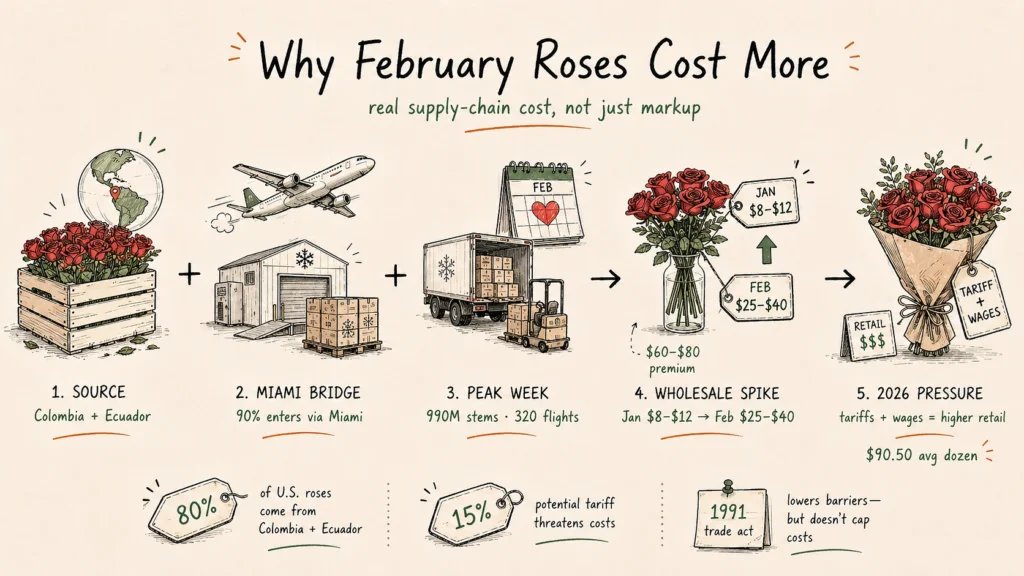
Around 80% of the roses sold in the US come from Colombia and Ecuador, and about 90% of all Valentine’s cut flowers enter through one airport, Miami International, where customs agricultural specialists process roughly 990 million stems in the weeks before February 14. Miami’s biggest flower importer runs about 320 full cargo flights carrying 19,000 tons for the holiday, more than double its normal schedule.
Sit with that for a second. An entire cold-chain airline bridge, spun up for one week, for one flower.
That’s what economists call a peak load problem. Demand for red roses concentrates into a five-to-seven day window, farms have to plant for it months ahead with no ability to scale up at the last minute, every link from greenhouse to cargo jet to refrigerated truck runs overtime, and a product that dies in about a week can’t be stockpiled in advance. Wholesale prices tell the story plainly a dozen standard reds that costs a florist $8 to $12 wholesale in January jumps to $25 to $40 wholesale the week before Valentine’s, with premium Ecuadorian varieties hitting $60 to $80 per dozen at wholesale. The florist’s cost tripled before you walked in the door.
There’s also a 2026-specific layer. Tariffs on Colombian and Ecuadorian imports, Ecuador’s sitting at 15% since last summer, plus a new Colombian minimum wage, have pushed landed costs up again, and New York Fed research finds about 90% of tariff costs land on the US side. One national tracker puts the average dozen at $90.50 retail, up 16% since 2023. Your florist isn’t inventing that.
Here’s the digression I can’t leave out, because it’s the best fact in the whole subject. The reason your roses come from Colombia at all is the war on drugs. Congress passed the Andean Trade Preference Act in 1991, killing tariffs on Colombian goods specifically to pull farmland and labor away from coca and into legal exports, and rose imports jumped over 30% within two years. The bouquet on your kitchen counter is, genuinely, a foreign policy outcome.
Supermarket Roses And Florist Roses Are Different Products Wearing The Same Name
The $23 supermarket dozen and the $95 florist dozen aren’t the same thing marked up differently, and understanding the split is where most of the money gets saved.
Supermarkets treat roses as traffic bait. The USDA’s own price data suggests grocery stores make little or nothing on roses most of the year, they’re priced to get you in the door the way rotisserie chickens are, and even the February price mostly passes through the wholesale spike. What you give up is everything around the flower the stems are typically shorter grades, the blooms are smaller-headed varieties bought on volume contracts, nobody’s stripping guard petals or re-cutting stems, and the bouquet was packed days ago to survive a truck, not arranged this morning.
The florist’s $90 buys four things the supermarket doesn’t sell. Longer premium stems, usually the 50 to 60 centimeter grades with bigger heads. Conditioning, meaning the roses were unpacked, hydrated, trimmed and stored properly instead of sleeved on a shelf. Design and hardware, the vase, the greenery, the arranging labor. And delivery on the single busiest day of the floral year, which is a logistics product all by itself.
So the honest rule is this: pay the florist when the presentation is the point, and pay the supermarket when the roses are. A vased arrangement arriving at her office on the 14th is a florist product. Two dozen stems you’re hand-delivering with dinner at home is a supermarket product, and buying it at florist prices is where the overpaying actually happens.
Stem Count And Stem Length Are The Two Dials, And Nobody Explains Either One
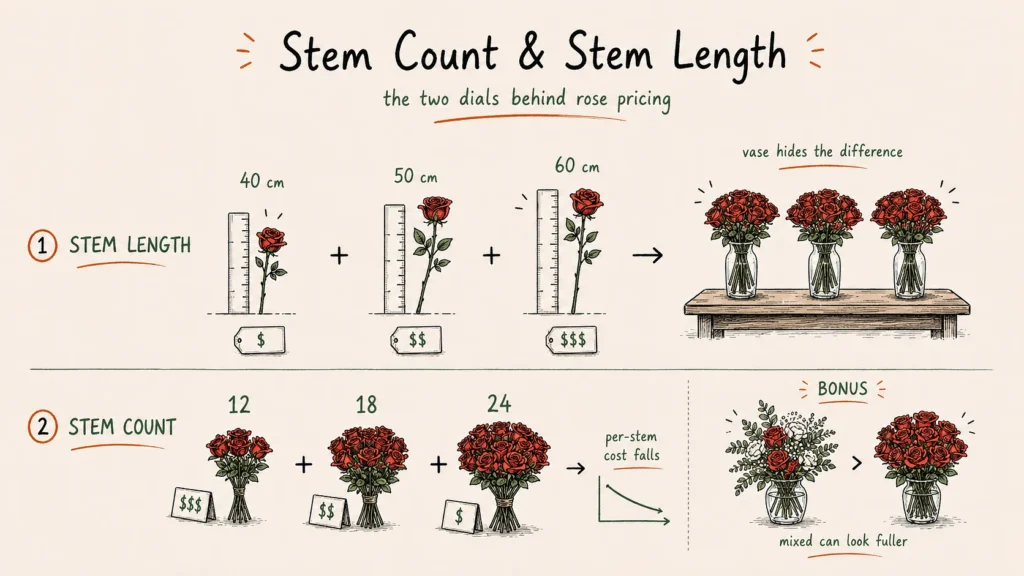
Roses are graded and priced by stem length, mostly 40, 50, 60 centimeters and up, because longer stems mean the plant grew longer per bloom and yields fewer flowers per plant. Length also correlates loosely with head size. None of it changes how the rose smells or how long it lasts in the vase. A 40cm rose in a short vase on a dinner table looks identical to its taller cousin, because the vase hides the only difference you paid for.
That’s dial one. Ask what length you’re being quoted, and if the arrangement is going in a vase anyway, the shorter grade is the same visual for less money.
Dial two is count, and the math rewards doing it out loud. Price the dozen, then price 18 and 24 stems, and divide. Per-stem cost usually falls as count rises, while the dozen carries the premium because “a dozen red roses” is the phrase everyone walks in asking for. Sometimes two dozen shorter-stem roses cost less than one dozen long-stems and land twice as hard on the table. And a single spectacular long-stem rose, presented well, costs almost nothing and outperforms a mediocre dozen more often than the industry would like anyone to notice.
One more count trick florists themselves use. Mixed arrangements built around fewer roses plus filler, ranunculus, spray roses, greenery, routinely look fuller than all-rose bunches at the same price, because roses are the most expensive stem in the shop that week.
The Calendar Does More Work Than Any Coupon
The markup peaks in a narrow window, which means timing is the cheapest tool you have.
- Buying on February 12 or 13 and hand-delivering skips the delivery surcharge and the day-of scramble entirely. Roses opened slightly early look better on the 14th anyway.
- Ordering delivery for the 13th instead of the 14th often costs meaningfully less for the identical arrangement, since you’re stepping out of the peak-load hour.
- Waiting until the 14th to walk in is the single most expensive way to buy, since you’re choosing from whatever survived at whatever it’s marked.
- And roses in the last week of February drop back toward normal pricing, which matters for anniversaries, apologies, and everyone whose relationship doesn’t run on the retail calendar. The August buyer gets the same flower for a third of the money, every year, documented since 2011.
Does that mean the February 14 rose is a ripoff? I’d argue it’s the opposite. You’re paying a real, traceable premium for a flower that was cut on a mountainside in Colombia ten days ago, flown through a cargo bridge that exists for one week a year, and put in front of you on the exact morning that demand peaks. The price is honest. It’s the not knowing which parts of it you can decline, the length grade, the delivery date, the vase, the dozen itself, that costs people money. Now you know, so decline the parts that aren’t doing anything for you and spend the difference on dinner.
References:
- Cohen J. “Americans spend millions of dollars on Valentine’s Day roses. I calculated exactly how much.” The Conversation, using USDA weekly price data.
- farmdoc daily, University of Illinois. “Valentine’s Day and the Gains from Agricultural Trade: Cut Flowers in the US,” February 2025.
- Associated Press. “Valentine flower imports increase at Miami airport, despite tariffs and higher costs,” February 2026.
- Washington Post. “From Colombia with love: The journey of a Valentine’s Day bouquet,” February 2025.

