


When the Spanish Fertility Society presented its national registry in Madrid in September 2022, the line that got picked up was about donor egg cycles. Where the embryo had been grown to day 5 before transfer, 45 percent of transfers ended in a birth. Where it had been transferred on day 2 or 3, the figure was 34.5 percent. Same donors, same patients, 10 points of difference, and the only thing that changed was waiting 3 more days in the lab.
That registry is the background to the choice this post is about. Spanish clinics used to sell donor treatment by the egg, 6 or 8 or 10 mature ones handed over for your cycle. Once day 5 transfer became the standard, the better clinics started selling the finished article instead, a set number of day 5 embryos ready to transfer, and the older egg count offer is still sold alongside it, usually a little cheaper.
What Each Offer Promises
The egg count offer promises a number of mature eggs from a donor, retrieved, fertilized with your partner’s sperm or a donor’s, and grown in the lab. Six is the floor at most clinics, 8 is common, and Instituto Bernabeu in Alicante promises 8 with an average of 11. Whatever those eggs turn into is yours, however many or however few.
The day 5 embryo offer promises an outcome from the lab rather than an input to it. One embryo, or 1 plus a second if the first does not take, or 3 in a row. The clinic uses as many donor eggs as it needs to get there, and if the first donor’s eggs do not produce the number promised, it goes to a second donor at its own cost. Natuvitro in Barcelona prices its IVF with egg donation this way, 5,795 euros for 1 embryo and 7,995 euros for 1 plus 1, and IVI, Barcelona IVF and most of the larger groups publish a similar ladder with figures a little above or below those.
The egg offer hands you the raw material. The embryo offer hands you the result. That is the difference, and the price gap between them, usually 1,000 to 2,000 euros, is what you pay for not carrying the lab risk yourself.
What Happens To 10 Eggs In The Lab
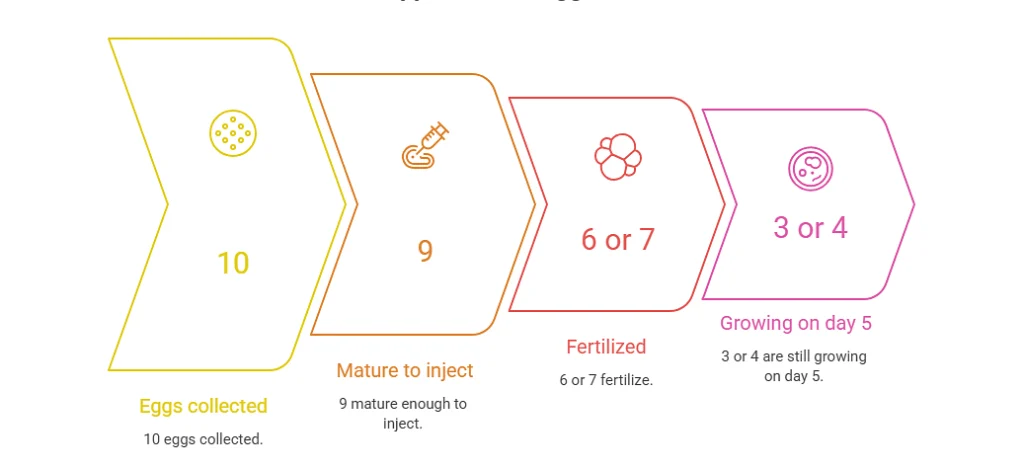
The lab chain is the part patients do not see, and it is where the 2 offers part company, so it is worth having the typical numbers in your head. Bernabeu publishes its own: about 10.5 eggs retrieved per donor cycle, 90 percent of them mature, 75 percent of the mature ones fertilizing normally. Natuvitro states the last step on its page, that around half of fertilized embryos reach day 5.
- 10 eggs collected.
- 9 mature enough to inject.
- 6 or 7 fertilize.
- 3 or 4 are still growing on day 5.
So a promise of 8 mature eggs mostly ends as 3 embryos, give or take 1, and a promise of 1 embryo is mostly met from the first 3 or 4 eggs with plenty left over. Mostly. Some donor cycles give 6 embryos from 10 eggs and some give 1, and once in a while a cycle gives none, because the sperm did worse than its test suggested or because the embryos stopped on day 3 for reasons the lab cannot see coming. That cycle is the one both offers are really priced around.
The Cycle That Goes Wrong
Take the bad cycle, 8 eggs that end as 1 weak embryo on day 5.
On the egg count contract, the clinic has delivered. Eight mature eggs were handed to the lab, and the contract said 8. The weak embryo is transferred or not, and if there is to be another go, it is a new donor, a new stimulation and a new lab fee, at full price or a discounted one depending on the clinic’s goodwill. Patients in this situation have spent 6,000 euros and are looking at another 5,000 or so before they get to a second transfer.
On the embryo contract, the clinic has not delivered. It owes you the number of day 5 embryos it promised, so it goes back to the donor or to a second donor, and the price you signed does not move. The clinic absorbs the second stimulation, and that cost is already built into the 1,000 or 2,000 euros extra you paid up front.
In the cycle that goes to plan, the 2 offers end in about the same place and the egg count one may leave you with more embryos in the freezer for less money. In the cycle that fails in the lab, the embryo offer is far cheaper, because the failure is the clinic’s bill and not yours. Which cycle you are going to get is the one thing neither you nor the clinic knows on signing day.
Storage Is Billed On Both
Neither offer includes keeping spare embryos frozen beyond the first year, and on some lists not even the freezing itself, so the storage line is the first thing to find in the small print on either contract.
Four Words In The Contract That Change Its Value
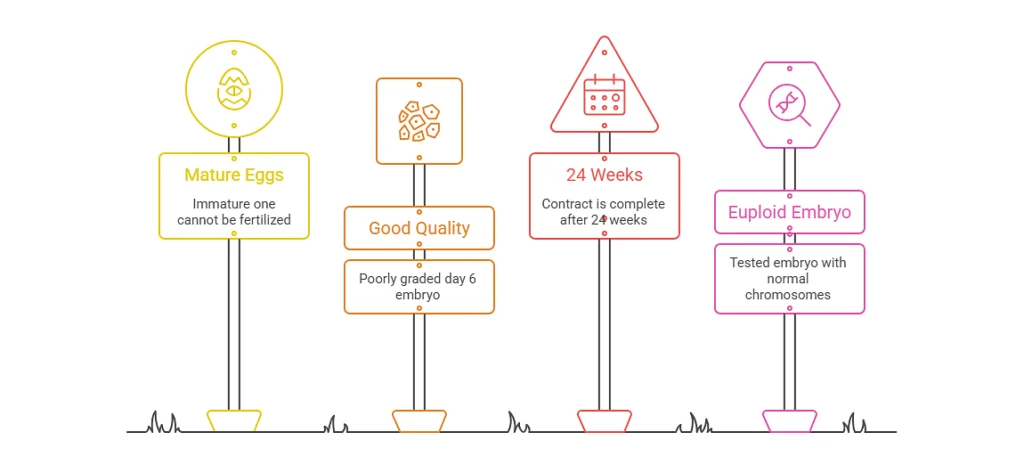
Mature:
An egg count is only worth anything if it counts mature eggs, since an immature one cannot be fertilized and some clinics count everything retrieved. The word should be in the contract, not in the brochure.
Good Quality:
Embryologists grade a day 5 embryo by how far it has expanded and how its 2 cell groups look, and a poorly graded day 6 embryo implants far less often than a well graded day 5 one. A contract that promises “a blastocyst” can be met with the former. One that promises “a good quality blastocyst” cannot, and that is the version to insist on.
24 Weeks:
On the 1 plus 1 and 1 plus 1 plus 1 packages, the second and third transfers stay available if the pregnancy ends before week 24. If it passes week 24 the contract is complete, whatever happens after, and nothing is refunded. Read that clause slowly, because it is the one families get surprised by.
Euploid:
Some clinics now sell a tested embryo, biopsied and shown to have a normal chromosome count, at roughly double the price, around 14,000 euros for 1 plus 1 at the Barcelona clinic mentioned earlier. With eggs from a donor in her twenties the share of embryos that are already normal is high, so the test adds less than it does with a 40 year old’s own eggs. Ask what the clinic’s untested donor embryos implant at before paying for it.
Donor sperm, if it is needed, medication, and the genetic matching test between donor and patient sit outside both offers at every clinic, usually another 1,500 to 2,500 euros in all.
Why Spain Can Make These Promises
A clinic can only promise a result from the lab if it has donors to go back to, and Spain has more of them than anywhere else in Europe. Donation there runs under Law 14/2006, which keeps it anonymous and altruistic, with donors between 18 and 35 paid a fixed sum for time and inconvenience rather than a price for the eggs. Spanish centers carry out somewhere around 40 percent of all donor egg cycles in Europe and the wait for a matched donor is a matter of weeks. The SEF’s latest registry, for 2022, counted more than 167,000 IVF cycles in the country in a single year.
For British readers there is a second thing to settle before the package. A child conceived from a Spanish donor cannot trace her at 18, where a child conceived from a UK donor can, and the HFEA’s page on treatment abroad is plain that it cannot take a complaint about a clinic outside the UK. That gets decided before any price list is opened.
The treatment itself takes about a month to find and prepare a donor, then her stimulation and retrieval, 5 days in the incubator and the transfer, and most Spanish clinics run it with 2 visits in person. There is a longer walk through of that calendar in this post on how long IVF takes, and the donor version follows the same shape with the stimulation weeks moved from the patient to the donor.
The One Question To Ask Before Signing Either
Ask the clinic, in writing, how many day 5 embryos its lab gets on average from 8 mature donor eggs.
A clinic that answers with a number, 3.2 or 2.8 or whatever it is, knows its own lab, and with that number in hand you can work out for yourself what its egg count offer is really worth. A clinic that answers with a pregnancy rate has not answered, so ask again. If the number comes back at 3 or better and the sperm side has tested well, the egg count offer is a fair bet and probably the better one for a couple who want a second child from the same donor later. If the number is lower, or the clinic will not give one, or this is the one cycle the budget allows, take the embryo offer with the second transfer built in, because a good embryo that does not implant first time is the most common way a donor cycle fails and that package has already paid for the retry.
One more thing to check before anything else is discussed. The SEF advises clinics not to transfer to women over 50, and most Spanish centers follow it, so anyone close to that age should ask about the limit on the first call.

