


The bed frame was marked “solid wood construction” and I believed it for about four years. Then we moved, a corner caught the doorframe, and a chip lifted off the headboard to reveal a tan, papery layer of compressed fiber underneath, nothing like best wood at all. The label had not lied, exactly. A structural rail somewhere in the frame probably was solid. The big flat panel I looked at every night was a slice of real oak, thinner than a coat of paint, glued over particleboard.
That gap between what the label says and what you actually own is the whole subject here. Both materials have a legitimate place, and veneer is not the villain the internet sometimes makes it. But “timeless,” the word every showroom reaches for, is true of exactly one of these constructions and marketing on the other, and telling them apart takes about ninety seconds of looking in the right places.
What These Words Actually Mean
Solid wood means boards of real lumber, the same material all the way through. Cut it, sand it, gouge it, and it is wood underneath, because it is wood everywhere.
Veneer is a thin slice of genuine wood bonded over a core of something else. The surface is real timber, walnut or oak or ash. What sits beneath it is the part that decides almost everything, and it is usually one of three things: plywood, MDF, or particleboard.
That core hierarchy matters more than the veneer on top, so hold onto it:
- Plywood core is the good news under a veneer. Layered, strong, stable, and it holds screws and survives moves. High-quality veneered furniture is frequently built this way, and there is nothing second-rate about it.
- MDF core is dense and smooth and stable, takes a finish beautifully, but swells permanently if water reaches it and holds screws poorly over time.
- Particleboard core is the mass-market floor, larger wood chips pressed with resin, and it rarely survives a house move intact.
So “veneer” alone tells you very little. A walnut veneer over marine plywood is a genuinely good bed. The identical-looking walnut veneer over particleboard is a countdown. Same face, completely different object.
How Thin Is the Real Wood, Actually?
Thinner than most people picture, and this is the fact that governs everything about repair.
Veneer runs anywhere from about 0.5mm to 3mm, and in most modern commercial furniture it sits at the low end, often under one millimeter. Hold that against a coat of house paint, which is roughly 0.1mm, and you realize the “real wood surface” you are buying can be just a handful of paint-coats thick. It looks identical to solid timber. It behaves nothing like it the first time the surface is damaged.
The Ninety-Second Test in the Showroom
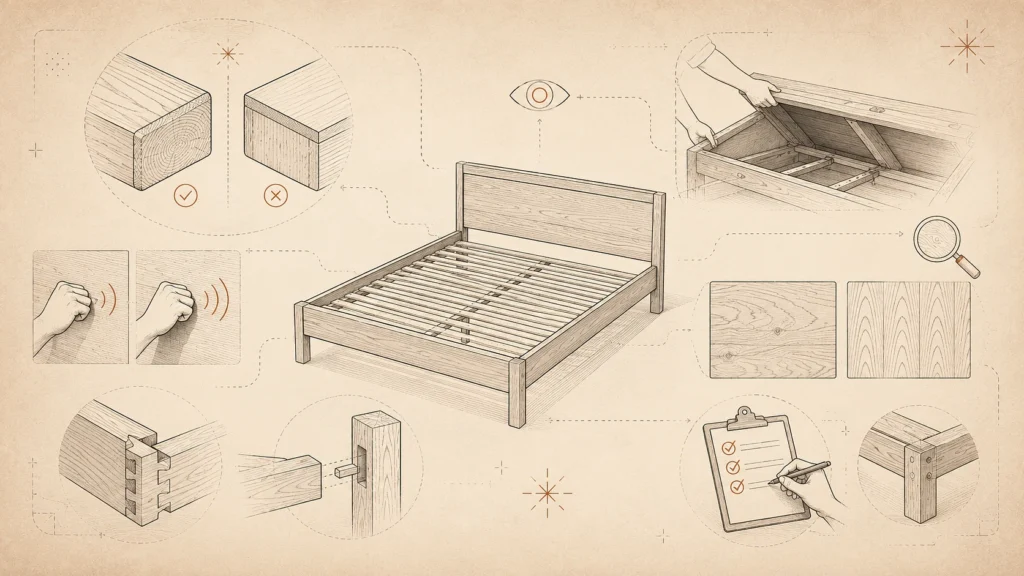
Here is where you stop trusting the label and start looking, and none of it requires tools.
Check the edges first. On solid wood, the grain on the top surface flows over the edge and continues down the side, because it is one piece of wood. On veneer, the top grain stops at the edge and a different strip, the edge banding, takes over. A seam where the top meets the side is the single clearest tell there is.
Look underneath and inside. Solid pieces show real, slightly irregular grain even in the hidden spots, the underside of a rail, the inside of a leg. Veneered and engineered pieces show a smooth, grainless, or suspiciously uniform surface where nobody was meant to look.
Then a few more:
- Knock it. Solid wood gives a dense, dull thud. Hollow or engineered cores ring lighter and higher.
- Find a repeating grain pattern. Real lumber never repeats. Printed or matched veneers sometimes show the same “knot” twice on different panels.
- Look at the joinery. Dovetails and mortise-and-tenon joints, visible on drawers and frames, signal a maker building for the long haul. Staples and cam-lock bolts signal the other thing.
- Ask the seller, in writing, exactly what every part is made of. A brand that builds honestly answers instantly. A brand that dodges has told you the answer.
Have you ever actually turned a bedroom frame over before buying it? Most people never do, and it is where the whole truth is kept.
Chart One: Reading the Real Differences
| What you’re weighing | Solid Wood | Veneer over plywood | Veneer over MDF or particleboard |
|---|---|---|---|
| The visible surface | Real wood throughout | Real wood slice | Real wood slice |
| What’s underneath | Same wood | Strong layered ply | Fiber or chip board |
| Refinishing | Many times, over decades | Light refresh only | Essentially none |
| Surviving a move | Very well | Well | Often poorly |
| Water on an edge | Swells slightly, recovers | Resists if sealed | Swells and stays swollen |
| Weight in the room | Heavy | Medium | Light |
| Honest lifespan | Generations | Many years | A handful of years |
When “Timeless” Is Actually True
Now the promise in the title, because “timeless” gets stamped on both materials and it is only ever true of one.
A thing is timeless when it can be renewed. Solid wood can be sanded back and refinished many times across its life, which means the scratches from this decade disappear into the fresh surface of the next one. Spill something, gouge it, let a kid attack it with a toy car, and in twenty years a refinish erases all of it and the bed looks near-new, because there is always more wood beneath the wood. That capacity to be restored, not any particular grain or stain, is what makes a piece an heirloom. A material that can be repaired is timeless; a material that can only be replaced is temporary, whatever the showroom calls it.
Veneer cannot do this, and it is honest to say why. The wood layer is too thin to sand. Try to refinish a veneered surface and you cut straight through the real wood into the core, and the piece is finished. A chipped edge exposes a substrate that will never match. So a veneered bed is bought for how it looks now, maintained gently, and eventually retired rather than restored. That is a completely reasonable thing to buy. It is simply not a timeless thing, and no amount of the word on a tag changes the thickness of the slice.
One fair complication, so this stays honest: veneer earns its keep on wide flat spans. Solid wood is alive to the weather.
The Part About Wood That Moves
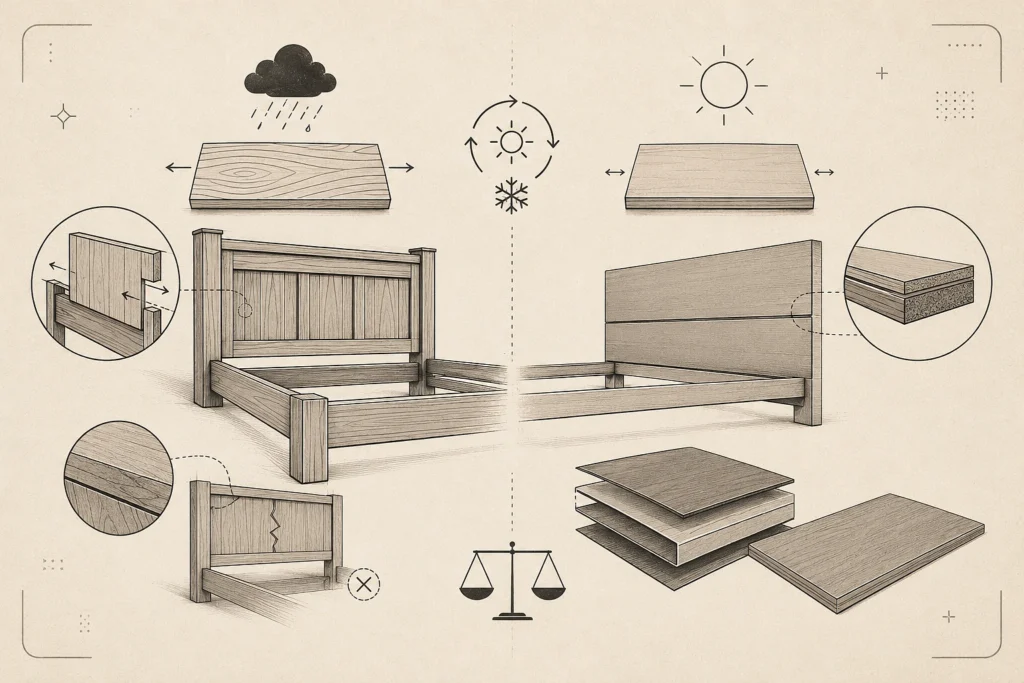
Solid timber expands in humid months and contracts in dry ones, every year, slightly, forever. Good makers plan for it with joinery that lets panels float while the frame holds steady, which is why a well-built solid headboard has those construction details in the first place. A cheap solid piece with everything rigidly fixed can actually crack as it moves against itself.
Veneer over a stable core barely moves at all. That is the genuine engineering reason luxury makers like Roche Bobois and BoConcept use expertly matched veneers on their widest surfaces, not to cut corners but because a four-foot solid panel fights the seasons harder than a veneered one does. On a big flat expanse, stability is a real virtue, and veneer delivers it. The trouble only starts when that same logic is quietly applied to a whole bed and sold under a word it has not earned.
Chart Two: Which One Actually Fits You
| If this is you | Lean toward | Because |
|---|---|---|
| Want one bed for the next thirty years | Solid hardwood | It can be refinished as life scratches it up |
| Renting, moving often, tighter budget | Veneer over plywood | Real-wood look, lighter, survives careful moves |
| Style-led, expect to redecorate in years | Quality veneer | You want how it looks now, not evolution |
| Family bedroom, worried about off-gassing | Solid hardwood | No MDF or particleboard resins in the room |
| Chasing the lowest price above all | Buy with open eyes | Particleboard core is fine short-term, not forever |
Notice the fourth row, because it rarely makes these comparisons. MDF and particleboard cores are held together with resins that can release VOCs, formaldehyde among them, and that is a reasonable thing to ask about for a room you sleep in eight hours a night. Solid hardwood with a water-based or hard-wax-oil finish sidesteps the question entirely. Veneer over plywood sits in between and depends on the adhesives. It is not a reason to panic. It is a reason to ask.
So, what are you really buying? A solid bed is a decades-long relationship you can repair your way through. A veneer bed is a good-looking piece with a known, finite life, and a great value when you buy it knowing that. The mistake is never choosing veneer. The mistake is paying solid-wood prices for it because a label used a word, and now you can turn the frame over and check before that happens to you.

