

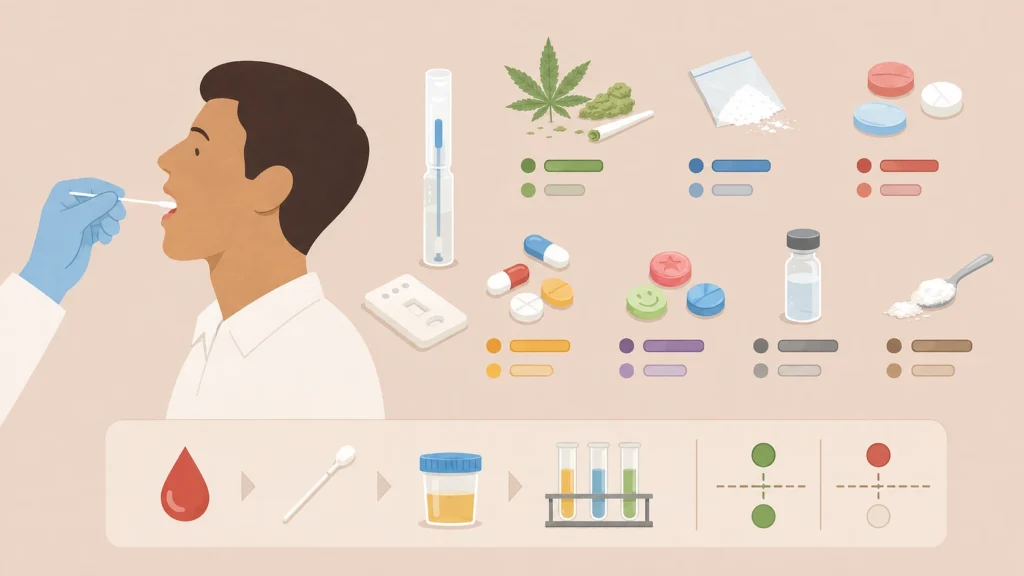
A urine test looks for what your body did with a swab drug test. A mouth swab looks for the drugs medications.
That single difference explains every number in this story, and it is the reason a cannabis user can fail a urine test three weeks after use and pass a saliva test three days after use. Urine screening targets stored metabolites. Oral fluid screening targets the parent compound, which is present while the swab drug is actually circulating and gone shortly afterward.
The Published Window is 5 to 48 Hours
The figure comes from Verstraete’s review of detection times across blood, urine and oral fluid, which found saliva drug test australia of abuse detectable in oral fluid for 5 to 48 hours at low nanogram per millilitre levels. Labcorp cites the same range in its own oral fluid documentation.
For comparison, from the same body of work:
- Blood: most drugs detectable for one to two days.
- Urine: 1.5 to 4 days after a single dose, roughly a week in chronic users, longer in extreme cocaine and cannabis cases.
- Hair: up to 90 days.
So the ordering runs hair, then urine, then oral fluid, then blood. Saliva sits near the short end deliberately. It was never designed to find historical use.
What That Means Drug By Drug
| Substance | Typical oral fluid window |
|---|---|
| THC, occasional use | around 24 hours |
| THC, heavy or chronic use | 24 to 72 hours |
| Cocaine | 24 to 48 hours |
| Amphetamines and methamphetamine | 24 to 50 hours |
| Opiates including codeine, morphine, heroin | 24 to 36 hours |
| PCP | up to 72 hours |
| Benzodiazepines | highly variable, hours to several days |
| Alcohol | roughly 6 to 12 hours, longer on low-cutoff EtG panels |
Detection also starts fast. Most substances appear in oral fluid within minutes of use, which is why these tests are the standard choice for post-accident and roadside screening rather than for pre-employment history.
The Exceptions That Break The Headline Range
The 5 to 48 hour figure describes typical use. Chronic heavy use is a different situation and the literature is honest about it.
Elimination of cocaine in saliva may extend to around 10 days in chronic users, and some sources report similar extended windows for methadone. Heavy cannabis use pushes THC past the 48 hour mark into roughly 72 hours.
None of that makes the headline wrong. It means the range describes the middle of the distribution, and heavy users sit outside it.
Why Cannabis Behaves So Differently In Saliva Than In Urine
This deserves its own explanation because it causes more confusion than anything else in workplace testing.
Urine tests look for THC-COOH, an inactive metabolite that is fat-soluble and accumulates in tissue. In a daily user it can persist for weeks. Oral fluid tests look for delta-9-THC, the active compound itself, deposited in the mouth during smoking and cleared over roughly 12 hours with a rapid initial drop.
The practical consequence: an oral fluid positive indicates recent use in a way a urine positive does not. Employers in legal-cannabis states have moved toward oral fluid for exactly this reason, since it distinguishes someone impaired on shift from someone who used on a Saturday.
Passive exposure is not a realistic worry. Someone who inhaled second-hand cannabis smoke tests negative within about an hour, so a positive result is not explained by having been in the room.
The Federal Cutoffs, Since a Positive Is Defined By a Number
Non-federal labs set their own thresholds, but most follow SAMHSA. The Mandatory Guidelines for Federal Workplace Drug Testing Programs covering oral fluid were published in the Federal Register in 2019, and the Department of Transportation subsequently permitted oral fluid as an alternative specimen in regulated testing.
Initial and confirmation cutoffs in nanograms per milliliter:
- THC: 4 initial, 2 confirmation.
- Cocaine: 15 initial, 8 confirmation.
- Heroin, as 6-AM: 3 initial, 2 confirmation.
- Other opiates: 30 initial, 15 confirmation.
- Amphetamine and methamphetamine: 25 initial, 15 confirmation.
- MDMA: 25 initial, 15 confirmation.
- PCP: 3 initial, 2 confirmation.
A result under the cutoff is a negative even if the substance is technically present. That is not a loophole, it is how every drug test in every matrix works.
Collection Details That Affect The Result
Donors are asked not to eat or drink for 10 minutes before collection. That is not ceremony. Food, drink, mouthwash and recent smoking all alter what is in the mouth at that moment.
There is a more interesting effect in the research on saliva stimulation. Agents that increase saliva flow, citric acid sweets and chewing gum among them, have been shown to dilute drug concentrations substantially, by two to six fold for codeine, two to four fold for methamphetamine, and around five fold for cocaine. That is a false-negative risk rather than a detection advantage, and it is a large part of why collectors control the pre-collection window and observe the sample being taken.
Which points at the real strength of this method. Collection is supervised, requires no restroom, and is difficult to tamper with. Urine collection is usually unobserved, which is where most adulteration happens.
Accuracy Compared to Urine
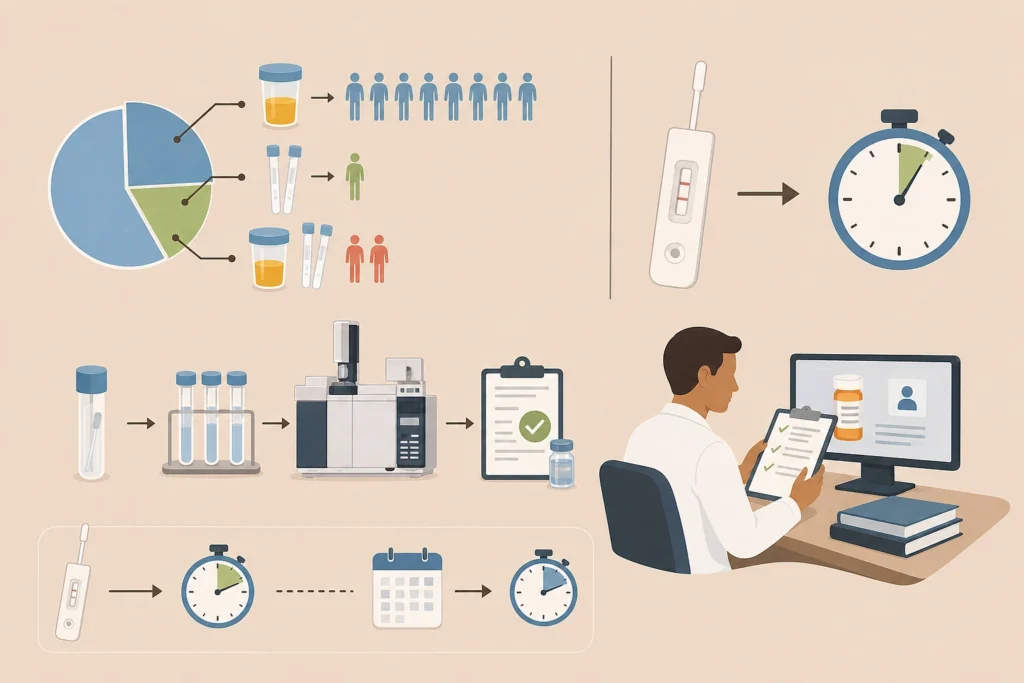
A comparison study of the two found urine more likely to identify substance use overall. Of 12 positive results across the study, nine came from urine alone, one from saliva alone, and two from both.
Instant oral fluid devices perform respectably against lab analysis, with one mobile system measured at 97.5% agreement with laboratory testing. But a presumptive positive from any instant device is not a final result. It should go to a laboratory for confirmation and then to a Medical Review Officer, who checks whether a prescription explains it before anything is reported to an employer.
Timing: instant devices give a reading in minutes. Lab analysis runs 1 to 3 days, with confirmation adding another 2 to 3 days.
Where This Test is The Right Tool And Where It Is Not
It suits post-accident testing, reasonable-suspicion testing, roadside screening and random testing in safety-sensitive roles, because all of those ask about now.
It suits pre-employment screening poorly. A candidate who abstains for three days across an interview process passes, and the test cannot say anything about the pattern of use behind that. Urine covers a longer window and hair covers months.
Employers should also check their own jurisdiction before building a program around it. Federal rules now accommodate oral fluid, state law varies considerably, and some states restrict when testing can occur at all, with California permitting pre-employment testing only after an offer has been extended.

