


The standard corporate hotel room is designed for a two-night stay. Everything about it, from the workspace to the storage to the food options to the mental atmosphere, is optimised for someone flying in Tuesday, presenting Wednesday, and flying out Thursday morning. That product works well for what it is. It also stops working well the moment the trip stretches past three nights, which is where most business travel is now heading.
The Australian business trip has quietly lengthened over the past few years. Industry data now puts the average corporate stay at around six nights, driven partly by the shift to bleisure travel and partly by a broader move toward longer, denser trips that combine multiple client meetings, internal team catch-ups, and personal time. The problem is that most companies still book their travelling staff into the same category of accommodation they used when the average trip was three nights. That mismatch is why so many corporate travellers now describe returning from Sydney trips feeling more depleted than restored.
The reasonable move isn’t to book a fancier hotel. It’s to recognise that a five-to-seven-night stay is a different product category from a two-night stay, and to book accordingly.
What Actually Breaks After Three Nights
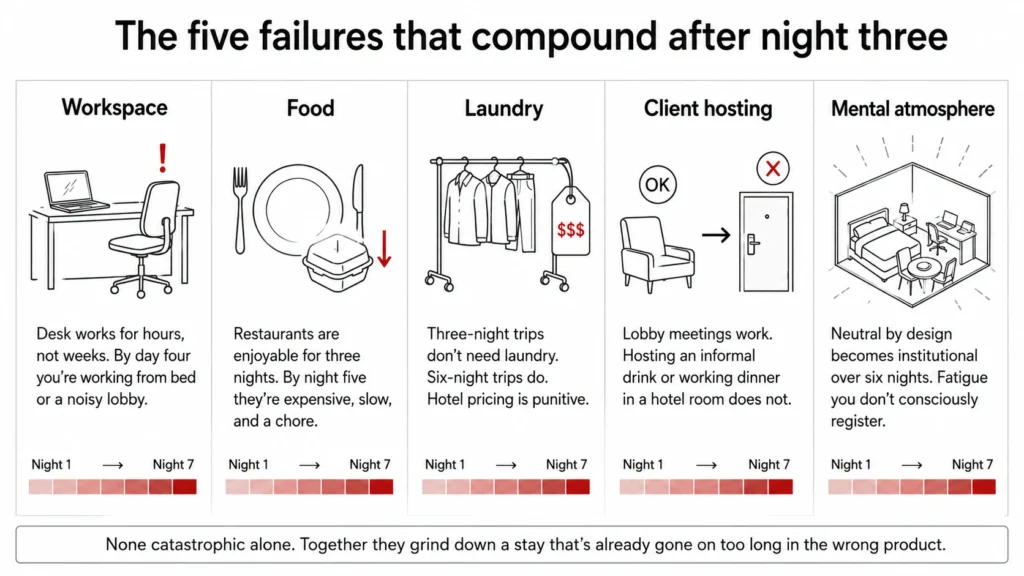
The failures of a standard hotel room on longer stays are predictable and cumulative. None of them are catastrophic on their own. Together they add up to a stay that quietly grinds you down.
The workspace stops being adequate. A hotel desk with a wobbly office chair works for a couple of hours of laptop work. It doesn’t work for a full week of remote calls, video meetings, and focused document review. By day four you’re either working from bed or from a lobby that isn’t as quiet as you need it to be.
Food becomes a problem. Restaurant meals every night are enjoyable for two or three nights. By night five they’re expensive, slow, and starting to feel like a chore. There’s no space to make a simple breakfast, no fridge for the groceries you’d actually want, and no proper kitchen to cook a straightforward dinner when you’ve had enough of Sydney’s admittedly excellent restaurant scene.
Laundry compounds. A three-night trip doesn’t need laundry. A six-night trip does. Hotel laundry pricing is punitive and the turnaround times don’t work for compressed corporate schedules. Most travellers end up either paying too much for laundry or bringing significantly more luggage than they’d like.
Client hosting gets awkward. Meeting a client in a hotel lobby is fine. Hosting an informal drink or a working dinner in a hotel room isn’t really possible, which means every client interaction has to happen in a restaurant or coffee shop. That works but it limits the kind of relaxed, extended conversation that often produces the best business outcomes.
The mental atmosphere accumulates. Hotel rooms are designed to feel neutral and slightly transactional. That’s fine for a short stay. Over six nights, the same design starts to feel institutional. There’s no personal space, no separation between work and rest, no visual variety. This is the piece most business travellers don’t consciously register but that shows up in the fatigue they bring home.
What the Longer-Stay Product Actually Looks Like

The category that solves these problems isn’t a luxury hotel. It’s serviced apartment-style accommodation, which is a genuinely different product designed for stays that hotels don’t handle well.
The essential difference is the split between living and sleeping space. A good serviced apartment gives you a bedroom for sleep, a separate living area for work and hosting, a full kitchen for food, and a laundry for the practical stuff. This lets your day have distinct modes: work in the living area, meals in the kitchen area, sleep in the bedroom. Hotels collapse all of that into one room and the friction shows up over time.
For Sydney specifically, the placement of the accommodation matters as much as the format. The Sussex Street corridor sits between the CBD and the harbour precinct, which gives corporate travellers walking access to both financial-district meetings and the waterfront entertainment areas without needing transport in between. That reduces one of the biggest daily frictions of Sydney corporate travel, which is that the CBD and the harbour venues are close enough to be one district in principle but far enough apart to be a taxi ride in practice.
Properties like the Sydney penthouses in Sussex street are examples of what the longer-stay product looks like when it’s built for corporate travellers rather than adapted from a hotel model. Separate living and workspace areas. Full kitchen. Laundry. The kind of city and harbour views that mean the space is genuinely pleasant to be in for a full week rather than merely functional. It’s the type of accommodation that changes what a six-night Sydney trip actually feels like, and it’s priced closer to premium hotel category than to any imagined luxury tier.
The Corporate Travel Policy Question

The most useful conversation this shift produces isn’t about individual travellers upgrading their own bookings. It’s about corporate travel policy catching up to how trips have actually changed.
A lot of company travel policies were written when the average trip was three nights and hotels were the obvious answer. Those policies now push travellers into accommodation that’s suboptimal for the trip length, then treat any deviation from the policy as an upgrade request. That framing is backwards. Serviced apartments for stays over four nights aren’t an upgrade. They’re the right tool for the job at a comparable or lower total cost when you factor in laundry, food, and productivity impact.
Companies that have updated their travel policies to make apartment-style bookings the default for stays of five nights or more consistently report better traveller satisfaction and, more importantly, lower burnout on repeat-trip roles. That last piece matters because burnout on frequent-travel roles is a real driver of turnover in senior client-facing positions, and turnover is far more expensive than the modest per-night difference between a hotel and a serviced apartment.
The Practical Version for Sydney
For anyone booking a Sydney corporate trip that’s going to run five nights or longer, the reasonable approach looks like this. Book accommodation that gives you separate living and sleeping space, full kitchen, and laundry. Prioritise placement over cost per square metre. Choose a location that lets you walk between your working meetings and your evening plans rather than routing through taxis or ride-shares that eat time and mental bandwidth.
The trip you get out of that setup is meaningfully different from the trip you get out of a standard hotel room. Not because the hotel is bad, but because the hotel is designed for something else. Longer trips need a different product, and Sydney has the accommodation stock to support it.
The rest of the shift is behavioural. Treat longer stays as their own category rather than as long short-stays. Book accordingly. The trip that results is the one you actually want.

