


There are at least two published case reports of people turning up at a dentist clinic with dead tissue in their mouth because they packed crushed raw garlic against a sore tooth. One was a 49 year old man with visible localized necrosis of the tissue in his upper vestibule. The other had left crushed cloves in place overnight and developed sloughing and ulceration.
Both of them were following advice that appears on almost every toothache remedy list published online, usually phrased as crush a clove into a paste and place it on the aching tooth.
So before going through what works, it is worth saying that home remedies for tooth pain are not automatically gentle just because the ingredients came out of a kitchen. Some of them are genuinely useful, several do nothing much, and a couple have injury reports in the dental literature.
None of them treat the cause. A toothache is a symptom of something structural, usually decay reaching the nerve, a crack, an exposed root or an infection, and none of those resolve because you rinsed with something.
The Three That Actually Earn Their Place
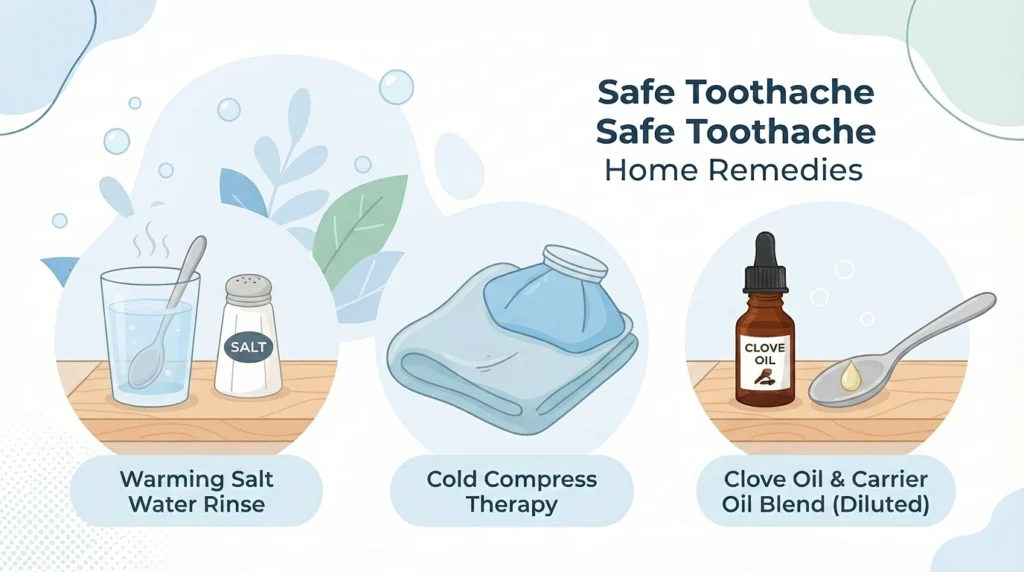
Salt water rinse. Half a teaspoon of salt in a cup of warm water, swished around the sore side for about thirty seconds, then spat out. It works by drawing fluid out of inflamed tissue and flushing debris out of the area, and it is safe enough to repeat several times a day. If something is trapped between teeth and driving the pain, this plus careful flossing sometimes solves the whole problem.
Cold compress. Ice wrapped in a cloth held against the cheek for fifteen to twenty minutes, with a break before repeating. Cold constricts the blood vessels feeding the area, which brings swelling down and dulls nerve signaling. This is the one I would reach for first with any facial swelling, and it is the only item on the list with no realistic downside.
Clove oil, applied correctly. Eugenol, the active compound in clove oil, is a real topical anesthetic with antimicrobial activity, and dentistry has used it for well over a century. The evidence behind it is the strongest of any plant remedy on this list.
The problem is how nearly every article tells you to use it. The instruction to put a drop on a cotton ball and hold it against the tooth skips the step that keeps you out of trouble.
- Dilute it. Around three to five drops of clove oil per teaspoon of a carrier oil such as olive or coconut oil.
- Place it near the tooth rather than pressed onto the gum, and leave it no longer than fifteen or twenty minutes.
- Stop at 48 hours without seeing a dentist, and stop immediately if the area starts burning rather than numbing.
- Never give it to a child, and never swallow it, since concentrated eugenol is toxic and has been linked to seizures in young children.
There are multiple published cases of oral mucosal burns from undiluted clove oil, including one patient who presented with widespread ulceration across the cheek, palate and tongue. The compound that numbs the nerve is also cytotoxic at full strength.
The Mild Ones That Will Not Hurt You
This group is worth trying if the first three are not enough and you are waiting for an appointment. The evidence is thin to moderate, and the risk is close to zero.
Peppermint tea bag, used warm or cooled in the fridge, held against the area. Menthol produces a mild cooling numbness. Pleasant, temporary, harmless.
Thyme, either as a cooled tea used as a rinse or as heavily diluted thyme oil. Thymol is a genuine antiseptic and turns up in commercial mouthwash for that reason. Same rule as clove oil applies to the essential oil version, meaning dilute it properly and do not hold it against soft tissue.
Guava leaves, chewed fresh or boiled into a cooled rinse. There is reasonable antimicrobial and anti inflammatory evidence behind guava leaf extract, and it is widely used for gum irritation in several countries.
Toothache plant, sold as Spilanthes or Acmella oleracea. Chewing a small piece of the flower produces a distinctive tingling numbness from a compound called spilanthol. The numbing effect is real, though the research is limited and it is harder to find than anything else here.
Vanilla extract on a cotton ball. Any numbing you feel is mostly the alcohol content, which is a weak and short lived effect, though nothing about it is harmful.
Wheatgrass juice swished around the mouth, and raw onion held against the sore area. Both appear on every list of this kind and both have very little supporting evidence for dental pain specifically. Neither will damage anything. I would not expect much.
The Two That Need a Warning Attached
Garlic. The antibacterial reputation is deserved in general terms, since allicin does have antimicrobial activity. Packing crushed raw garlic against oral tissue is a different matter, and the case reports at the top of this article are what happens when the exposure is prolonged. Raw garlic is caustic to mucosa. Eating it is fine. Leaving it pressed against your gum is how people end up with a burn on top of a toothache.
Hydrogen peroxide. This one is genuinely contested among dentists. The case for it is that a solution of 3 percent peroxide mixed with equal parts water, swished and spat, has antibacterial action and can help with inflamed gum tissue. The case against it is that peroxide is harsh on healthy mucosa, disrupts the oral microbiome, and does very little for pain originating inside a tooth.
If you use it, never use it undiluted, never swallow any of it, and do not make a habit of it beyond a few days. Some dentists will tell you to skip it entirely and I do not think that is an unreasonable position.
The One That is Not On The List And Should Never Be
Aspirin held against the tooth. It comes up constantly as folk advice and it produces a well documented chemical burn known in dental literature as an aspirin burn, leaving a white sloughing patch that hurts considerably more than the original toothache.
Aspirin works through the bloodstream. Swallowing it helps. Dissolving it against your gum only damages the gum.
Where Home Treatment Stops Being Appropriate
This is the part the source lists usually leave out, and it matters more than any remedy above it.
Some of these signs suggest infection that is spreading, and infections in the mouth sit uncomfortably close to the airway and the bloodstream. Get urgent care rather than a next available appointment if you have:
- Swelling in the face, jaw or neck, particularly if it is growing.
- Any difficulty breathing or swallowing.
- Fever alongside the tooth pain.
- Pus, a visible boil on the gum, or a bad taste that keeps returning.
- Pain severe enough that it is waking you or not responding to over the counter painkillers.
- A tooth that broke, or pain that started after an injury.
Speaking of over the counter painkillers, they are more effective for dental pain than anything else in this article and it is strange how often remedy lists omit them. Ibuprofen in particular works well for toothache because the pain is largely inflammatory, assuming you can take it safely.
What These Remedies Are Actually For
They buy you time. That is the honest description of the entire category.
A rinse and a cold pack can make a Saturday night survivable until Monday morning. Diluted clove oil can take the edge off enough for you to sleep. None of that touches the decay, the crack or the infection producing the pain, and the pain returning after a few hours is the expected outcome rather than a sign you chose the wrong remedy.
The tooth that hurts today will still need treating, and the gap between temporary relief and no relief is usually the gap between calling a dentist tomorrow and calling one next month.

