


For most of my adult life I believed a person is only as good as their routines. Six years after building mine up into something like a small religion, that idea now seems ridiculous to me. Not the routines themselves, some of them were fine. The idea that keeping a routine and benefiting from it are the same thing.
What broke the spell was getting sick. Three weeks of it, the kind where you can’t do much besides lie there. Every habit I owned collapsed at once, without asking me, and when I finally surfaced I noticed something I probably wasn’t supposed to notice: almost nothing had gone wrong. Work was fine. My head was actually quieter.
There’s something strange about habits that only becomes visible from outside them. You pick one up because it improves your life, and at some point, usually without noticing, you start maintaining it so you never have to find out whether it still does. A smoker doesn’t smell the smoke on his own jacket. He only smells it a month after quitting, and then he can’t believe he walked around like that for years. Habits are like that. You cannot evaluate one from inside it.
So here are the five I dropped, and what you notice when you do.
1. The 5 AM Wake-Up
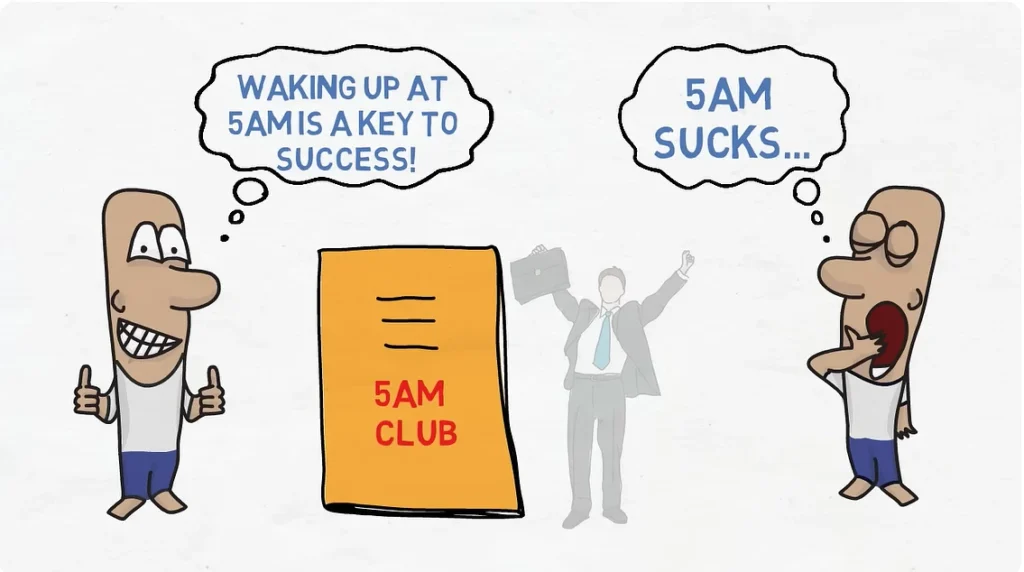
This was the one I preached about, which probably should have told me something. The habits that are quietly working for you don’t generate much preaching.
The case for early rising is familiar. The world is asleep, the hours are pure, the discipline spills over into everything else. And all of that is true, as far as it goes. What it politely ignores is the question of where the hours come from. Mine came out of my sleep. I was going to bed at midnight and getting up at five, and because the fog I worked in happened before sunrise, with coffee, I called it focus.
Within a couple of weeks of letting the wake-up float, you notice your first working hours getting sharper, not softer. The magic was never in the clock saying 5:00. It was in having a stretch of uninterrupted time while rested, and I had spent years keeping the first half of that arrangement while wrecking the second. I get up around seven now. Nobody came to collect my discipline card. Nobody even noticed.
2. Morning Journaling
Ten minutes, three pages, every day for four years. I’d have told you it was the keystone of everything, and for the first year or so it probably was.
But somewhere along the way the journal stopped being a place where I thought and became a place where I reported. Keep a mandatory reflection practice going long enough and eventually you’re performing reflection rather than doing it, a bit like a kid who’s been told to apologize and says the words in the correct order without meaning a single one of them. My entries from the final year could be shuffled like a deck of cards and you couldn’t put them back in sequence. Same worries, same plans, same vague resolve to do better, over and over.
What Replaced It
Nothing scheduled, which felt wrong for a while and then didn’t. I write when something is actually chewing on me. That turns out to be about twice a week, sometimes not for a month. And the entries got longer and stranger and more honest the moment they stopped counting toward anything. The streak was measuring my consistency, which is fine, except consistency was never the thing I was after. I wanted to understand myself a little better, and apparently that doesn’t run on a schedule.
3. The Reading Quota

Fifty books a year. I hit it three years running, and I’m going to keep this section short because the lesson is short, even though this habit took me the longest to admit was broken.
Attach a number to your reading and the number starts reading for you. You catch yourself doing things no actual reader would do:
- Picking the shorter book instead of the better one
- Skimming the dense chapter because it’s costing you pace
- Finishing a book you gave up caring about at page 40, since quitting it doesn’t count
Last year I read eleven books, and I can tell you what’s in all eleven. The three fifty-book years have mostly evaporated. Maybe some of it soaked in somewhere and I just can’t see it. Hard to say. But whatever residue six years of quota reading left behind, it’s thin, and I use the slow eleven all the time.
4. Sunday Meal Prep
Four hours every Sunday, chopping and portioning and stacking containers in the fridge like I was provisioning a ship. Two years of this. Of the five habits, this one had the defense that sounded the most like math and survived the least contact with it.
The pitch is time and money. The reality, once you actually sit down and count (which I avoided doing for a suspiciously long time), is that the food is sad by Thursday, you’re ordering out Friday anyway, and the containers you throw out were paid for twice, once at the grocery store and once with the only free afternoon you had all week. Nobody wants to run this audit on their own system. The real sunk cost wasn’t the four hours. It was the two years I’d spent telling people the four hours were worth it.
Cooking something simple a few evenings a week takes less total time. I did not believe that until I logged both for a month, and the fact that I needed a log to see it says something about how well the habit had been defending itself.
5. Inbox Zero
I saved this one for last because it collapsed the most completely, and because what it taught me travels the furthest.
An empty inbox feels like control. It feels like a clean desk, a settled account, a small daily victory. What it actually is, and you can only see this from a distance, is an agreement to answer other people’s requests at whatever speed those people would prefer. The game refills itself. That’s the whole design. Winning it every day just means you’ve signed up to play it every day, forever.
During the three sick weeks, about four hundred emails piled up. I braced for wreckage. What the pile actually contained maybe fifteen messages that needed a real answer from me, a handful of problems that had quietly solved themselves while I was gone, and several hundred notifications, newsletters, and threads I’d been copied on out of politeness. Fifteen out of four hundred. I check email twice a day now and let the unread count sit wherever it wants to sit. It’s been a year. Not one person has said anything. The urgency was something the inbox itself was producing, and I’d spent years treating it as news.
What Quitting Actually Tells You
I still keep habits. I’m not against them, any more than someone who returns a few library books is against reading. But I hold them more loosely now, and I test them.
Somewhere we picked up the belief, probably from an industry that only ever sells acquiring habits and never letting them go, that a dropped habit is a small moral failure. So we defend our routines the way we defend our oldest opinions, with reasons that were perfectly true at the time we formed them. Every habit on this list earned its spot once. Then my life moved and the habits stayed put, and I kept paying the upkeep for years, mostly because the streak had quietly become the thing I was protecting. Sleep is a result. Free Sundays are a result. A streak is just a count.
You don’t need three weeks of illness to find any of this out. A week off from any habit will show you more than a year of thinking about it will. And if there’s one you’d refuse to even test, well, I’d start with that one.

