


I have a complicated relationship with air quality advice, because most of it is clearly written by people who live somewhere the air is optional. Their guidance amounts to “if the AQI is bad, exercise indoors,” which works beautifully in Portland and means nothing in a city where the AQI has not seen double digits since the last big rain. I live in one of those cities. If I only trained on clean days, I would train maybe forty days a year, and the strange comfort I want to hand you up front is that the research mostly agrees with the people who go out anyway.
Not blindly. There are real cutoffs, and a couple of them will surprise you by how permissive they are. There are also cheap tricks in route choice that change your actual dose far more than most people expect, and that part almost never makes it into the standard advice, so it gets the most space here.
Sitting Still Is Not The Safe Baseline People Think
The instinct on a smoggy day is that skipping the workout protects you, and for a single day, sure. Over months it runs the other way. Physical inactivity is one of the biggest mortality risks on the planet in its own right, and a 2025 analysis following about 1.5 million adults found that regular exercise still lowered the risk of early death even in polluted areas. The benefit shrank, from around a 30% mortality reduction down to 12 to 15% where long term PM2.5 stayed high, but it never flipped negative. Dirty air taxes the workout. It does not cancel it. That finding measured year round exposure, so it speaks to living in a polluted city, not to one apocalyptic smoke day, and it is the strongest argument I know against the quiet decision so many people make to just stop training entirely from November to February.
The reason bad air matters more to you mid run than to your neighbour on the couch is ventilation. At rest you move roughly six litres of air a minute. On a hard run you pull ten to twenty times that through your lungs, most of it through your mouth, skipping the nose’s filtering. Same air, ten times the dose. Hold that thought, because it is the logic behind every cutoff and every trick that follows.
The AQI Cutoffs That Actually Matter
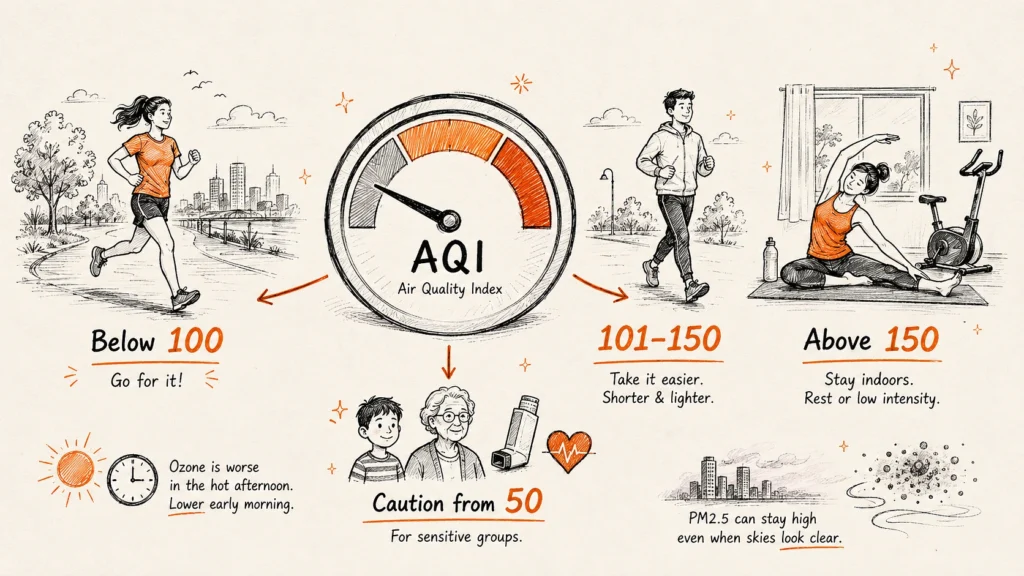
The honest version of the thresholds, pulled from ACSM and EPA linked guidance rather than from vibes, is shorter than you would think.
- Below 100, train normally. For a healthy adult the benefits clearly outweigh the exposure here, and one sports pulmonologist quoted on this put it flatly, under 100 with good lungs the math is not close.
- 101 to 150, keep going out but shorten the session and drop the intensity, because intensity is what multiplies your dose. An easy hour beats a hard forty minutes on these days.
- Above 150, this is where the general population’s benefit curve genuinely bends and the indoor session or the rest day stops being cowardice.
- Sensitive groups, asthma, heart disease, older adults, kids, pregnant women, start applying caution from about AQI 50, not 100. The averages in these studies are not them.
Two wrinkles the tidy table hides. First, the AQI is a composite, and what is driving it changes your playbook. If ozone is the problem, it peaks on hot sunny afternoons and is lowest in the early morning, so a 6 am session can sit in a completely different exposure world than a 4 pm one on the same calendar day. If fine particles are the problem, wildfire smoke or winter smog, mornings buy you much less and the sky can look deceptively clear while PM2.5 sits ugly. Check the number, not the horizon. Second, the AQI you see is from a monitoring station that might be kilometres from your street, which leads into the part of this topic I actually find interesting.
Your Route Changes Your Dose More Than The Forecast Does
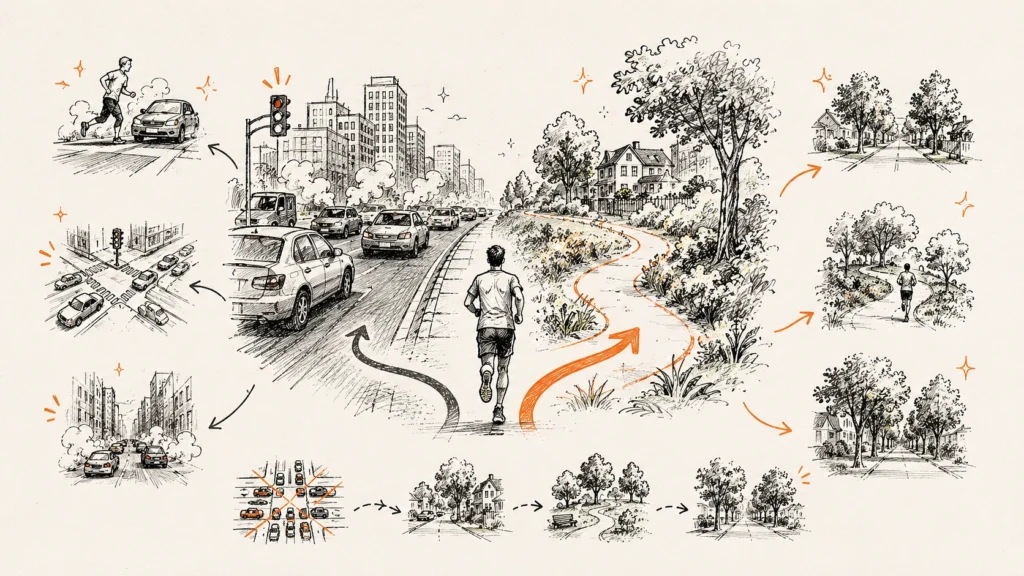
The city does not have one air quality. It has thousands, street by street, and the spread between them is where a person with no control over the smog gets their control back.
Traffic pollution is intensely local. Concentrations spike right at the road and fall off fast with distance, dropping toward background levels within roughly 500 to 600 feet downwind of a major road, and researchers studying near roadway exposure suggest around 75 metres of separation from a highway already does a lot. Which means the runner on the arterial road shoulder and the runner in the park three blocks over are, in exposure terms, exercising in different cities. Study after study bears this out in ways that feel almost petty in their precision. Cyclists on Berkeley’s low traffic bicycle boulevards measured lower fine particles, ultrafine particles, carbon monoxide and black carbon than cyclists on the parallel busy roads. Pedestrians walking the less congested side of the same street in Auckland dodged most of the short term concentration spikes that hit the people on the opposite footpath. Even walking at the building edge of a pavement instead of the kerb edge measurably lowered exposure on a busy London street.
So the practical route rules stack up like this, and none of them cost fitness. Trade the main road for the parallel residential street even when it adds distance, since the extra minutes of easy running in cleaner air beat fewer minutes marinating in exhaust. Cross to the side of the road facing away from the congested direction during rush hours. Avoid loitering at big intersections, where idling and acceleration make the worst pockets on your route, and if your intervals need a stop point, do not make it a traffic light. Put parks and green streets in the middle of the loop, not just because trees are nice, vegetation genuinely intercepts particles, and green routes measure cleaner across cities as different as London, Rotterdam and São Paulo. And shift the clock before you shift indoors, dawn beats evening on ozone days and beats rush hour on all days.
I will admit the thing this whole section implies, which is that a boring route through the back streets is often the medically superior workout to the scenic one along the waterfront road, and I do not always take my own advice on that.
Where That Leaves The Indoor Question
Indoors is the right call above 150, on smoke days, and for anyone in the sensitive groups when the number is unfriendly. It is worth saying, though, that indoor air is not automatically clean air, gyms can run higher coarse particle levels than outdoors from all the dust getting kicked around, and a stuffy studio during peak hours is its own compromise. A well ventilated, well filtered indoor space beats an AQI 180 street. A stale basement gym versus an AQI 60 park is not the win people assume.
What I will not give you is a rule that resolves every day neatly, because the daily call sits on things only you can see, your lungs, your city’s pollution rhythm, whether today’s number is your winter’s floor or its ceiling. The cutoffs above are the guardrails. The route habits are the part you keep forever. Between the two, the days that genuinely require the couch are rarer than the forecast makes them look.

