



My dog sleeps roughly fourteen hours a day, and for years I quietly worried about it. Fourteen hours. If I slept fourteen hours, someone would stage an intervention. He’d nap after breakfast, nap through my calls, do a hard afternoon shift of sleeping, then look mildly offended when I woke him for dinner. Every “why does my dog sleep so much” search I ran gave me the same answer, a number and a shrug: dogs sleep 12 to 14 hours, that’s normal, don’t worry. True, but it never explained the thing I actually wanted to know, which is why. Why do they need so much more than we do?
The answer, once I finally found it, turned out to have almost nothing to do with how many hours they sleep and almost everything to do with how they sleep. Your pets dog isn’t sleeping more than you because they’re lazier or more relaxed. They’re sleeping more because their sleep is built completely differently from yours, and it’s a less efficient design that has to make up the difference in volume. Once you understand the architecture, the fourteen hours stops being a mystery and starts making perfect sense.
The Real Reason: Their Sleep Is Lighter and More Broken Up
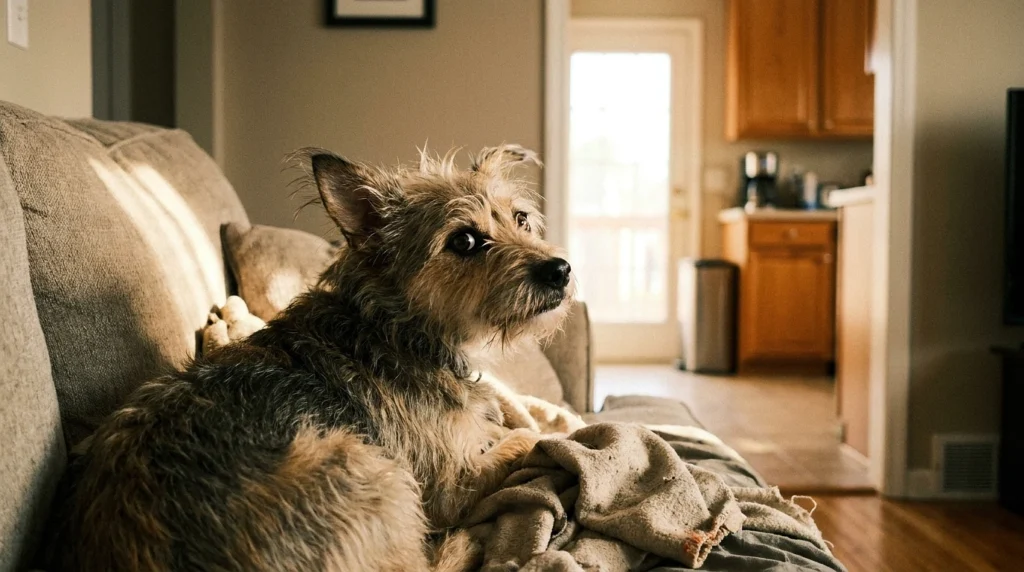
Here’s the fact that reframes everything. You are a monophasic sleeper you go down once, ideally at night, for one long consolidated block. Your dog is a polyphasic sleeper, resting in many short bouts scattered across the whole 24-hour day, which is why a normal dog might have twenty or more separate sleep episodes between breakfast and bedtime. That string of naps isn’t laziness. It’s the species’ default setting, inherited from ancestors who couldn’t afford one long vulnerable stretch of unconsciousness and slept opportunistically instead, ready to snap awake.
And each of those naps runs on a much faster clock. A dog’s sleep cycle lasts around 20 minutes a human’s runs about 90. So where you cycle down into deep sleep and stay there through long stretches, your dog is constantly entering and exiting sleep, surfacing toward wakefulness every twenty minutes or so. That’s why dogs wake so easily, at a footstep, a fridge opening, a leaf of interest outside, and drop back to sleep just as fast. Their whole design is built around light, interruptible rest, not the deep uninterrupted kind you rely on.
Why Light Sleep Means More Hours
Now the part that actually answers the question, and it’s a piece of arithmetic. The most restorative stage of sleep, for dogs and people both, is REM, the deep dreaming phase where the real recovery happens. Here’s the imbalance: humans spend roughly 20 to 25 percent of sleep in REM, while dogs spend only about 10 to 12 percent.
Sit with what that means. If your dog only banks restorative REM at half the rate you do, they have to run the clock longer to accumulate the same amount of genuine recovery. A dog sleeps fourteen hours to get the deep rest you get in seven or eight, because their sleep is lighter, more fragmented, and thinner on the restorative stage. The big number isn’t a sign of a sleepy animal. It’s the compensation their sleep design requires, and it’s completely healthy. The fourteen hours was never the thing to explain. The 10 percent REM was.
This is also why sleep quality matters more for dogs than the raw hour count ever will. A dog constantly woken from its short cycles, by noise, by an uncomfortable spot, by too much disruption, has to keep restarting toward REM and rarely gets there, accumulating a real sleep debt behind an ordinary-looking number of hours in bed.
What Normal Actually Looks Like, By Dog
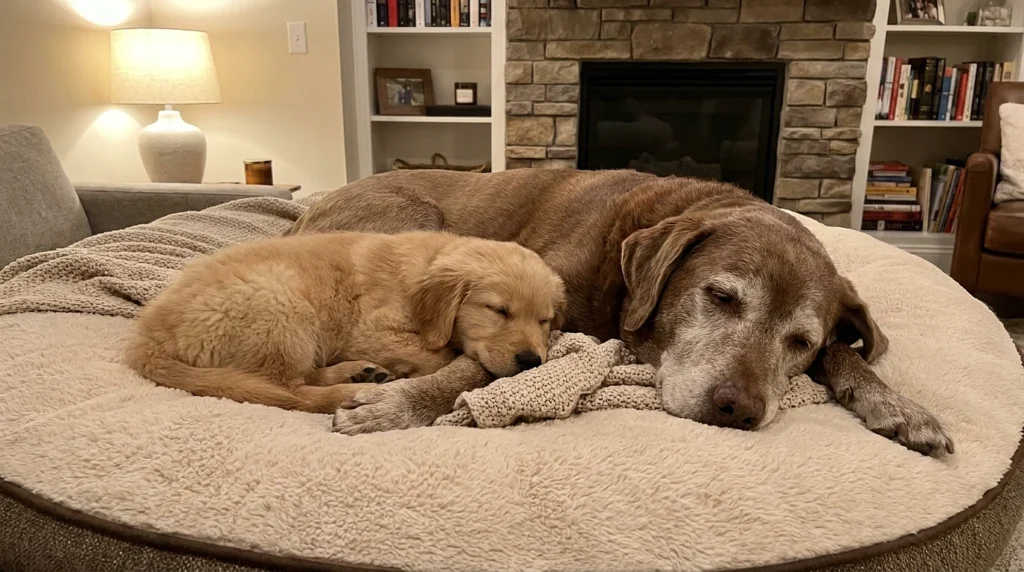
With the mechanism clear, the usual factors make more sense as adjustments to a baseline rather than a mysterious range. The typical adult lands around 12 to 14 hours, and it shifts predictably:
- Age moves it most. Puppies and senior dogs commonly sleep up to 18 or 20 hours, puppies because they’re burning enormous energy growing and consolidating everything they learn, seniors because recovery simply takes longer. Both are normal.
- Size and breed nudge it. Larger breeds like Mastiffs and Saint Bernards genuinely tend to sleep more than small energetic dogs, so a giant breed logging serious hours is usually just being a giant breed.
- Activity sets the rest. A dog with a stimulating day of walks, work, and problems to solve sleeps differently from a bored dog, and here’s the counterintuitive part: a bored under-stimulated dog often sleeps more, not less, simply because there’s nothing else to do.
- Health and diet shift the baseline in both directions, which is exactly why a change from a dog’s own normal matters more than where that normal sits.
When the Sleep Is Actually Telling You Something
This is the part worth reading slowly, because the honest answer to “is this too much sleep” is never a universal number. It’s a change from your dog’s own established pattern. You know your dog’s normal better than any chart does, and a shift away from it is the real signal. A few worth taking seriously:
- A clear change in the pattern, sleeping substantially more or less than this dog’s own usual, especially if it came on quickly.
- Low energy while genuinely awake, not just sleeping a lot but seeming flat, uninterested in food, play, or the walks they used to love.
- Sleep changes riding alongside other changes, shifts in appetite, weight, thirst, or any sign of discomfort or difficulty settling.
- Trouble breathing during sleep, loud labored snoring or pauses, which is different from ordinary snoring and worth a mention to your vet.
None of these is a reason to panic, and any of them is a reason to check in. The pattern to remember is simple: a dog that sleeps a lot but is bright, engaged, and happy when awake is almost certainly a normal dog running normal software. A dog whose sleep changed and whose waking self also seems off is the one to have looked at. When something feels genuinely different from your dog’s baseline, a vet visit is the right move, since sudden sleep changes can accompany real health issues and are far easier to sort early.