

Your surgeon is not misleading you when they say two weeks. They are answering a narrower question than the one you are asking.
There are two different clocks running after any procedure, and the industry has names for both. Recovery time is when you can function again, go to work, drive, socialise without explaining yourself. Healing time is when your tissue has finished the job, swelling has fully resolved, scars have matured and the result you paid for is actually visible.
The first is usually measured in days or a couple of weeks. The second runs to months, and in several common procedures, a full year or longer.
The Gap, Procedure by Procedure
| Procedure | Back to work | Final result |
|---|---|---|
| Rhinoplasty | 7 to 10 days | 12 months, with tip refinement continuing to 18 months |
| Facelift | 10 to 14 days | 3 to 6 months, scars maturing over about a year |
| Breast augmentation | around 1 week | roughly 6 weeks for recovery, longer for settling |
| Breast reduction | around 2 weeks | about 2 months |
| Tummy tuck | 2 to 3 weeks | 6 to 12 months for contour, 12 to 18 months for scar maturation |
| Liposuction | 1 to 2 weeks | up to 3 months |
Look at the rhinoplasty row in particular. Ten days off work, twelve months to the actual nose. That is not a badly run practice, it is the nature of nasal swelling, and patients who did not know it going in spend months quietly worried that something went wrong.
Why Swelling Takes So Much Longer Than Anyone Expects
The pattern is consistent across procedures and it is worth knowing because it explains the whole disappointment cycle.
One surgeon describes it to patients like this: roughly 60 to 70% of bruising and swelling resolves in the first two to three weeks, another meaningful reduction happens over the following two to three months, and then subtle changes continue from six months to a year. Those late changes are small, but they are the ones that turn a good result into the result.
So the moment you look presentable is not the moment you are healed. It is the moment the majority of the swelling has gone, with a long tail still to come.
What Else is Still Happening After You Feel Fine
- Nerve regeneration. Numbness around surgical sites is normal and expected. Sensation typically returns over three to six months, with full recovery around the one year mark. After breast surgery, permanent sensation loss occurs in roughly 2% of cases.
- Scar maturation. Scars continue changing colour and texture for a year or more. A scar at six weeks tells you very little about the scar at eighteen months.
- Tissue settling. Implants settle, contours refine, and skin redrapes over a timescale nobody experiences as fast.
The Activity Timeline is a Third Clock, And People Ignore It
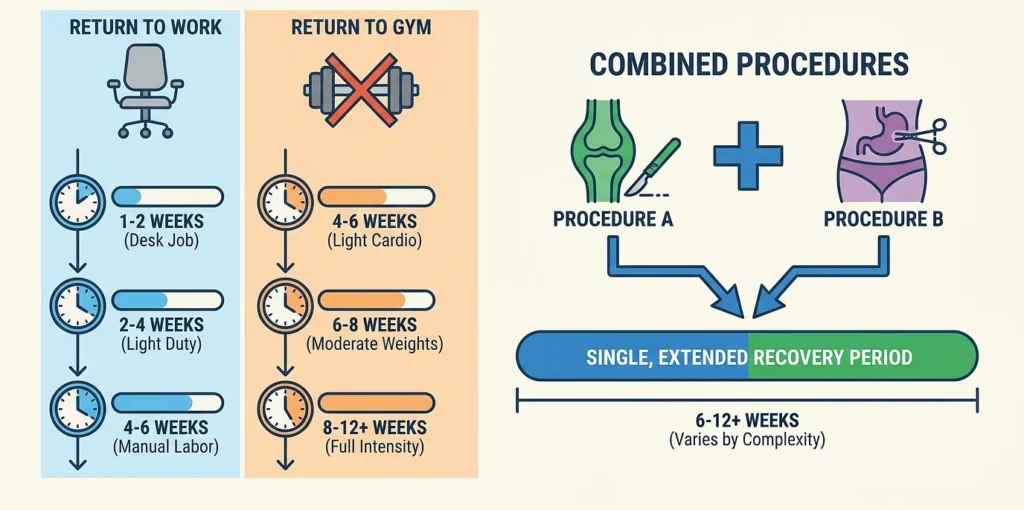
Returning to work and returning to the gym are not the same permission.
For a tummy tuck, light exercise is generally from four weeks, with full gym and core work at eight to twelve weeks. Rhinoplasty allows light exercise from two weeks with no impact and no bending, and full contact sport at six to eight weeks. Compression garments after body contouring are commonly worn for six to eight weeks regardless of how you feel.
This is where avoidable complications happen. The tissue does not know that you feel better, and lifting too early after abdominal work is one of the more reliable ways to compromise a result you have already paid for.
Does Combining Procedures Double The Recovery?
No, and this surprises people in a good way. Combining procedures in one operation produces a recovery similar to the longest single procedure rather than the sum of them, generally extended by about an additional week.
That is a genuine argument for combining where it is clinically appropriate, though it is a conversation for your surgeon rather than a decision to arrive with.
What Actually Extends Your Timeline
Some of this is outside your control and some is not.
- Smoking or vaping during recovery is the big one, producing impaired wound healing, higher rates of skin necrosis and delayed scar maturation. Surgeons who insist on cessation are not being fussy.
- Overall health and nutrition, since well nourished non-smokers heal measurably faster.
- Aftercare compliance, meaning compression garments, sleeping elevated, sun protection and attending follow-ups.
- Procedure complexity, and whether muscle repair was involved, which lengthens abdominal recovery considerably.
- Age and individual healing capacity, which vary more than any brochure admits.
Planning Around The Real Numbers Rather Than The Quoted Ones
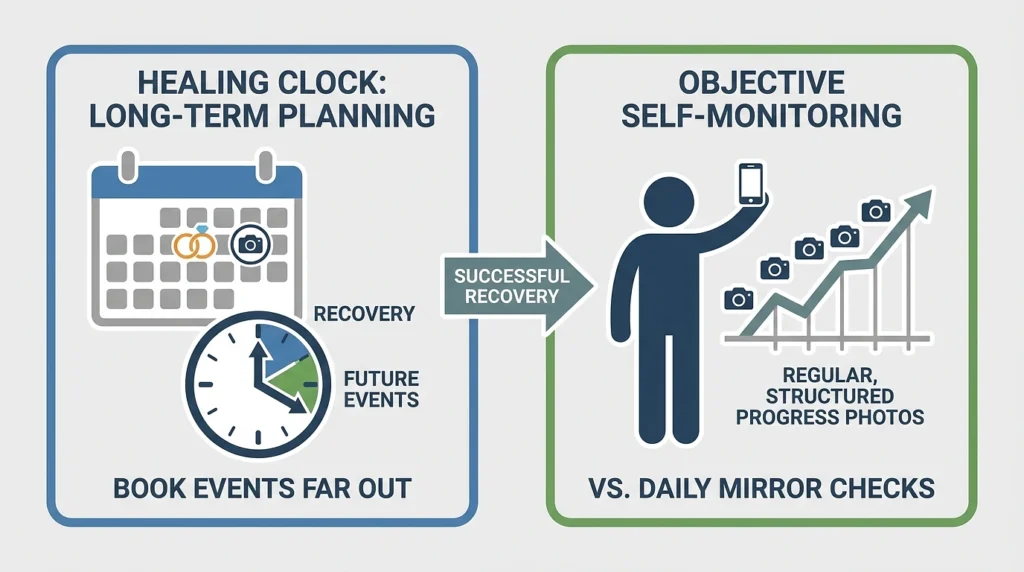
If you are booking time off, book against the recovery clock. If you are booking an event, book against the healing clock.
That distinction matters enormously in practice. A wedding, a holiday, a photographed occasion. Do not schedule any of those against your back to work date, because looking functional and looking finished are separated by months in most procedures and by a year in rhinoplasty.
Two practical habits help more than anything else. Take standardised composition in photography at intervals rather than judging in the mirror daily, since daily comparison hides gradual change and amplifies asymmetries that are still resolving. And expect a low patch somewhere in the first fortnight, which is common enough that surgeons anticipate it and is not a sign the decision was wrong.
Anything that concerns you, increasing pain, fever, unusual swelling on one side, or a wound that looks wrong, goes to your surgical team the same day rather than to a forum. That is what the follow-up structure exists for.
None of this argues against having surgery. It argues for going in with the correct calendar, because most of the disappointment I have seen described in this field is not disappointment with the result. It is disappointment with the result at six weeks, judged against an expectation that was never accurate.

