


“How many patients does the physiotherapist see at the same time as me?”
The answer tells you more about your recovery than any photo of the treatment room. A clinic where one therapist runs three patients at once is selling you something different from a clinic where you get an hour of undivided attention, and both of them will describe it as physiotherapy.
Capacity Decides Whether You Get a Physiotherapist or a Supervised Waiting Room
Staffing levels in rehabilitation settings directly affect whether patients receive personalized attention or become one of many in an overbooked caseload.
That sounds obvious until you see how it plays out. In an overloaded clinic, the therapist assesses you, sets you up on an exercise, and moves to the next person. You do the exercise unsupervised. Nobody corrects your form. Nobody notices you are compensating with the wrong muscle group, which is the exact thing you came in to fix.
Rehabilitation depends on frequent adjustment and correction, and when staffing falls short, therapy becomes rushed and fragmented. Patients risk delayed progress, reduced supervision, and incorrect execution of the exercises they were prescribed.
So when you are comparing a rehab clinic in Ramkhamhaeng, including คลินิกกายภาพ รามคำแหง, the first thing worth establishing is the ratio, not the equipment list.
More Sessions Do Not Automatically Produce Better Outcomes, Which is The Honest Complication
I want to be straight about something, because it cuts against the simple version of this argument.
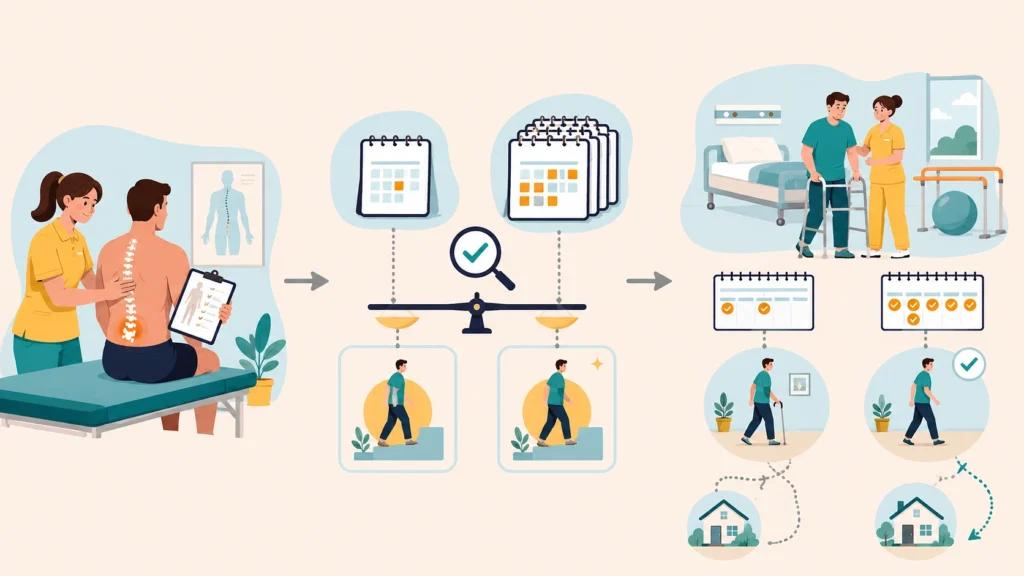
A randomized controlled trial published in JOSPT compared a single session of education and exercise prescription against six sessions of multimodal physiotherapy for adults with spinal disorders. The result was no significant difference between groups on pain severity at 6, 12 or 26 weeks. The multiple-session group showed one small improvement in pain interference at six weeks, less than one point on a ten-point scale.
Six sessions. One session. Broadly the same outcome.
That finding does not mean physiotherapy is useless. It means quality of contact beats quantity of contact, and a clinic that books you for twenty sessions is not automatically giving you more than a clinic that books you for six and gets the assessment right.
Where dose clearly does matter is in the acute setting. A trial of 996 patients across two Australian rehabilitation facilities compared therapy five days a week against six days a week. The six-day group had greater functional independence and better quality of life at discharge, and their stay was about two days shorter.
Different setting, different answer. Which is why the capacity question is really a quality question, not a volume question.
Thai Clinics Operate Under Ministry Regulation, And You Can Ask To See The License
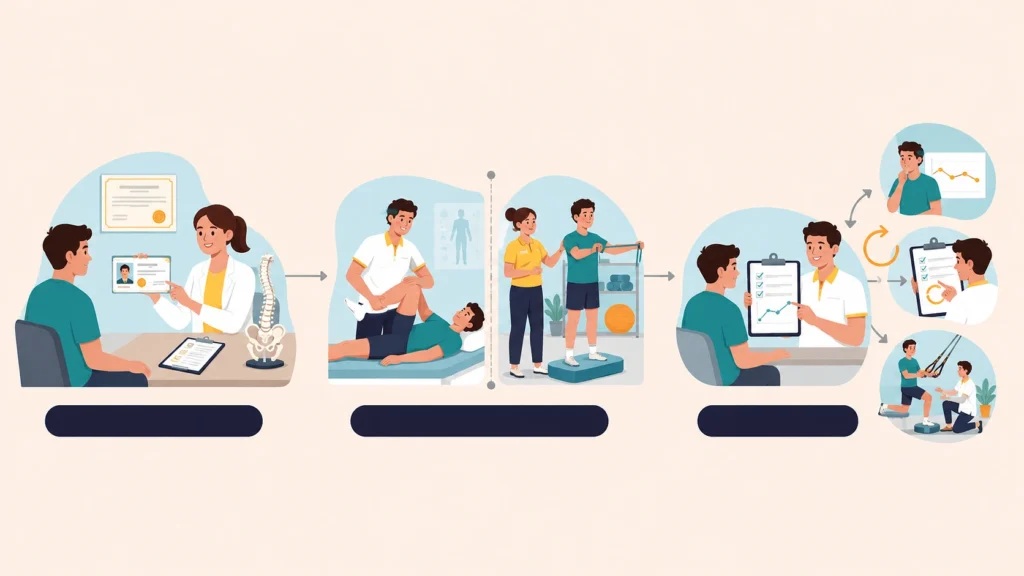
The Ministry of Public Health sets standards that clinics and hospitals in Thailand must follow, covering practitioner qualifications, equipment, and patient safety.
The practical version of that for you as a patient:
- Ask whether the person treating you is a licensed physiotherapist, and ask to see the license. Not the clinic’s registration. The individual practitioner’s.
- Ask who delivers each part of the session. Assessment by a physiotherapist followed by exercises supervised by an assistant is a legitimate model, but you should know that is what you are buying.
- Ask what happens if you are not improving by a stated point. A clinic with a plan for that answers immediately.
For anyone new to physiotherapy, this feels awkward to ask. It is the same awkwardness people feel before they see an orthopaedic surgeon for the first time, and it passes about ninety seconds into the appointment.
The First Session Should Produce a Plan With Dates On It, Not Just Treatment
A proper first consultation covers your medical history, current condition, and how you actually live and work. What comes out of it should be a treatment plan with specific goals and realistic timeframes.
Treatment itself usually combines several things:
- Exercise therapy for strength, flexibility and balance, which is the part with the strongest evidence behind it
- Manual therapy, hands-on work for pain and stiffness
- Electrotherapy or ultrasound to support tissue healing
- Education, meaning being shown how to manage the condition at home between sessions
That last one deserves more respect than it gets. In the spinal disorders trial above, the single-session group received education and an exercise program, and they did about as well as the group attending six times. What you are taught to do on your own is doing real work.
Distance to The Clinic Predicts Whether You Actually Attend

Bangkok traffic is not a minor inconvenience, it is an adherence problem.
A rehabilitation plan only works if you turn up to it, and attendance drops when getting there is a battle. Choosing a clinic in Ramkhamhaeng when you live or work in Ramkhamhaeng removes the most common reason people quit a course of treatment halfway through, which is not lack of belief in the therapy but forty minutes each way in traffic after work.
Consistency matters more than the specific approach. The 2025 Cochrane review on physical rehabilitation after stroke found no single approach clearly superior to any other, and concluded that optimal delivery and dose remain uncertain.
Turning up regularly to a competent clinic near you beats attending sporadically at a famous one across the city.
Long-Term, Rehabilitation is About Not Needing It Again
The short-term goal is healing an injury. The longer goal is a body less likely to be injured the same way twice, which comes from strength and movement quality rather than from passive treatment.
There is a mental health dimension worth naming too. Recovering physical independence after an injury reduces the anxiety that comes with not trusting your own body. That is not a soft benefit. For anyone who has been unable to carry shopping or climb stairs without planning it first, getting that back changes the shape of the week.
References:
- Increasing the dose of acute rehabilitation, 996-patient RCT
- Single session versus multiple sessions for spinal disorders, JOSPT randomized trial
- Physical rehabilitation approaches after stroke, Cochrane Review 2025
- Thailand Ministry of Public Health

