


I’ve worn mechanical watches for twenty years and I still remember being annoyed at the original Apple Watch in 2015, mostly because it was being sold as jewelry when it was really a sensor with a screen. A decade later the marketing has swapped diamonds for cardiology, and the pitch now is that the thing on your wrist is a tiny medical clinic. So this is the straight answer to what that clinic can and can’t do, graded against the actual research rather than the keynote.
Some of the health claims are better than the skeptics say, one of them is a genuine breakthrough with an asterisk, and the fitness number you probably care about most is the one it’s worst at. Let me take the big promises one at a time.
First, Forget The 2015 Lineup. Here’s What You Actually Buy Now.
The old three-tier Sport, Watch, Edition split is long dead. Today there are three models and the choice is refreshingly simple.
The SE 3 starts at $249 and is the one most people should buy. It now has an always-on display and the core health sensors. The Series 11 starts at $399 and adds the ECG, blood oxygen, the brighter screen, and the hypertension feature. The Ultra 3 starts at $799 and is a genuinely different proposition, bigger, tougher, satellite messaging, 42-hour battery, aimed at people who leave cell coverage on purpose. For most wrists, the honest recommendation is the SE 3 unless you specifically want the ECG and hypertension alerts, in which case the Series 11 is the floor.
One thing the upgrade cycle hides: most of the marquee health features arrive through watchOS, not new hardware. Hypertension alerts and the sleep score reach several older models too. If you already own a Series 9 or 10, the software probably gave you most of this for free, and you do not need to buy anything.
The Heart-Rhythm Claim: Better Than The Doubters Think, With Limits
This is where the Apple Watch earns its reputation, and the evidence is real.
The foundational study is the Apple Heart Study, which enrolled 419,297 participants, the kind of scale you almost never see. Among people who got an irregular-pulse notification, the positive predictive value was 0.84, meaning when the watch flagged a possibly-irregular rhythm, it was onto something most of the time. That’s the optical sensor doing background screening.
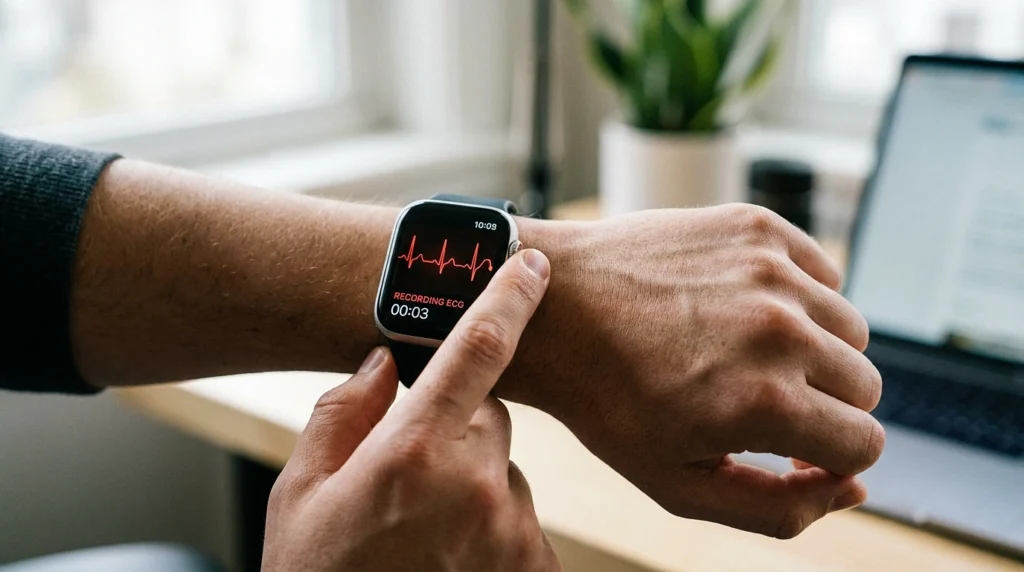
But the watch has two different tools here, and conflating them is where hype lives. The everyday background monitoring uses the optical sensor, and across studies that PPG-based AFib detection lands around 91% specificity and 79% sensitivity, good enough to screen, not good enough to diagnose. The on-demand ECG, the one you trigger by holding the crown, is a different animal: a meta-analysis using a proper 12-lead ECG as the reference found the Apple Watch ECG hit sensitivity around 96% for atrial fibrillation. That’s genuinely impressive for a wrist device.
The honest framing every cardiologist I’ve read lands on: it’s a superb early-warning tool and a terrible diagnostician. A notification is a reason to see a doctor, not a diagnosis, and false positives are real and can send you into unnecessary tests and real anxiety. It has, without exaggeration, caused people to catch AFib they’d never have known about. It has also scared healthy people over nothing. Both are true.
The Blood-Pressure Feature: The Real Headline, Still Wearing An Asterisk
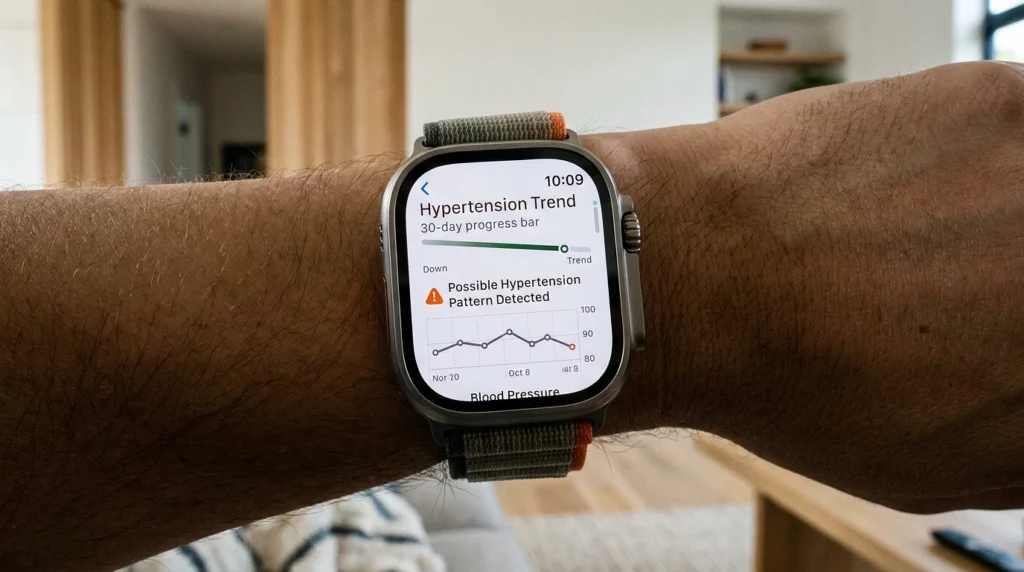
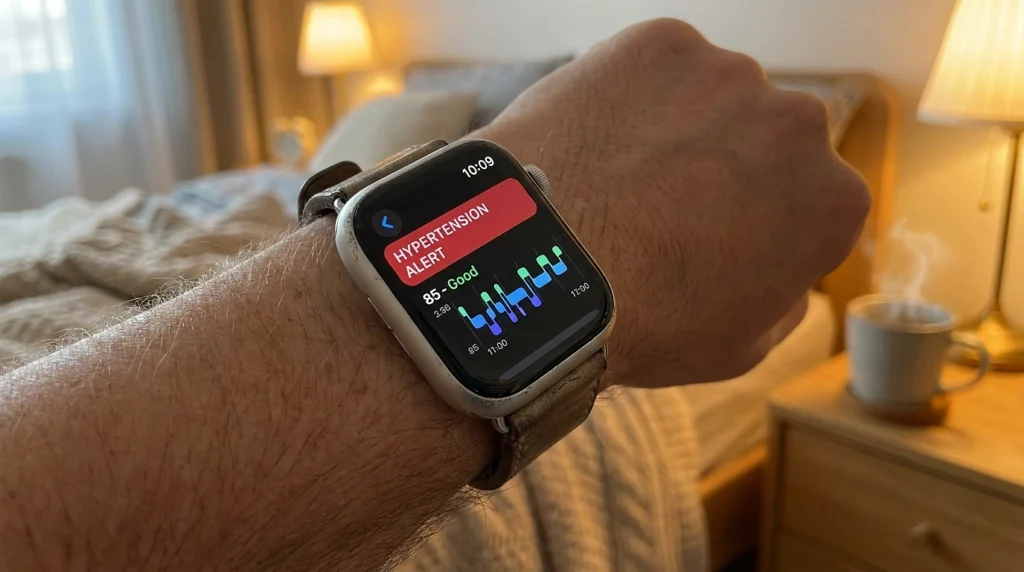
The 2025 hypertension feature is the genuinely new thing, and it’s clever in a way worth understanding before you get too excited or too cynical.
It does not give you a blood-pressure number. There’s no cuff, so it can’t. What it does instead is analyze how your blood vessels respond to your heartbeat via the optical sensor, over a 30-day window, and flag you if it sees a pattern consistent with chronic hypertension. Apple built the algorithm on data from over 100,000 participants and says it expects to notify more than a million people with undiagnosed high blood pressure in the feature’s first year.
That’s the promise. Here are the asterisks, because they matter on a health claim. It detects trends, not readings, so it will never replace the cuff on your bathroom shelf. It rolled out pending FDA clearance, so depending on when and where you’re reading this, it may or may not be active on your wrist. And it’s explicitly designed to catch chronic patterns, which means it’s a screening net, not a monitor. If it flags you, the next step is a real blood-pressure check and a doctor, the same as the heart-rhythm alerts.
Framed correctly, this is the most useful thing the watch does, because hypertension is genuinely a silent condition and a nagging wrist is better at catching it than a person who feels fine and never checks.
The Fitness Tracking: Accurate Where It’s Quiet, Shaky Where It Counts
Now the part the marketing glosses and the research is blunt about.
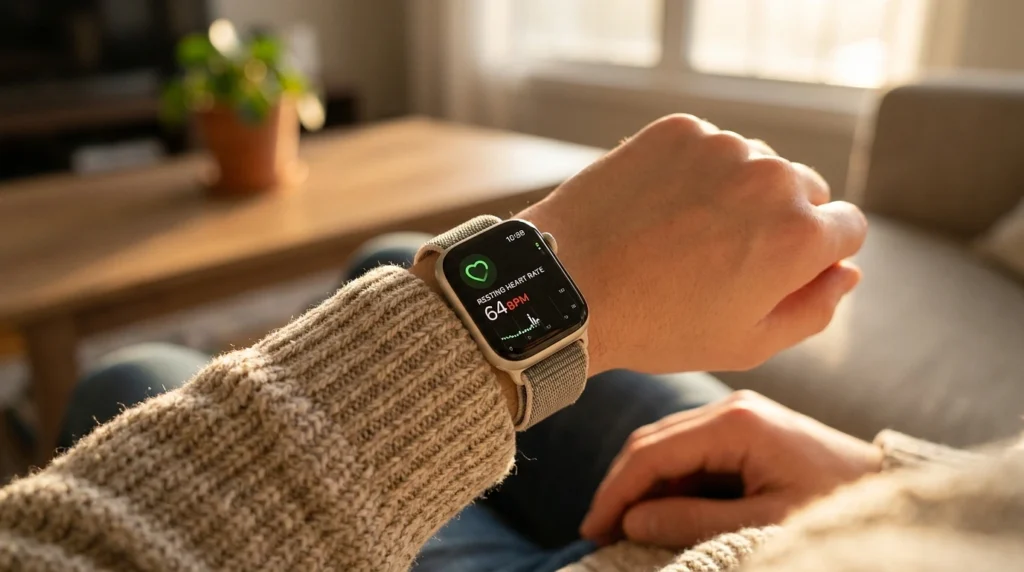
Heart rate at rest is good. The third-generation optical sensor, in every Apple Watch from Series 6 on, tightened the accuracy to within a few beats per minute of a chest strap under most conditions, which for a wrist device is a real achievement. If you’re tracking resting heart rate or general cardio zones on easy efforts, trust it.
Then you start moving hard and it drifts. Wrist optical sensors struggle during intervals, when your heart rate spikes fast and your wrist tendons move, and the reading can lag or smooth over exactly the peaks a serious trainer wants to see. Anyone doing structured interval work should still cross-check against a chest strap, because that’s where wrist PPG is weakest.
And the number to actively distrust is calories. Energy-expenditure estimates are the least accurate metric the watch produces, with errors that ran past 20 to 30 percent during exercise across multiple validation studies. The reason is simple and unfixable: the watch cannot actually measure calories burned, it infers them from heart rate and movement through a proprietary algorithm, and that inference is a guess dressed as a number. Use the calorie count as a rough, consistent-to-itself trend if you must, but do not build a diet around it believing it’s precise. It isn’t, and no wrist device is.
So What Do You Actually Get
Strip the keynote away and the honest ledger looks like this.
- A real, evidence-backed heart-rhythm screener. Not a diagnosis, but a genuine catch-it-early tool that has demonstrably found AFib in people who had no idea. Worth the price for that alone if heart health is on your mind.
- A clever new hypertension net. Trends not readings, FDA timing depending, but pointed at a real silent problem the average person never checks for.
- Excellent everyday fitness tracking and mediocre calorie math. Trust the resting heart rate, cross-check the interval spikes, and treat the calorie burn as fiction with good intentions.
- A smartwatch that’s still, underneath all the health talk, a very good smartwatch. Notifications on the wrist, quick replies, easy strap swaps, the stuff the 2015 model was already decent at, now refined over a decade.
The thing I’d tell anyone on the fence: buy it for the smartwatch and the heart screening, not for the fantasy of a lab on your wrist. It is not a medical device, its makers are careful to say so in the fine print even while the marketing implies otherwise, and every one of its health features points to the same next step when it finds something, which is a real doctor with real equipment. Treat it as the thing that taps you on the shoulder and says maybe get that checked, and it’s genuinely one of the more useful objects you can wear. Treat it as the doctor itself, and you’ve misread both the watch and the fine print. If you already live inside an iPhone, though, and you want one gadget that covers a active, connected lifestyle and quietly watches your heart in the background, this is still the one to beat.

