


Three women I know wear wefts, and between them they’ve made every mistake this article exists to prevent.
Dana has thick, coarse hair and paid top dollar for hand-tied wefts because a video told her they were “the luxury option,” then spent months following care rules designed to protect a delicacy her hair never needed. Priya has baby-fine hair and got machine wefts because they were cheapest, then spent a year styling around a seam that showed through every ponytail. And Kate, who did her homework, cut a hand-tied weft at home to make it fit better, and watched a three-hundred-dollar strip of hair dissolve into loose strands in her hands, because nobody had told her the one construction fact that governs this entire category.
Three smart women, three wrong turns, all preventable with about ten minutes of the right information. So here it is, the ten minutes: what actually separates these three wefts, what each genuinely costs across a year rather than at the register, what your Sundays look like with each, and, most usefully, which of the three women you are.
The One Fact That Decides Almost Everything
Before any specs, learn the fact that ruined Kate’s afternoon, because it’s the cleanest dividing line in the whole category whether a weft can be cut.
A hand-tied weft is exactly what the name says, hair knotted by hand onto a thread, and those knots are a chain. Cut the thread anywhere and the chain lets go, which is why hand-tied wefts must be ordered at the width they’ll be worn and why the industry’s standing warning is to never trim one, only seal the ends if you absolutely must. A machine weft, sewn by industrial machinery onto a reinforced track, cuts fine. And the genius weft, the newest of the three, was engineered around this exact problem: an ultra-thin, machine-made strip with a sealed edge that can be cut anywhere without unraveling, which lets a stylist trim it on your head to match your exact sections.
That single property cascades into everything else. Cuttable wefts waste less hair, fit better, and install faster. The uncuttable one demands precise ordering, careful planning, and a stylist who measures twice. Hold onto the dividing line and the rest of the comparison organizes itself.
The Three Constructions, Through the Three Heads of Hair
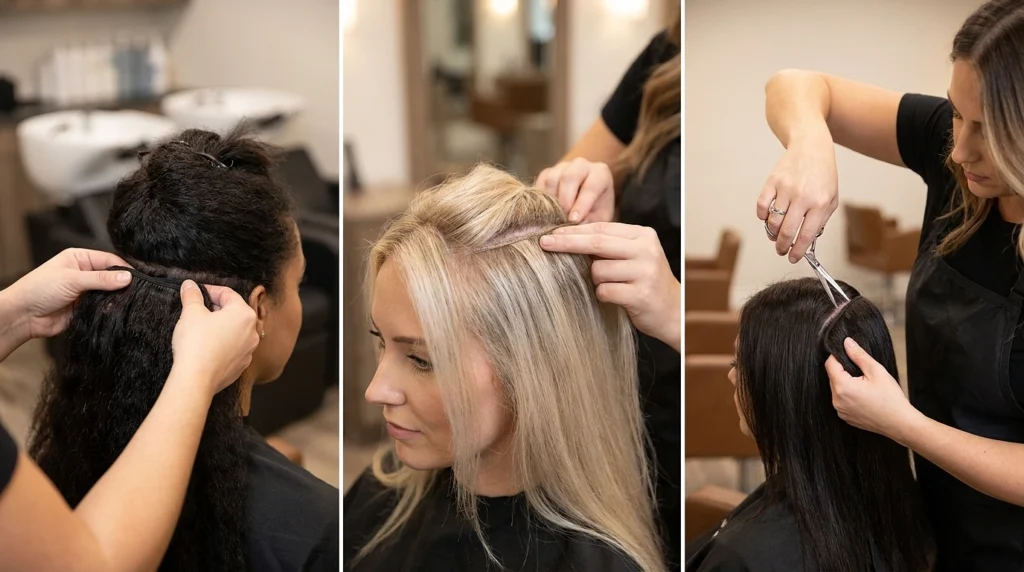
What Dana’s Thick Hair Actually Needed: Machine Weft
The machine weft is the oldest and least glamorous of the three, a dense strip with a stitched track running up to a few millimeters thick, and the beauty industry instinct to treat “oldest and cheapest” as “worst” is exactly backwards for a head like Dana’s. Thick, coarse hair swallows that seam whole. It also pairs naturally with the machine weft’s other personality traits: it carries the most hair per inch, shrugs off regular washing, heat, and ordinary brushing, and survives eight months to a year of wear. Dana’s expensive hand-tied set bought her precisely nothing her hair could display, at triple the care burden. The luxury option for hair that can hide a seam is the cheap one, and no one selling wefts will ever phrase it that way.
What Priya’s Fine Hair Was Crying Out For: The Thin Wefts
Priya’s problem was the mirror image. On fine, low-density hair, a machine weft’s track telegraphs through, especially pulled back, and the thin wefts exist for exactly her. Here she’d have faced the one genuinely close call in the category, because the two thin options split a hair, so to speak. The hand-tied weft is the lighter and softer of the pair, moving almost strand by strand, the flattest possible lay, and the format the most premium hair lines are exclusively offered in. The genius weft is nearly as flat, carries noticeably more hair per strip, has zero short return hairs at its sealed seam, and stacks in rows without bulk. The practical split: hand-tied for the finest hair chasing pure invisibility and willing to pamper it, genius for fine-to-medium hair that also wants density and an easier life. Priya, who wanted volume and hates fuss, was a genius-weft client who never got asked the right questions.
What Kate Should Have Been Sold: Genius, for the Fit Alone
Kate’s home-trimming disaster had a second lesson inside it she cut the weft because it didn’t fit her head well, and a weft that needs cutting to fit is a weft that was the wrong construction for her from the start. The genius weft’s cut-anywhere edge means the fit happens in the chair, tailored to her sections at every install, and manufacturers note the on-head trimming saves 20 to 40 minutes of install labor per appointment while wasting less hair. Fit problems, in this category, are usually construction problems wearing a disguise.
Real Costs: The Register Lies, the Year Tells the Truth
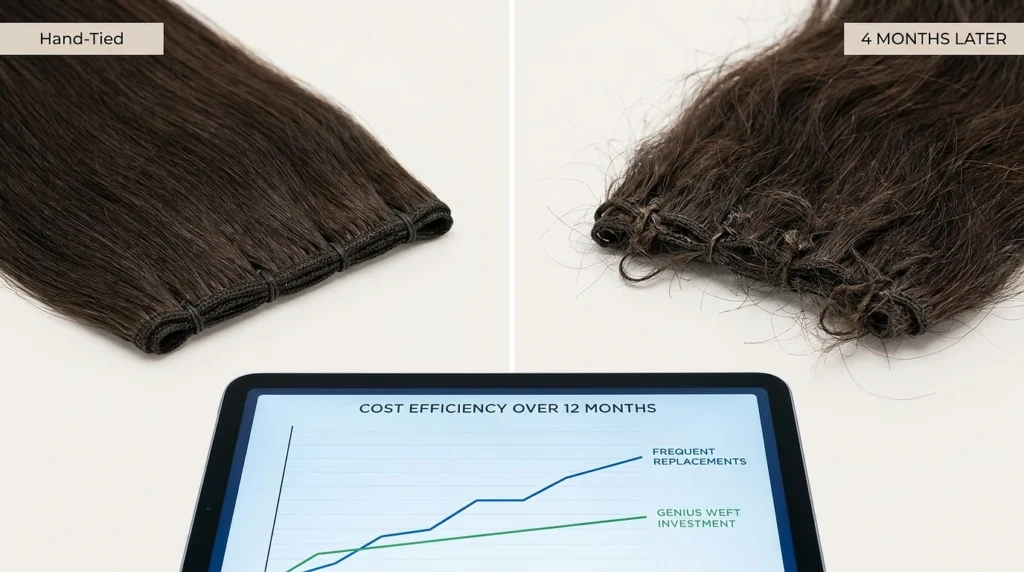
Now the money, and the reframe that matters more than any dollar figure: these three don’t compete at the register, they compete across a year, because wefts are a recurring service, not a purchase.
Every option carries the same four cost streams: the hair, the initial install, the move-up appointments every 6 to 8 weeks that no construction method exempts you from since it’s your own growth that moves the rows, and eventual hair replacement. Exact prices vary too much by city and stylist for honest universal figures, a full initial install commonly running from several hundred into the low thousands, move-ups a fraction of that per cycle. What doesn’t vary is the ranking, and the industry’s own comparative verdict states it flatly machine weft costs least upfront, hand-tied carries the highest total annual cost, and genius weft delivers the strongest cost efficiency once you wear extensions past a year, its longer-lived hair and faster installs compounding every cycle.
One number deserves its own caution flag. Hand-tied lifespan quotes range wildly, four months at the low end, a year at the high, and the spread isn’t sloppy reporting, it’s the product: those hand-knotted attachment points reward careful owners and punish careless ones harder than anything else in extensions. Price a hand-tied budget at the pessimistic end unless your track record with delicate things says otherwise. Dana’s, for the record, did not.
The Sunday Question: Maintenance in Real Life

Forget the care-guide bullet lists for a second and ask the honest lifestyle question, what does owning each one actually feel like week to week?
- Machine weft ownership feels like having hair. Wash it, style it, brush it like a normal person, show up for your move-up on schedule. Its forgiveness is the entire value proposition.
- Hand-tied ownership feels like owning silk. Gentle brushing from the ends toward the roots with the right brush, deliberate washing technique, hair tied loosely for sleep, vigilance around the knots, and the payoff is the most beautiful lay in the business. Wonderful if you’re the pampering type. A slow-motion write-off if you’re not.
- Genius weft ownership sits in the easy middle. The sealed spine doesn’t need protective handling, just the universal basics every weft wants: sulfate-free shampoo, no heavy oils at the rows, heat protectant, and the 6-to-8-week appointment kept like a dentist’s.
So Which of the Three Women Are You?
The whole decision compresses into three questions, honestly answered. Can your natural hair hide a seam? If yes, thick or coarse, the machine weft is your quiet bargain and everything pricier is paying for invisibility you already own. Is your hair fine, and are you a careful, ritual-loving owner with a premium budget? Hand-tied gives the flattest, most undetectable result in existence, and the top-shelf hair lines will meet you there. And if you’re the largest group, fine-to-medium hair, wanting density and invisibility and a life that doesn’t revolve around a brush technique, the genius weft is the one the category built for you, and for once the newest thing and the right thing are the same thing.
Dana switched to machine wefts and now spends the savings on the hair itself. Priya’s genius rows don’t show in a ponytail. Kate keeps the unraveled hand-tied strip in a drawer, she says as a souvenir, though we both know it’s a warning label. Three heads, three right answers, and none of them was universal, which is the only verdict in this category worth trusting.

