


Have you ever walked into someone else’s living room and known, within about five seconds, exactly what was wrong with it? Of course you have. Everybody’s got that superpower in other people’s houses.
And here’s the uncomfortable part: whoever just walked into YOUR living room has it, too.
I’ve been doing this for long enough to tell you what the biggest secret in home staging is. I’ll tell you right here: Most people do not have a bad living room. There’s one room they stopped seeing years ago. You pass by it every day. Your brain just stopped telling you about it back in 2019. The lamp that doesn’t work is on the console because the lamp that doesn’t work has always been on the console. That’s the whole mystery.
So today I’m going to walk you through your living room the way I walk through a client’s, and show you what a stager sees in the first few minutes. We’ll go through the little stuff first. I’ll save the big one for last, because it’s the one that costs sellers real money, and almost nobody believes me until I prove it. You won’t want to miss it.
Your Furniture Is Hugging the Walls
Every living room I go into looks the same: every large piece of furniture pushed up against the wall flat, so you have this big open space in the middle of the room. They think that makes the room look bigger.
It does the opposite. Even a sofa floating twelve inches off the wall, with a narrow console behind it, instantly changes a room from defaulted to designed. Everything hugs the perimeter, and the eye reads the room as a waiting area. And I say this gently and with love: nobody falls in love with a waiting area.
I staged a house last month for a couple, Dana and her husband, whose couch had been against that same wall for eleven years. We pulled it out. We set two chairs toward it. Dana stood in her own doorway and said “whose house is this?” That’s what the whole job is.
The Rug Is Too Small. Yes, Yours.
If I could fix one thing in every living room in the country it would be that 5×7 rug floating in front of the sofa like a bath mat, touching nothing.
And here is the rule, and it is a rule, not a suggestion, All front legs of every single piece of seating must be on the rug, which visually connects the furniture and translates the seating area into one large, intentional area. When it doesn’t, the room looks like it’s wearing a jacket two sizes too small, and everything you paid for, the sofa, the chairs, the coffee table, looks cheaper than it is.
Usually, a living room rug should be at least 8×10. The bigger the rug the more it will cost. Yes. Is it the best money-per-impact spend in the entire house? Also yes.
The Art Is Too High and Too Lonely
Stagers, however, can also use art height to date a house. Somewhere along the way, people decided art goes near the ceiling, perhaps to keep it safe from the children.
Art can be hung at eye level, with the center of most art between 57 and 60 inches from the floor. Hang art over a sofa so that the bottom of the artwork frame is 8 to 10 inches above the back of the sofa cushions, close enough that the sofa and the art read as one unit.
And one small piece alone on a big wall doesn’t decorate the wall. It measures it. So it hangs there like a postage stamp announcing exactly how much empty drywall surrounds it. Go bigger, or group pieces together, or leave the wall honestly bare. A bare wall is quiet. A tiny lonely frame is loud.
One Ceiling Light Is Not Lighting.
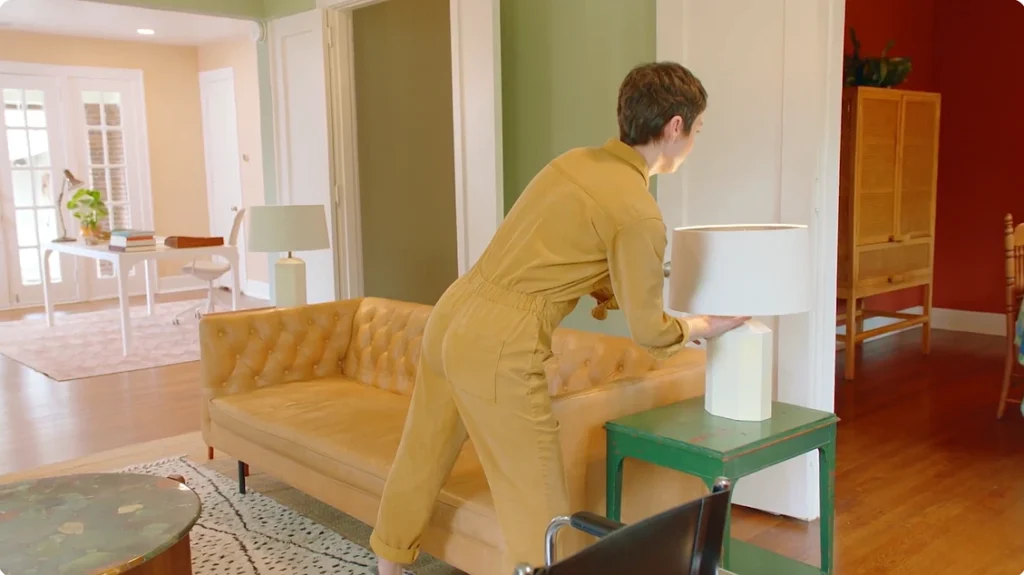
You can walk into your living room tonight, flip the switch, and watch what that single overhead light fixture does, it lights up the floor but creates shadows under everyone’s eyes. Restaurants are well aware of this fact, which is why no one has ever looked romantic under a boob light.
A living room needs light at three levels, and this is the fastest and cheapest way.
- Table lamps at eye level when seated, at least two.
- A floor lamp in the dead corner every room has.
- The overhead, dimmed, doing background work instead of solo work.
When I stage a vacant house, lamps go in before almost anything. When buyers walk into the room, they think it’s the paint that makes them feel warm and comfortable. They’re responding to the lamps.
The Room Has Two Different Focal Points.
I see this a lot. There’s a fireplace on one wall, and a TV on another, and the sofa is facing, vaguely, between them, as if it were the referee. You don’t know what space to pay attention to.
Pick one. In a home you’re living in, it’s probably the TV, and so you commit to it, letting the fireplace be secondary architecture. If you’re selling a home, you’ve got to make it the fireplace, because buyers are buying the fantasy of the life where they read by the fire. They own a TV already. They’re not paying for yours on top.
And the Biggest One: Your Stuff Is Telling Your Story, Not Theirs
Here it is, the one I promised, the one that separates staging from decorating.
Your living room is a museum of you: family photos, the trophy shelf, a souvenir from Portugal, a throw that your mother crocheted. In a home you’re living in, wonderful, that’s what a home IS. But the moment that house goes on the market, every personal item becomes a small “no trespassing” sign. A buyer standing in a room full of your memories is a guest. A buyer standing in a room that has room to breathe is for thirty seconds already the owner. Here comes their sofa. Their own Christmas tree. That moment when someone figures out how they would arrange the furniture and it suddenly feels like a house with potential, that’s when it sells.
Statistics show staged homes sell, on average, faster and for thousands more than those not staged. Plus, you get the personal-item edit for free! It’s just boxes and an afternoon.
One of my sellers, Marion, fought me hard on her photo wall, twenty-six frames of her grandchildren going up the staircase. We packed them with care, labeled each box, and she had three offers on her home nine days later after it sat flat for four months. One day she called me to tell me the strangest thing: with the wall bare, she could see the staircase.
That’s the whole job, really. You don’t see your living room any more. You see your life in it, which is beautiful and completely blinding. A stager just walks in without the memories and reports what the room has been trying to tell you all along.

