


Close to fifty million American adults lived with a mental illness in a recent year. That is roughly one in five. Put it another way: whatever room you are in right now, do the math on the people in it, and the number is not abstract.
So when people call mental health a “growing concern,” the phrase undersells it. It is not a trend. It is a baseline fact of how common this is, and the more useful question is not whether it matters but what actually helps, what the evidence says, and where the real barriers sit. That is what this piece is about.
What We Actually Mean By Mental Health
Mental health is not the absence of problems, and it is not a mood. It is the broader state of your emotional, psychological, and social functioning, the thing that shapes how you handle stress, relate to other people, and make decisions.
Worth saying plainly: everyone has mental health, the same way everyone has physical health. You do not need a diagnosis to have a stake in it. A person can be free of any disorder and still be doing badly, and a person managing a serious condition can be doing well. The point of awareness is not to get everyone labeled. It is to get people to treat the mind with the same seriousness they would a body.
The Stigma Is Not A Side Issue. It Is The Main Barrier.
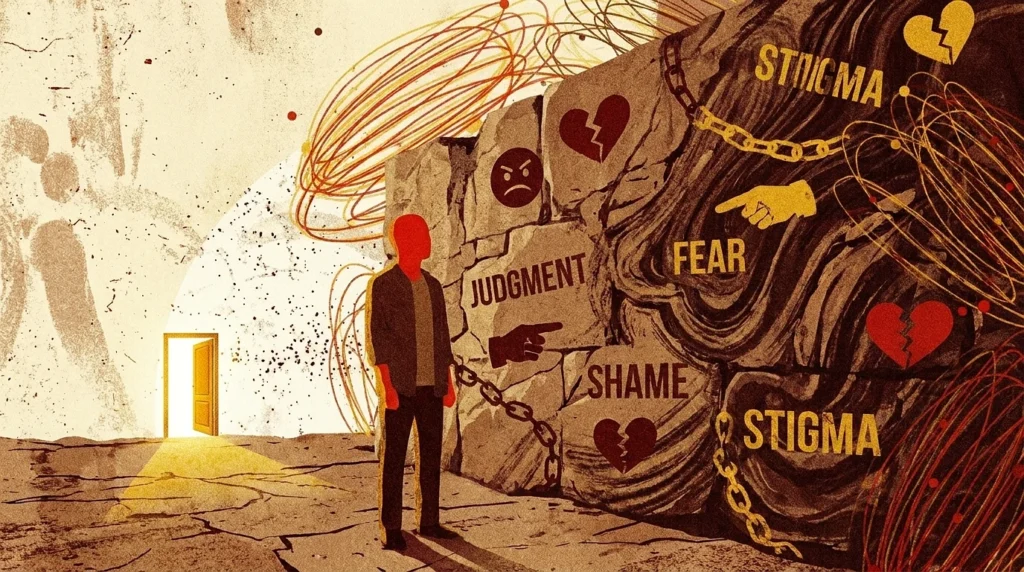
Across countries, around two-thirds of people with a known mental disorder never seek help from a health professional. Worldwide, more than seventy percent of young people and adults with mental illness receive no treatment at all. Researchers call that distance between how many people are affected and how many get care the treatment gap, and stigma is one of the biggest forces holding it open.
And the stigma itself does measurable harm. In a survey spanning forty-five countries, eighty percent of people with mental health conditions said the stigma can be worse than the symptoms of the illness. Sit with that. The social weight of the thing outranking the thing itself.
What keeps people from the door tends to fall into a few buckets: not recognizing the symptoms as illness, not knowing how to get treatment, fear of being judged, and the expectation of discrimination if the diagnosis gets out. Each one is a place an intervention can work, which is the hopeful part. The evidence is decent that education plus real contact, hearing from people who have lived it, shifts attitudes better than facts alone.
- Source: Mental illness stigma and the treatment gap – https://pmc.ncbi.nlm.nih.gov/articles/PMC3698814/
- Source: Global stigma survey, 45 countries – https://www.therapyroute.com/article/breaking-down-stigma-around-mental-illness-2025-statistics-by-therapyroute
Common Conditions And What They Look Like
This is not a diagnostic tool, and nothing here replaces an actual clinician. But knowing the rough shape of the common conditions helps you recognize when something has crossed from a hard week into something worth attention.
| Condition | What it can look like |
|---|---|
| Anxiety | Racing heart, fast breathing, restlessness, a sense of dread that outlasts the trigger |
| Depression | Persistent low mood, loss of interest in things you used to enjoy, fatigue, changes in sleep and appetite |
| Bipolar disorder | Swings between low periods and elevated or agitated “up” periods, with shifts in energy and behavior |
The thing these share is duration and disruption. Most people feel anxious or flat sometimes. The line worth watching is when the feeling sticks around for weeks and starts interfering with work, relationships, or daily function.
Why Catching It Early Changes The Outcome
Early is better, and that is not a slogan, it is how these conditions behave.
Many disorders show up young. More than half of anxiety and fear-related disorders begin before age eighteen, and roughly three-quarters by age twenty-five. The conditions also tend to deepen and entrench when they run untreated, so the window where help is easiest is often the one people spend talking themselves out of needing it.
The flip side is genuinely encouraging. Most people who get into treatment improve, and they improve faster than they expect. In recent US data, a large share of patients started seeing results within the first handful of sessions. The lesson is not that treatment is magic. It is that the cost of waiting is usually higher than the cost of starting.
- Source: Age-of-onset and treatment-response data – https://www.treatmyocd.com/blog/therapy-statistics
Mental Health Moves Through The Life Stages
It does not look the same at six as it does at sixty. The pressures change, and so do the conditions that tend to surface.
| Life stage | Concerns that more commonly surface |
|---|---|
| Children | ADHD, separation and other anxiety, behavioral difficulties |
| Adolescents | Depression, eating disorders, substance use |
| Adults | Chronic stress, anxiety, depression |
| Older adults | Dementia-related changes, loneliness, grief |
Older adults are the group people forget, and the assumption that low mood is just a natural part of aging does real damage, because it gets serious, treatable depression written off as normal. It is not normal, and it responds to treatment at any age.
A Safety Plan Is A Real Clinical Tool, And It Is Not A DIY Project
You will see “make a mental health safety plan” passed around online. The term is real and the tool is genuinely useful, but it is worth being precise about what it is, because this is the one area where a generic web article should not pretend to be your guide.
A safety plan is a structured, personalized plan that someone at risk works out, ideally with a clinician, to get through a crisis. It typically covers recognizing personal warning signs, coping steps that have helped before, people and places that provide support, and how to reach professional help quickly.
If you or someone you care about may be in crisis, this is not the moment for self-help reading. In the US, you can call or text 988 to reach the Suicide and Crisis Lifeline, any time. Building the actual plan is something to do with a professional, who can tailor it and make sure nothing important is missing.
- Source: 988 Suicide & Crisis Lifeline – https://988lifeline.org/
The Daily-Life Basics Genuinely Move The Needle
None of what follows replaces treatment when treatment is needed. But sleep, movement, and food are not wellness-influencer filler, they have real effects on mood and resilience, and they are among the few levers fully in your own hands.
- Sleep is the one most people underrate. Poor sleep and poor mental health feed each other in both directions, and protecting it is often the single highest-yield change available.
- Exercise has a real, repeatedly observed antidepressant and anti-anxiety effect, and it does not require a gym, regular brisk walking counts.
- Food and routine matter less dramatically but steadily; blood sugar crashes and chaotic days both tax a system that is already working hard.
The trap is treating these as a cure. They are a foundation. When someone with clinical depression is told to just exercise and eat better, that advice can land as blame. Hold both ideas at once: lifestyle helps, and it is not a substitute for care.
Other People Are Part Of The Treatment
Isolation is both a symptom and an accelerant. One of the most consistent findings in the whole field is that social connection protects mental health, and loneliness corrodes it.
You do not need a large circle. You need a few real connections, people you can be honest with. For a lot of people the hardest part is that the conditions themselves, depression especially, push you to withdraw exactly when connection would help most. Worth naming that trap out loud, because recognizing it is the first step to pushing back against it.
Therapy And Medication, Briefly And Honestly
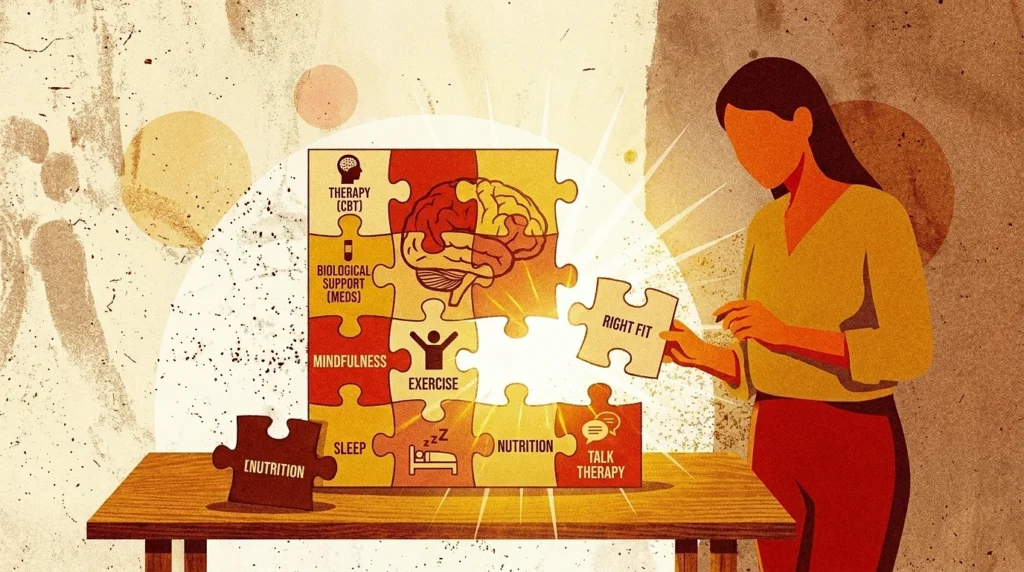
These are the backbone of treatment for most conditions, and they are not either/or.
Therapy comes in evidence-backed forms, cognitive behavioral therapy among the best studied, which works by changing the patterns of thought and behavior that keep a condition running. Medication, prescribed and monitored by a doctor, can correct the underlying biology enough that the other work becomes possible. For many conditions the strongest results come from the two together.
The honest caveat is that finding the right fit takes patience. The first therapist or the first medication is not always the one that works, and that is normal, not failure. People who improve are very often people who tried a second thing after the first did not land.
Mental HEALTH AT WORK
Work is where a lot of adults spend most of their waking hours, and it is a major source of the stress that tips people over. The encouraging shift is that workplaces are slowly being forced to take this seriously, partly because the cost of ignoring it, in lost days and lost people, became impossible to overlook.
Know what your employer offers, many have employee assistance programs that quietly include free counseling sessions. Protect the boundary between work and the rest of your life where you can. And if work itself is the thing making you ill, that is information worth acting on, not pushing through.
The Internet Is Doing Something To All Of Us
Social media is not uniformly bad, and the research does not support pretending it is. It connects isolated people and spreads exactly the kind of awareness this article is about.
But the comparison engine is real, the doom scrolling is real, and the effect on sleep and attention is well documented. A reasonable approach is not abstinence, it is friction, making the mindless checking slightly harder so you do it on purpose rather than by reflex. The goal is using the tool instead of being used by it.
Awareness Has To Start Where People Are Young
Schools and universities are where a lot of conditions first appear, given how early onset tends to be, which makes them the obvious place to build recognition and support. Programs that teach young people the basic vocabulary of mental health, what is normal, what is not, how to ask for help, do measurable good, partly by getting in ahead of the stigma before it fully sets.
It Looks Different Around The World
Mental illness is universal. How cultures understand and treat it is not.
In some places it is openly discussed and well resourced; in others it is hidden, stigmatized, or framed in entirely non-medical terms. The treatment gap is widest in lower-income countries where services barely exist. There is something clarifying in that global view: the conditions themselves are a shared human inheritance, and most of the difference in outcomes comes down to access and attitude, both of which are things societies can actually change.

