


Before anything else, a correction to how these three usually get presented together.
PRK is not a type of LASIK. Standard LASIK and bladeless LASIK are lamellar procedures, meaning a flap is cut into the cornea and the tissue underneath is reshaped. PRK is surface ablation, where no flap is made at all and the outer layer is removed instead. They are cousins rather than siblings, and grouping them under one heading has misled a lot of patients into thinking the choice is cosmetic when it is structural.
With that said, they are the three laser vision correction procedures most people are actually choosing between, so let me take them in order and then get to how the decision is really made.
What Laser Vision Correction Does
All three reshape the cornea, the clear dome at the front of the eye, so that light focuses correctly on the retina. That is how they treat nearsightedness, farsightedness and astigmatism.
The procedure itself is short, roughly fifteen minutes for both eyes, and it is done under anaesthetic drops rather than general anaesthesia. Discomfort during the surgery is minimal. Recovery is where the three diverge sharply, which is the part worth understanding before you pick.
The Three Procedures
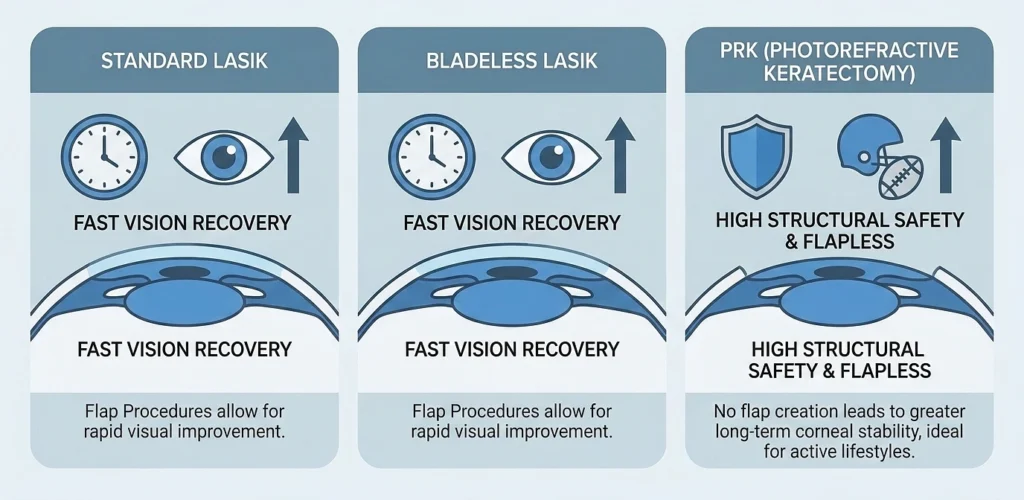
1. Standard LASIK
A microkeratome blade creates the corneal flap. The surgeon lifts it, reshapes the underlying tissue with an excimer laser, and lays the flap back down, where it adheres without stitches.
It works well for patients with a stable prescription, meaning no meaningful change for around two years, and sufficient corneal thickness. Visual recovery is fast, often functional by the next morning.
The flap is the trade-off. It never returns to full original strength, which matters over a lifetime for anyone taking impacts to the face.
2. Bladeless LASIK
Same procedure, different flap. A femtosecond laser creates it instead of a blade, giving far more control over thickness, diameter and orientation.
That control is not marketing. In a comparison of dry eye outcomes after flap creation, the incidence of LASIK-associated dry eye was 46 percent in the microkeratome group against 8 percent in the femtosecond group, with a correspondingly lower need for treatment afterwards. That is a substantial difference from one change in technique.
Bladeless is generally the better option where corneal thickness is marginal or the corneal shape is irregular, and it allows the flap to be planned around the anatomy of each individual eye.
3. PRK
No flap. The thin epithelial layer is removed, the excimer laser reshapes the surface directly, and a bandage contact lens goes on while the epithelium regrows over several days.
PRK is the answer for thin corneas, large pupils, and anyone whose life makes a flap a liability, which is why it is standard for military personnel, police, and people in contact sports. There is no flap to dislodge, ever.
The honest cost is recovery. Several genuinely uncomfortable days, and vision that sharpens over weeks rather than overnight. Long term visual results are comparable to LASIK, so what you are trading is short term comfort for structural durability.
Correcting Something That Appears in a Lot of LASIK Material
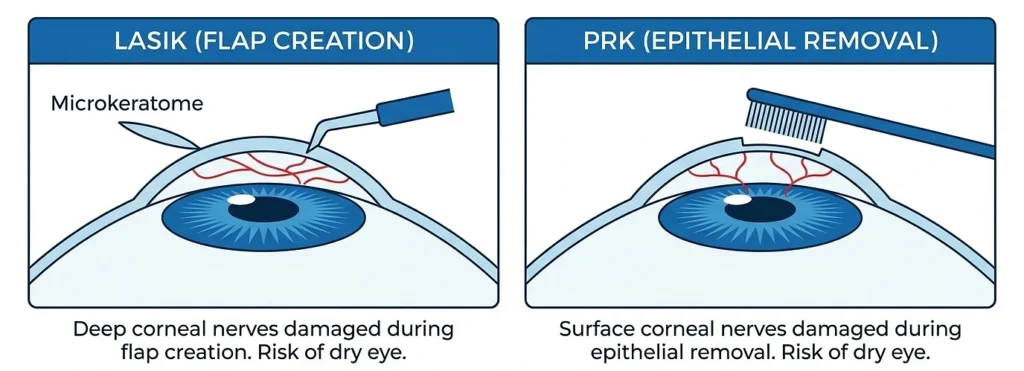
You will frequently read that dry eye is a LASIK problem and not a PRK problem. That is not what the research shows.
Both procedures damage corneal nerves, just differently. LASIK transects the basal nerve plexus across roughly 300 to 310 degrees through flap creation. PRK damages superficial nerve structures through epithelial removal and ablation. A study of 778 patients following refractive corneal surgery found that PRK and transepithelial PRK actually demonstrated significantly higher dry eye incidence than LASIK and femtosecond LASIK, which contradicts the usual assumption.
Other work finds the two roughly comparable by one year. The fair summary, in the words of one corneal specialist, is that there is reasonable data that neither causes more dryness than the other, but both cause some dryness.
This matters because dry eye is not a footnote. It accounted for about 20 percent of patient dissatisfaction in studies from Wills Eye Institute and Wilmer Eye Institute, and somewhere between 20 and 55 percent of patients report persistent eye symptoms at six months or more after LASIK.
How The Choice is Actually Made
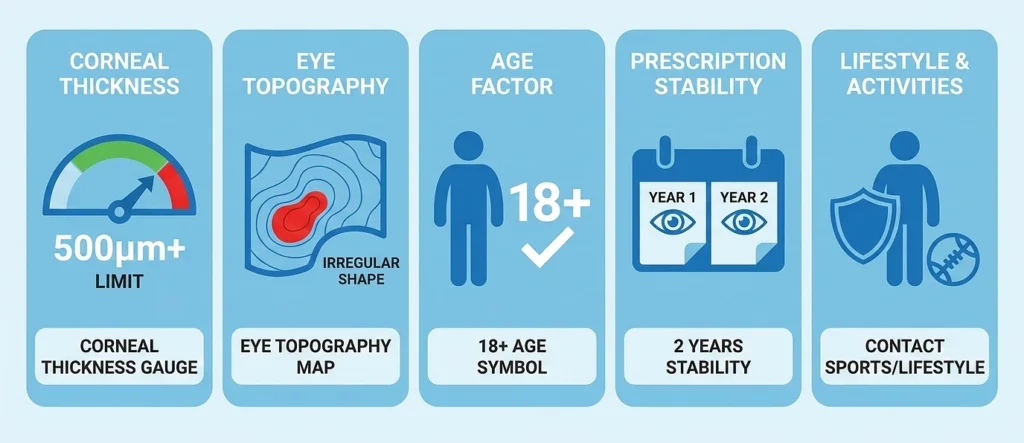
Patients tend to think they are choosing. In practice the eye chooses, and the consultation exists to find out what it will allow.
- Corneal thickness sets the outer limit. Tissue removed is tissue gone, and enough has to remain underneath to hold shape permanently. Thin corneas push you toward PRK.
- Corneal shape matters as much as thickness. An irregular topography map, particularly one suggesting keratoconus, is the strongest reason to decline surgery altogether.
- Prescription stability over roughly two years. Correcting a moving target guarantees regression.
- Age, since candidates should be at least 18 and stable, and older patients face presbyopia, which none of these procedures addresses.
- Lifestyle, which is the one factor genuinely in your hands. Contact sports, martial arts, military service and similar all argue for a flapless approach.
- Existing eye health, including chronic dry eye, previous eye surgery, or inflammation.
Who Gets Turned Away, And Why That is The System Working
Roughly one in five people who arrive expecting laser surgery are told no or not yet, and the reasons are specific.
Laser refractive surgery is generally not recommended for people with autoimmune conditions such as rheumatoid arthritis, a weakened immune system, persistently dry better eye health, or recent vision changes caused by medication, pregnancy, breastfeeding or hormonal shifts. Corneal inflammation, lid disorders, eye injuries, uveitis, ocular herpes simplex, glaucoma and cataracts all complicate it.
The strongest exclusions are keratoconus or corneal ectasia, or a family history of either, along with very large pupils, very thin corneas, or severe nearsightedness that would require removing more tissue than the eye can spare.
Being disqualified is genuinely disappointing and it is also the screening doing its job. The safety record of these procedures depends on the people who are turned away.
What Should I Ask at The Consultation?
The most useful question is not about technology. Ask what they found that gives them pause, and what would make them decline to operate on you.
A surgeon with a real screening practice answers that immediately, because they turn people away regularly. Ask specifically about your corneal thickness number, whether your topography is clean, and what your dry eye risk looks like given your baseline tear function. And mention if you wear contact lenses, since you will be asked to switch to glasses for a period beforehand so the cornea returns to its natural shape before measurements are taken.
The Risks Worth Knowing Before You Decide
Dry eye, light sensitivity, reduced night vision including glare and halos, infection, and the possibility of under or overcorrection requiring an enhancement procedure. Flap complications are specific to LASIK and bladeless LASIK rather than PRK.
None of that makes these bad procedures. Satisfaction rates are high and the great majority of patients are pleased with the outcome. It does mean that any clinic presenting the surgery as risk-free is telling you something about the clinic rather than about the surgery.
Talk this through with an ophthalmologist who has examined your eyes, since nothing here substitutes for measurements taken from your actual cornea.

