


Parents arriving at a dyslexia evaluation almost always bring a theory about what they did. The usual suspects:
- The move in second grade.
- The divorce, or the year before the divorce.
- Too much screen time, not enough books.
- The stressful teacher nobody wanted.
- The new baby, the job loss, the year everything was hard.
None of them did it. Not one. And I am starting there because a whole genre of articles online implies the opposite, linking cortisol to dyslexia risk in a way that reads as though a hard childhood assembles the condition, which reverses the direction of causation and hands families a guilt they never earned.
Two claims keep getting welded together in this subject. One is well supported. The other is not. Pulling them apart is the whole job here.
Dyslexia Is Heritable And Neurobiological, And The Genetics On This Is Not A Close Call
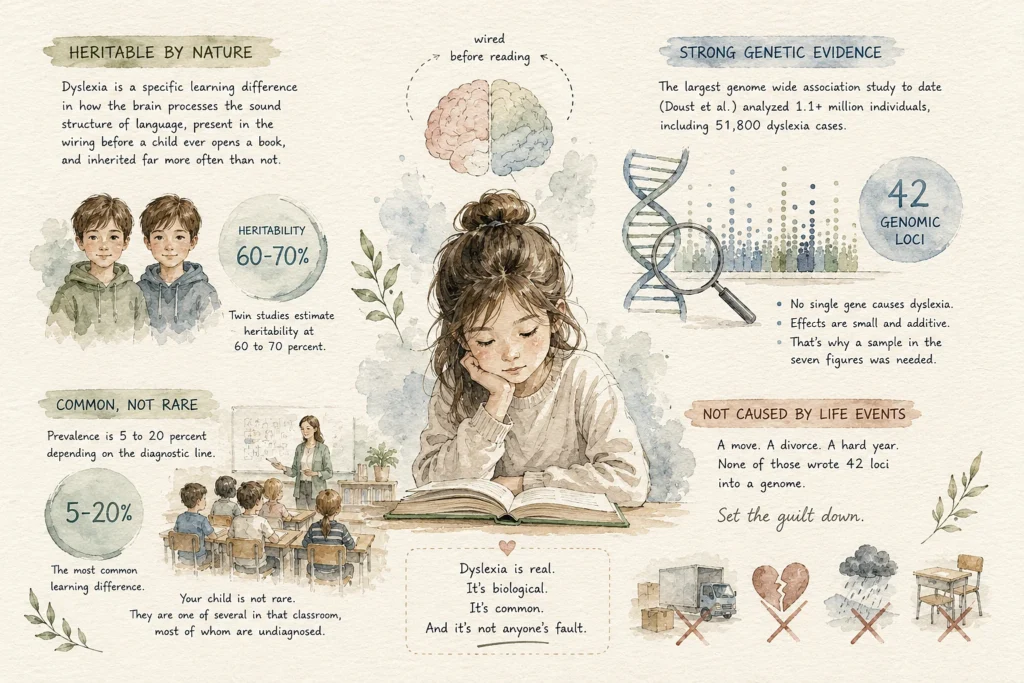
What dyslexia actually is a specific learning difference in how the brain processes the sound structure of language, present in the wiring before a child ever opens a book, and inherited far more often than not.
The evidence behind that definition is heavy. Twin studies put heritability at roughly 60 to 70 percent. The largest genome wide association study to date, run by Doust and colleagues across more than 1.1 million individuals including 51,800 dyslexia cases, turned up 42 genomic loci tied to the condition. No single gene carries it, the individual effects are small and additive, and that is exactly why researchers needed a sample in the seven figures before anything showed up at all.
Prevalence lands at 5 to 20 percent of the population depending on where the diagnostic line is drawn, per the Yale Center for Dyslexia and Creativity, which makes this the most common learning difference there is. Your child is not rare. Your child is one of several in that classroom, most of whom are undiagnosed.
So, plainly a move, a divorce, a frightening teacher, a hard year. None of those wrote 42 loci into a genome. Set the guilt down.
What Stress Genuinely Does Is Tax The Working Memory That Reading Runs On
Reading, for a child still learning it, is a working memory sport.
Hold the sounds. Hold the letters that make them. Keep the front half of the sentence alive while decoding the back half, and keep meaning assembling while the machinery grinds through it. Every one of those jobs draws from the same limited pool.
Elevated cortisol interferes with prefrontal function and working memory. Shrink that pool and decoding gets harder for any child at all. For a child whose phonological processing already costs extra, the shrinkage lands on a system that had no spare capacity to give.
Stress does not cause dyslexia. It makes reading with dyslexia harder today, in this chair, on this page. That distinction is not a technicality. One is a false claim about origins. The other is a true claim about performance, and the second one is the one you can do something about this week.
The Loop Runs Both Directions, And The Reading Trouble Came First
Anxiety is the emotional symptom people with dyslexia report most often, and there is nothing mysterious about why.
A child who cannot read at the pace of the room gets asked to read aloud in that room. Repeatedly. For years. The anxiety that follows is a rational response to a genuinely threatening situation, not a character flaw, and certainly not the cause of the reading difficulty. Then the anxiety eats working memory, performance drops further, the loop tightens another notch. Adults with dyslexia are often carrying the compounded interest on decades of that.
Early Adversity Can Produce Reading Problems That Resemble Dyslexia, Which Is A Diagnostic Problem And Not A Causal One
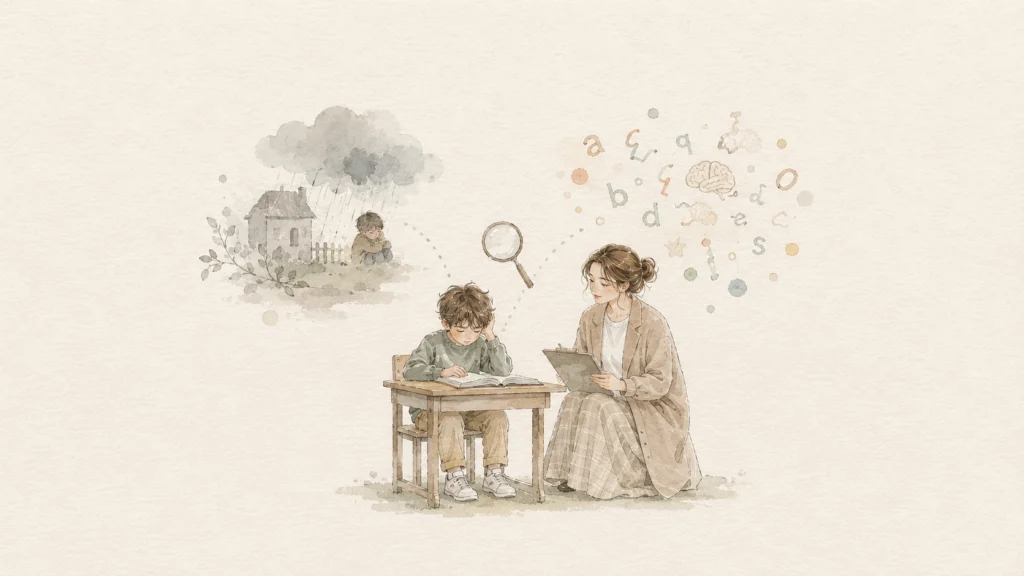
Here is where the honest version gets complicated, and where I suspect the sloppy articles picked up their bad idea.
Chronic early life stress does affect the developing brain, including regions central to language learning. Children growing up under sustained adversity and poverty show measurably weaker phonological awareness, which is one of the strongest predictors of later reading trouble. Real finding, serious research, nothing to argue with.
But read what it says rather than what it suggests. Adversity can produce reading difficulty.
Is That The Same As Producing Dyslexia?
No, and collapsing the two is exactly how a correlation becomes a myth. What it creates is a differential diagnosis problem, because a child struggling because of chronic stress and a child struggling because of dyslexia can look nearly identical on a Tuesday morning in third grade, while needing somewhat different responses. Untangling that is what a proper evaluation exists to do.
One Citation Error Worth Knowing, Because It Spreads
Some articles on this topic reach for adult research to make the point, including Framingham Heart Study work on circulating cortisol and brain structure, presenting it as though it described children.
That study looked at middle aged adults. Whatever it tells us about cortisol and the aging brain, it says nothing about a seven year old learning to decode, and stretching it that way is the sort of move that should make you distrust everything else on the page.
Lowering The Anxiety Helps, And Teaching The Reading Helps More
Reading anxiety is worth reducing on its own merits, and a calmer child brings more working memory to the page. Cheap, defensible, start today.
- Stop cold calling the child to read aloud. Volunteering or a prearranged passage removes the single largest source of classroom dread.
- Give time. Timed tasks convert a decoding difficulty into a panic response, and the panic costs more than the clock ever saved.
- Read together at home without correcting every error. Enjoyment of books is a resource worth protecting by itself.
- Keep practice separate from assessment, and make sure the child knows which one is happening.
- Name it plainly. Children told that their brain handles letter sounds differently, and that this says nothing about how smart they are, do better than children left to invent an explanation. The explanation they invent is almost always that they are stupid.
Now the correction to my own enthusiasm, because the intervention research is blunt about it.
Reducing stress does not teach a child to read. The approaches that work sit closest to reading itself, explicit structured instruction in letter and sound rules, rather than aiming at more distant abilities like general working memory training. Comfort is the condition that lets instruction land. It is not the instruction, and any article implying a calmer household will resolve dyslexia is quietly costing a family two years.
The sequence for a worried parent runs one way. Get the evaluation, school based or through a qualified psychologist, because identification is what unlocks structured intervention and the evidence on early identification is genuinely strong. Reduce the anxiety in parallel starting tonight, since it is free and it buys back capacity. And leave the list at the top of this page behind, because whatever else that hard year did to your family, it did not write this.

