


A cosmetic consultation starts with the dentist asking what you don’t like, and the answer is almost never “everything.” It’s one corner off a front tooth. A gap you’ve hidden in photos since school. Teeth two shades yellower than they were at 25. One gray tooth from a bike crash in 1998. Each of those has a fix, and for four out of the five the fix costs hundreds rather than thousands and leaves the tooth as it was. The fifth is the gray tooth, and that’s the one that gets a veneer.
Chips, small gaps, worn edges and surface staining are handled with bonding or whitening, at a fraction of the cost of veneers and with the enamel left alone. Veneers are for discoloration inside the tooth, teeth of the wrong shape or size, and teeth that have already lost enamel. Once enamel is removed for a veneer it doesn’t come back.
A Chipped Front Tooth Gets Bonded The Same Day
You come in with a corner missing and you leave with it back. The dentist roughens the broken edge, builds the corner up in tooth-colored resin, hardens it with a blue light and polishes it to match. Under an hour for one tooth. No impression, no lab, no second visit, and the enamel on the rest of the tooth stays where it is.
How long it holds depends on what you do with it. Cleveland Clinic puts bonding at three to ten years, a figure Colgate’s guide to bonding repeats, and the things that pull it toward three are coffee and cigarettes, which stain resin faster than enamel, and ice, pens and bottle caps, which chip it. If it does chip, you’re back for another hour and another corner. One caution: a chip that stings with cold water or aches at night isn’t a cosmetic job yet. That tooth may have a crack running under the chip, and it wants an X-ray before it wants resin. The toothache remedies that help overnight cover the night before that appointment.
A Narrow Gap Is Bonding, A Wide One Is Aligners
For a gap of a millimeter or two between the front teeth, resin goes onto the edge of each tooth until they meet, and you’re done in the single visit described above. Past about three or four millimeters the arithmetic changes. Fill that much space with resin and the two front teeth come out plainly wider than the teeth beside them, so at that width the better route is to move the teeth with clear aligners over a few months, with no enamel touched. HAR Dental’s cosmetic dentist Tulia, TX page builds aligners into its plans on that basis, moving teeth into place first so that whatever cosmetic work follows goes onto teeth that are already where they should be.
Yellowed Teeth Whiten, And Whitening Goes Before Anything Else

Stain from coffee, tea, red wine, tobacco and plain age sits in the enamel, and whitening reaches it. You’ve got three strengths to pick from:
- In the dentist’s chair: a strong peroxide gel, around an hour, the biggest shade change in one go.
- Custom trays at home: a weaker gel worn for a set time each day over one to two weeks.
- Drugstore strips: weaker again, slower, and they don’t cover the curve of the teeth as well.
What changes is the shade of the enamel. Fillings, crowns, old bonding and veneers keep the color they were made in, so whitening after any of those leaves the restoration a shade darker than the teeth around it. Dentists whiten first for exactly this reason and then match any new work to the brighter shade; HAR Dental’s page describes whitening before crowns or veneers so the lab can match the brightest natural color, and you’ll find the practice works that way wherever you go.
Whiten first. Bonding and veneers are matched to the teeth beside them when they’re made, and they don’t lighten afterward.
One Gray Tooth Is Where A Veneer Makes Sense
A single dark tooth among normal ones is nearly always discolored from the inside: a nerve that died after a knock, or tetracycline taken while the tooth was still forming. Cleveland Clinic’s dentists explain that the antibiotic binds into the developing tooth and discolors it from within, that drugstore whitening and short courses do little to it, and that supervised whitening helps some people over several months. Bonding can mask a mildly dark tooth, though resin is thin and gray shows through it.
A porcelain veneer covers the color completely and keeps its own shade for around ten years, the figure Colgate attributes to the American Dental Association. To fit it the dentist grinds about a millimeter of enamel off the front and sides, and the ADA’s patient page on veneers states the consequence without softening it: the treatment is not reversible, because the enamel has been removed. A veneer that cracks or comes loose is replaced with another veneer, for as long as you have the tooth.
Worn Or Oddly Shaped Teeth Depend On How Much Enamel Is Left
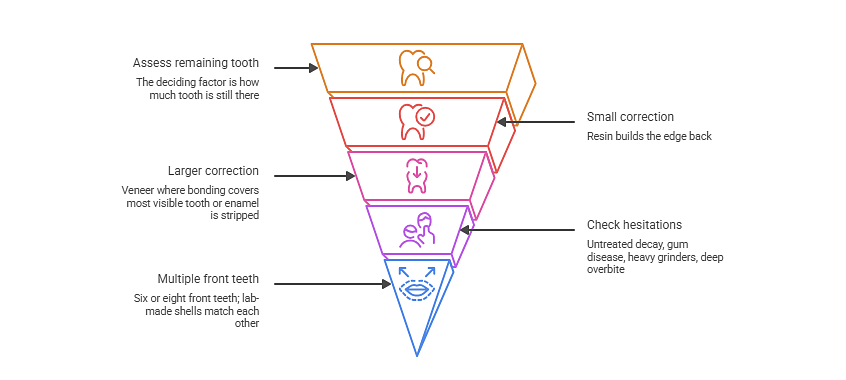
Edges ground flat, or one tooth noticeably shorter or narrower than its neighbors, can go to bonding or to a veneer, and the deciding factor is how much tooth is still there. Where the correction is small, resin builds the edge back. Where bonding would have to cover most of the visible tooth, or where grinding has already stripped the enamel, a veneer is the sounder choice: there’s less enamel to lose and porcelain stands up to the wear that caused the problem. Grinders get a nightguard whichever way it goes. The ADA lists the people a dentist will hesitate over before placing veneers:
- Anyone with untreated decay or gum disease, which is dealt with first.
- Heavy clenchers and grinders, unless a nightguard is part of the plan.
- People with a deep overbite.
When six or eight front teeth need the identical correction, veneers move ahead of bonding for a practical reason: six shells made together in a lab match each other, while six corners shaped by hand on the day can drift a shade or a half-millimeter apart.
How The Costs Compare And Why The Cheap Fix Goes First
Porcelain veneers run $925 to $2,500 a tooth on the ADA’s estimate as Colgate reports it, so a front set is somewhere between $5,500 and $20,000. Bonding is priced in the low hundreds per tooth, and the comparison with current figures is worked through in the article on what composite bonding costs before you book veneers. Whitening costs less than either. Insurance treats all three as cosmetic unless there’s a medical reason, a point HAR Dental’s page makes alongside its free consultation, which goes through the plan and the price before anything is booked.
The cheap option goes first because, if it works, the expensive one never gets bought, and if it doesn’t work, nothing has been lost that the next step needed. Whitening settles the shade and changes nothing permanently. Bonding adds material and can be redone. Veneers take enamel and commit the tooth to a replacement roughly every decade, so they’re kept for the problems above that the first two can’t reach. Anyone treating a smile upgrade as part of looking after themselves spends less and keeps more tooth by going in that order.
The ADA’s veneers page carries a warning that didn’t exist a few years ago. Veneers are placed by a licensed dentist. The unlicensed “veneer technicians” now advertising cheap sets online have been sending people on to dentists with infections, nerve damage and decay missed under the shells.

