


Status as of this writing the pilot ended in November 2025. The Port of Rotterdam Authority has not published its findings.
That sentence is not a hedge. It is the story, and anyone claiming to tell you what RPA ZERO proved is filling a gap the Authority itself has left open.
So this piece does something slightly unusual. It sets out precisely what was verifiably established when the trial began, what the Authority said it would measure, and what the continued silence does and does not imply. Where the record stops, this article stops with it.
What Was Actually Announced, Stripped of The Press Release Gloss
The Vessel and The Arrangement
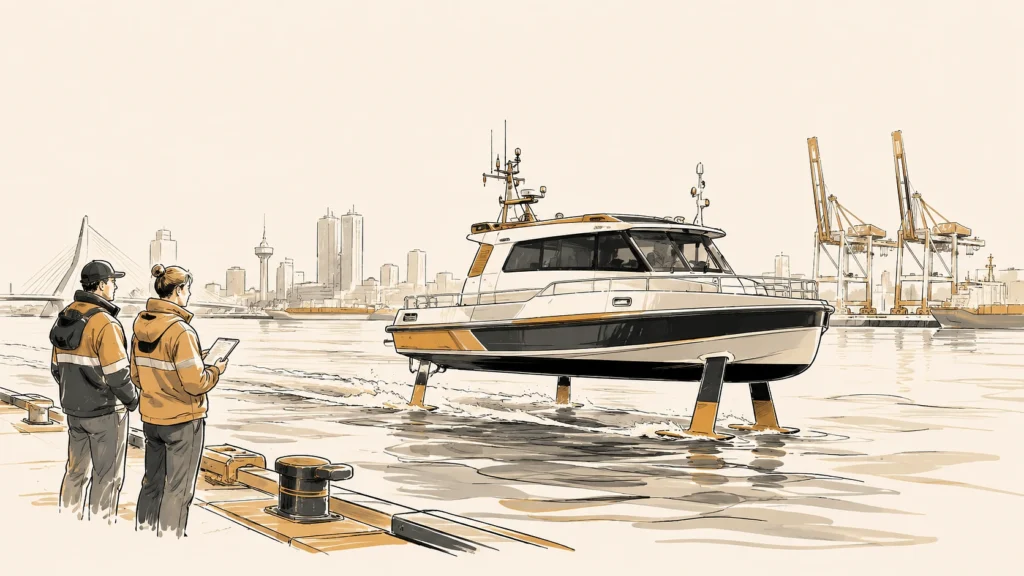
On 28 May 2025, the Port of Rotterdam Authority put an Artemis EF-12 Workboat into service on the Nieuwe Maas under the name RPA ZERO, a reference to its zero emissions capability. Two details in that sentence get lost in most coverage.
The vessel was leased, not purchased, from Artemis Technologies of Belfast. And it was a pilot within a fleet renewal programme, not a fleet decision. Those are the terms of a trial designed to be reversible, which is exactly what a competent asset manager does with unproven technology.
The Mechanism
A hydrofoil lifts its hull clear of the water as it accelerates, cutting drag and wave impact and raising energy efficiency. The claimed operational benefits went beyond fuel. Lower noise, reduced wake, less vibration, and greater stability in rough water, all of which matter in a dense port where wash from patrol craft is a genuine nuisance to other users and to people living along the water.
The Stated Evaluation Criteria
The Authority was specific about what the Fleet Renewal and Sustainability Programme team, working with crew and asset managers, would assess.
| Criterion | What it was testing |
|---|---|
| Sailing behaviour | Handling and stability in working conditions on the Nieuwe Maas |
| Vessel reliability | Whether it holds up under real duty rather than demonstration runs |
| Benefits and challenges of electric power | The practical trade offs against diesel incumbents |
| Charging requirements | Infrastructure, turnaround time, and what a charged fleet would demand |
| Task suitability | Whether it can do the Harbour Master’s Division’s actual work |
| 24/7 deployment | The hardest test, since patrol work does not pause |
Note what sits at the bottom of that list. Round the clock availability is the criterion that kills most electric workboat cases, because a vessel that charges is a vessel that is not patrolling, and a harbour master’s division needs coverage rather than enthusiasm.
Why The Fleet Question is Bigger Than One Boat
Here is the context that makes this pilot worth watching rather than filing away.
Over the next 12 years, the Authority’s vessels reach the end of their technical service life style. All of them. That timing created an unusual opening, and the Authority chose to treat it as one, renewing the entire fleet at once while standardising and simplifying maintenance. Its executive board stated an ambition to make the new fleet as emission free as possible.
So RPA ZERO was never really a boat trial. It was a procurement question dressed as a boat trial, and the answer feeds into a replacement cycle covering an entire working fleet at Europe’s largest seaport. That is why the result matters to more people than the crew who sailed it.
What The Silence Does And Does Not Tell Us
I want to be careful here, because the temptation to read meaning into an absence is strong and usually wrong.
What we can say. The pilot concluded on schedule in November 2025. No public findings, no follow on order announcement, and no statement of intent regarding hydrofoils in the renewed fleet have been published in the months since.
What we cannot say. That the trial failed. Port authorities routinely absorb pilot results into internal procurement processes without publishing them, particularly where a competitive tender is coming, and saying nothing during a procurement window is standard practice rather than a verdict. Commercial confidentiality around a leased asset from a single supplier points the same direction.
What would be worth watching for. A tender or framework agreement naming vessel types for the renewal programme. Any statement from Artemis Technologies about a Rotterdam order, since suppliers publicise wins faster than customers do. And the Authority’s own sustainability and annual reporting, which is where a quiet mention of pilot outcomes is most likely to surface.
If you need the answer for a commercial decision, the honest route is a direct enquiry to the Port of Rotterdam Authority rather than any article, including this one.
What The Pilot Proved Regardless of The Report
Some things were demonstrated by the trial simply happening, and they hold whatever the internal findings say.
- A major port authority put an electric foiling workboat into real operational duty, on a working river, for roughly six months, rather than into a demonstration day.
- The lease structure worked as a de risking model, letting the Authority test an unproven platform without committing capital to it, which is a template other ports can copy directly.
- The evaluation criteria were published up front, which is more transparency than most fleet pilots offer and gives outside observers a real standard to hold the outcome against.
- Charging and 24/7 availability were named as central questions, confirming that the industry’s hard problem with electric workboats is duty cycle rather than propulsion.
None of that is the same as proof that hydrofoils belong in the fleet. It is proof that the question was asked seriously, by an operator with the scale to make the answer matter, and the follow through is now a matter of public record that has not yet been written.
I would rather tell you that than invent a conclusion the Authority has not reached in public.

