


Penicillin has been in clinical use since the 1940s and it is still the first choice for several common infections. It is also the drug most people wrongly believe they cannot take.
Both of those things are covered below, what it treats, what it does to you, and why the allergy note in your file is probably wrong.
Penicillin Treats Strep Throat, Dental Abscesses, Cellulitis, Syphilis And Group B Strep
The class works by breaking bacterial cell wall construction. Human cells have no cell walls, which explains a good deal of why the drug sits so well in most people.
What doctors prescribe it for:
- Strep throat. Seventy years in and resistance is still essentially absent, which is unusual enough to be worth noting.
- Dental infections and abscesses. One of the highest-volume prescribing situations there is.
- Skin infections including cellulitis and impetigo.
- Some pneumonias, ear infections and sinus infections.
- Syphilis. Injectable penicillin is the only recommended treatment in full pregnancy and nothing substitutes adequately.
- Group B strep in labour, given by drip to stop transmission to the baby.
- Rheumatic fever prevention, taken long term by people who have had an episode.
Amoxicillin is the version most people have actually swallowed. Penicillin V, penicillin G, co-amoxiclav and flucloxacillin belong to the same family and get chosen for different bugs and different tissues.
Diarrhoea, Nausea and Thrush The Common Side Effects, and Are Allergies
Diarrhoea leads by a wide margin. After that: nausea, stomach discomfort, and thrush in the mouth or vagina, since the drug strips out useful bacteria along with the ones causing trouble.
These are pharmacological effects. They are what the drug does, not an immune reaction to it, and guidance states plainly that a known adverse effect such as nausea should not be recorded as an allergy.
It gets recorded as one constantly. Someone mentions at a follow-up that amoxicillin made them queasy, it lands in the file under the wrong heading, and it stays there.
If side effects are making a course hard to finish, ring the prescriber rather than stopping. Bacteria that survive a half-finished course are the ones best equipped to survive it.
Anaphylaxis, C. Difficile and Blistering Skin Reactions Need Immediate Medical Care
Anaphylaxis normally arrives inside an hour. Swelling of the face, lips, tongue or throat, trouble breathing, hives spreading fast, dizziness or collapse. Call an ambulance.
C. difficile infection shows up as watery diarrhoea that will not stop, often with cramping and fever, and it can start weeks after the antibiotics finished.
Stevens-Johnson syndrome and related reactions are rare. Skin blistering or peeling, sores in the mouth or eyes, usually with fever. Urgent care, same day.
10% of Americans Have a Penicillin Allergy on File and Fewer Than 1% Are Allergic
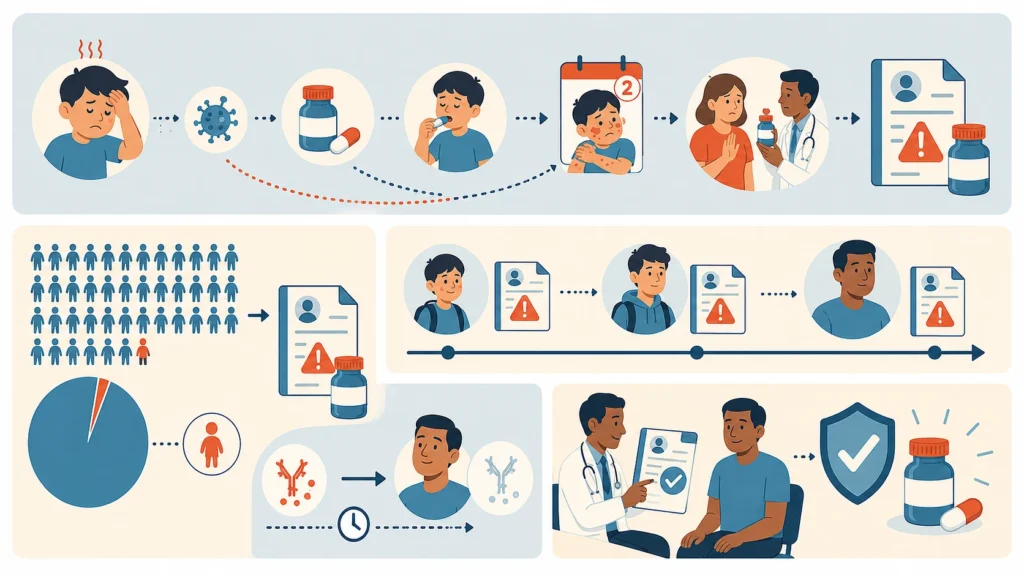
Those numbers are the CDC’s. Among hospital inpatients the reported rate runs nearer fifteen%, and over ninety% of those patients can take penicillin safely.
Most of these labels start the same way. A child gets ill, gets an antibiotic, develops a rash on day two, and the antibiotic takes the blame. Only the most common cause of rashes and hives in children is the viral infection itself. The rash was coming regardless.
Nobody behaved badly in that story. Stopping a drug when a child breaks out in spots is the correct call at the time. The label simply never gets looked at again.
Allergy also fades. IgE-mediated penicillin allergy weakens over the years, so somebody who truly reacted at seven often has no reaction at all by thirty-five.
The Allergy Label Raises MRSA Risk by 55% and C. Difficile Risk by 35%
Marked allergic, you get broader-spectrum alternatives. Those carry consequences that have been measured: a 55% higher risk of picking up MRSA, a 35% higher risk of C. difficile, longer stays in hospital, higher costs, and in some studies a higher rate of in-hospital death.
The CDC, AAAAI, SHEA and IDSA all treat penicillin over-labelling as a public health matter rather than a paperwork quirk.
Pregnancy is where it bites hardest. Syphilis in pregnancy has no adequate alternative, group B strep prophylaxis works best with the same drug, and a false label at that point creates a genuinely awkward clinical problem. Some obstetricians now want the question settled during pregnancy instead of on the labour ward.
A Direct Oral Challenge Can Clear the Label in One Supervised Appointment
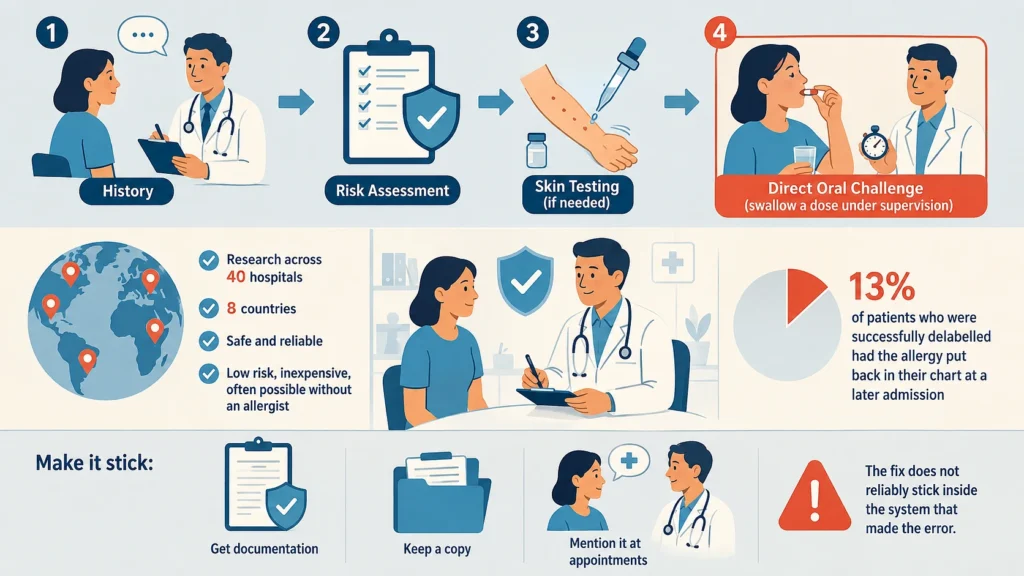
Testing runs in stages. History first, then a validated risk assessment, then skin testing or a direct oral challenge, which means swallowing a dose while somebody watches flip, twist you for a reaction.
Research across 40 hospitals in eight countries found direct oral challenge both safe and reliable for sorting genuine allergy from inherited paperwork. Hospital delabelling programmes describe it as low risk, inexpensive, and often possible without an allergist.
One thing to plan for: about 13% of patients who were successfully delabelled had the allergy put back in their chart at a later admission. Get documentation, keep a copy yourself, and mention it at appointments, because the fix does not reliably stick inside the system that made the error.
A Childhood Rash is Worth Re-Testing, a History of Anaphylaxis
Raise it with your doctor if the label came from childhood and nobody has questioned it since, if what you actually remember is an upset stomach rather than hives or swelling, if it was written down because a relative reacted rather than you, or if you have taken a penicillin since then without trouble.
Pregnant or planning to be? Move it up the list.
If your history includes anaphylaxis or a severe delayed reaction with blistering skin or organ involvement, that goes to a drug allergy specialist. The label stays until they say otherwise, and nothing here suggests otherwise.

