


The happier the marriage, the more weight the couple gains. That’s not a joke or a jab, it’s the actual finding of a four-year study of 169 newlywed couples. And the flip side is the part that stings. The spouses who stayed lean were, statistically, the ones thinking about divorce.
Everybody knows the marriage-weight connection, right? The aunt at the party, the “married life is treating you well” conversation, the whole ritual. And the link itself is about as settled as this research gets, marriage is associated with weight gain and divorce with weight loss, the field’s own researchers say so plainly. What’s new is what the weight might be saying about the marriage underneath it.
The Newlywed Study That Flipped The Assumption
Psychologist Andrea Meltzer (then at Southern Methodist University) recruited 169 husbands and wives who had married in the past six months. The average age for husbands was twenty-five, and the average age for wives was twenty-three. For the next four years, researchers weighed each couple at six-month intervals and tested them on marital satisfaction. They also asked whether the couple had sought a divorce. Published in Health Psychology, the findings were opposite of what most might assume: as a spouse’s satisfaction increased, so did weight, and if satisfaction decreased, so too did weight.
Not because misery is slimming. But because what sat in the middle of the data was the thought of divorce. The people who are unhappy at home, who want to leave, are the same people who are holding their weight down. We controlled for pregnancy, so it wasn’t that. That translated to a 0.12 increase in BMI per unit increase in satisfaction every six months, or about the impact of half a pound. A small effect, but consistent over four years.
The Two Theories, And The One That Won
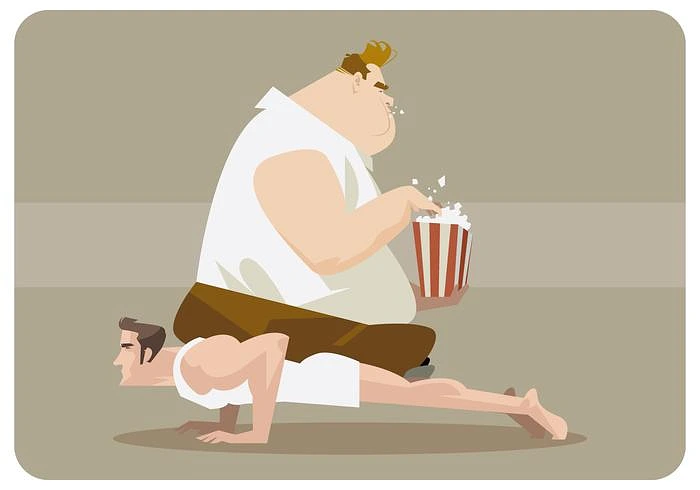
What makes this study genuinely interesting is that it was built as a fight between two competing ideas, both plausible until tested.
The health regulation model predicts the opposite: a bad marriage is stressful, which wrecks sleep and self-control, so unhappy spouses should gain while happy, supported ones stay healthy. Reasonable. At least most people would bet.
The cynical model is a mating market model that essentially states that the reason adults stabilize at a certain weight is because it is the best they can do to attract mates, and that the motivation stops the moment you’ve got one and you are satisfied. Furthermore, this was for the market, and you’ve left the market. Logically, the only spouses left doing any work are the ones who knowingly or unknowingly think they might have to attract somebody new at any moment.
The numbers support the cynical take. As Meltzer points out, the bottom line is that these findings show that people’s concerns with their weight are largely tied into appearance, not health. The happy spouses were no longer trying to perform for an audience they no longer needed, but the lean unhappy ones were.
Your Partner’s Weight Rubs Off On You, Just Less Than Your Friends’ Does

The famous “obesity is contagious” study usually gets folded into this conversation, and the version everyone passes around gets it half right. Nicholas Christakis and James Fowler tracked the social network of 12,067 members of the Framingham Heart Study for 32 years, and published the results in the New England Journal of Medicine, measuring what happens to your own odds when someone in your network becomes obese:
- If your spouse is obese, your chances increase by 37%.
- A sibling: about 40%.
- A friend: about 57%.
Read that order again, because it’s backwards from what everyone assumes. Your spouse, the person you share every dinner with, moves your odds less than your friends do. As Fowler explains, it runs on social norms rather than shared refrigerators. Your spouse may not be the person you look to when deciding what body size is normal or how much to eat. Your friends are. You picked them, you compare yourself to them, and when they change, your sense of “normal” quietly moves with them. So the couple gaining weight together isn’t just that they’re splitting fries. They’re importing a recalibrated idea of what fine looks like, and more of it comes from their social circle than from each other.
Before Anyone Panics About Their Happy Marriage
Now the honest brakes, because this research turns into a terrible headline and a worse argument at dinner.
These amounts were pretty small, so four years later, when you looked at these couples, most of them were still at a healthy weight. Nobody ballooned because they were in love, they drifted a few pounds because they’d stopped auditioning.
And all of it is correlational at the individual level. A thin spouse is no evidence of a packed suitcase, some people just run. A few happy pounds are no symptom of anything but comfort.
It’s not about, ‘be worried if your partner joins a gym’. What it means is, stop making weight about appearance, because if you’re happy, that’s the first thing that evaporates. The health-based reasons don’t evaporate. Diabetes doesn’t care how good your marriage is.
So, in a way, the aunt at the party is paying you a compliment, backed by peer-reviewed research: most of the weight of a happy marriage is the weight of no longer performing. It’s a good move to keep some of the effort going anyway, not in the market that you’re leaving but in the decades that you want to spend with the person who took you off it.

