


Somewhere in your kitchen right now there’s a drawer you avoid opening. Mine holds an avocado slicer, a strawberry huller, a garlic press I used twice, and an egg separator that performs a job my own hand does for free. Total spent on that drawer over the years, probably $200. Total spent on the knife that does 90% of my actual cooking, $45.
The kitchen industry runs on convincing you the opposite is true. Every holiday season brings a new wave of “17 gadgets every home cook needs,” and every one of those lists is quietly sponsored, loosely researched, or written by someone who cooks less than you do. So this article makes the reverse argument. Three tools carry a home kitchen. Everything else is either a nice-to-have or a countertop hostage. Let’s price the three, back the claims with people who actually test this stuff for a living, and then go through the twelve purchases you can skip without your cooking noticing.
1 – A Chef’s Knife, And The Best One Costs About $45, Not $200
Not a knife block. Not a 15-piece set. One good 8-inch chef’s knife handles chopping, slicing, mincing, breaking down a chicken, smashing garlic, all of it.
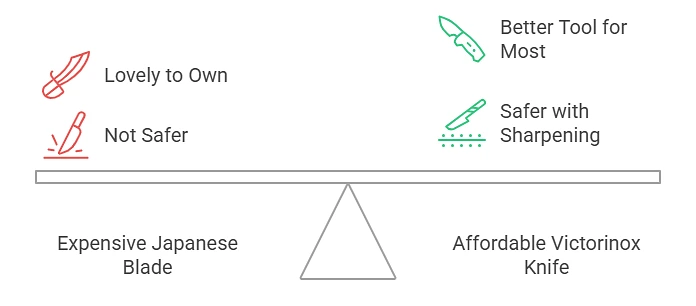
Here’s the part the knife-marketing world hates. America’s Test Kitchen has been running standardized knife tests for close to thirty years, mincing onions, slicing tomatoes, splitting butternut squash, and their winner has stayed the same nearly the whole time: the Victorinox Fibrox Pro 8-inch, at $45 to $70. It’s the plastic-handled workhorse you’ll see in actual restaurant kitchens, it beat knives costing three and four times as much, and if even that stretches the budget, their tests found the Mercer Culinary Millennia performs just as well for under $30. A $200 Japanese blade is a lovely thing to own. It is not a better tool for most hands, and pretending otherwise is how knife sets get sold.
Fit matters more than pedigree. The knife should feel balanced when you grip the handle with your thumb and forefinger pinching the blade. If it feels nose-heavy or the handle digs into your palm, it’s the wrong knife for you no matter what the review said, and the only way to know is to hold it.
One more thing, because it’s genuinely a safety issue and not just knife-nerd talk. ATK’s own testers put it plainly: a bad knife doesn’t just slow you down, it makes you less safe. A dull edge skids off a tomato skin instead of biting, and skidding blades find fingers. So budget for a $15 honing rod and learn a whetstone eventually, or pay a sharpening service $10 twice a year. Sharpening the cheap knife beats owning the expensive one dull. That’s the whole economics of knives in one sentence.
2 – A Stand Mixer, Around $350, But Only If You Actually Bake
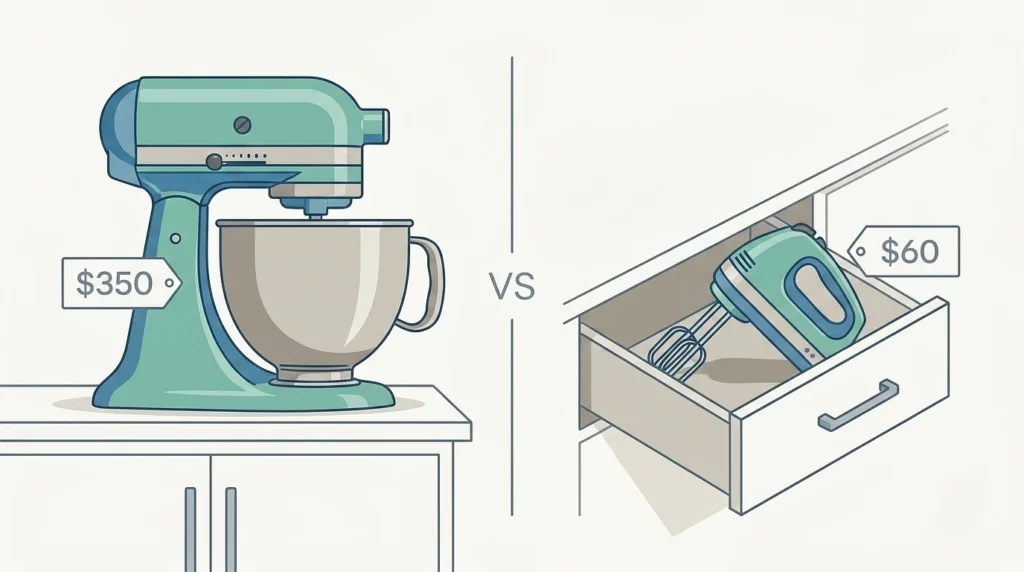
I love my stand mixer and I’m still going to argue against it for half the people reading this, because the honest recommendation depends on what you cook. This machine earns its footprint through dough. Kneading bread, mixing stiff cookie batches, whipping meringue while your hands do something else. If that’s your kitchen, a stand mixer is the best money you’ll spend. The KitchenAid Artisan 5-quart, the default answer for decades, lists around $450 and routinely sells for $350, and the durability stories aren’t marketing, reviewers keep turning up with the same unit still running after 10 and 11 years. Divide $350 by a decade of weekly use and it’s pocket change per bake.
But listen to what the testing outlets say when they think nobody’s selling. America’s Test Kitchen’s own stand mixer guide ends with an admission you almost never see in a product roundup: if you only occasionally bake a cake or a batch of cookies, skip the stand mixer entirely and buy a hand mixer. That’s the review site telling you not to buy the thing. A $60 hand mixer whips cream and creams butter just fine, and it lives in a drawer instead of eating a square foot of counter. Their moderate-price pick, for what it’s worth, is the smaller KitchenAid Classic 4.5-quart, which shaves a chunk off the Artisan’s price for near-identical guts.
So the real question isn’t “is a stand mixer good.” It’s how many times you kneaded anything last year. Answer that honestly before the $350 leaves your account.
3 – Pot Racks And Drawer Organizers, $30 To $80, The Unglamorous Multiplier
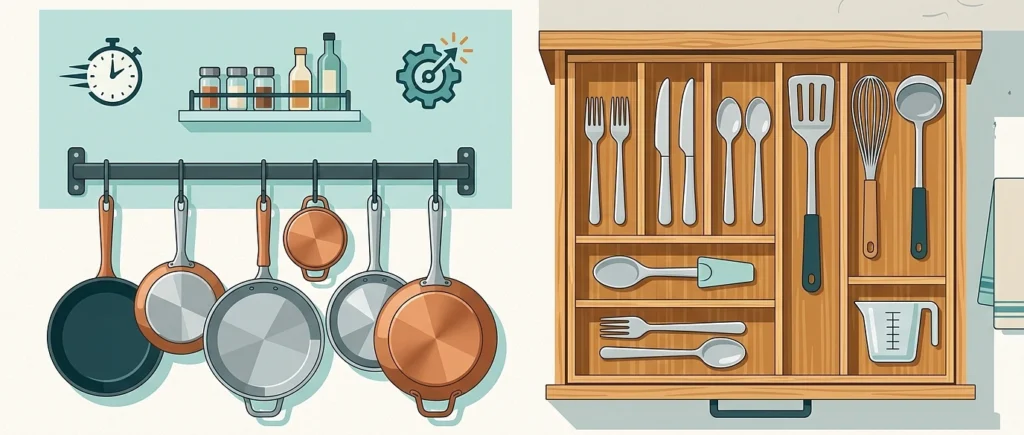
Nobody brags about buying drawer organizers, which is exactly why they’re underrated. The two tools above make you faster at cooking. Organization makes you faster at everything around cooking, which is most of the time you spend in a kitchen. Digging through a Jenga stack of pans to reach the one on the bottom, that’s friction, and friction is the quiet reason takeout wins on a Tuesday.
A wall-mounted or ceiling pot rack runs $30 to $80 at any hardware store, frees an entire cabinet, and puts your most-used pans one reach away. Bamboo or plastic drawer dividers cost $15 to $25 and end the utensil scrum permanently. And the payoff compounds in small kitchens, where every stolen bit of cabinet space matters twice. Speaking of restaurant habits worth stealing, this is the one professional kitchens are actually built on. Line cooks don’t work fast because of fancy gear. They work fast because every tool has one home and living and the hand goes there without looking. You can buy that entire principle for under a hundred bucks, which makes it, dollar for dollar, the best value on this list.
The 12 “Must-Haves” Your Kitchen Will Never Miss
Every item below does one job that one of the three tools above, or your own two hands, already does. The unitasker problem, as Alton Brown has spent twenty years preaching, isn’t that these gadgets fail. It’s that they work once, then occupy drawer space for a decade.
- Garlic press. The flat of your chef’s knife smashes a clove in one second and cleans up with a wipe.
- Avocado slicer. It’s a knife and a spoon. You own both.
- Strawberry huller. A paring knife, or honestly the knife tip you already have.
- Egg separator. Your hand, or the shell-to-shell pour your grandmother used.
- Banana slicer. I refuse to elaborate.
- Electric can opener. A $10 manual one outlives three electric ones.
- Bread machine. If you bake bread often enough to justify it, the stand mixer kneads and your oven bakes better.
- Salad spinner, the giant kind. A clean dish towel and thirty seconds of arm swinging. Free.
- Herb scissors. Five blades to do what one blade does.
- Quesadilla maker. It’s a skillet. It was always a skillet.
- Knife block sets. You’re paying for six knives to get the two you’ll use.
- Single-purpose electric choppers. The knife skills you build doing it by hand pay you back at every meal for the rest of your life.
Could you find a happy owner of any item on that list? Sure. My aunt swears by her salad spinner and she eats more salad than anyone I know, so fine, exceptions exist and I’m not confiscating anything. The point isn’t that these products are scams. It’s that they’re answers to problems the three real tools already solved, and their combined cost, easily $300 to $400, would buy the Victorinox, the drawer organizers, the pot rack, and most of a hand mixer with money left for groceries.

