


You get home, you are tired, and there is still work to do. A paper, a project for the side thing you swore you would keep up with. The stretch of evening it would take feels impossible, so you do not start at all, and the hours leak away while the work sits there untouched. Then you feel worse than when you walked in.
That is the trap I want to talk about. Not time management in the grand sense, the spreadsheets and the color-coded calendars. Just the small, ground-level problem of being too fried or too buried to do the next thing.
I have two strategies for it. Neither is clever. Both have held up for me, and both happen to rest on some real psychology, which is the part I find reassuring, because it means they are not just one person’s lucky habit.
Sit Down For Twenty Minutes And Nothing More
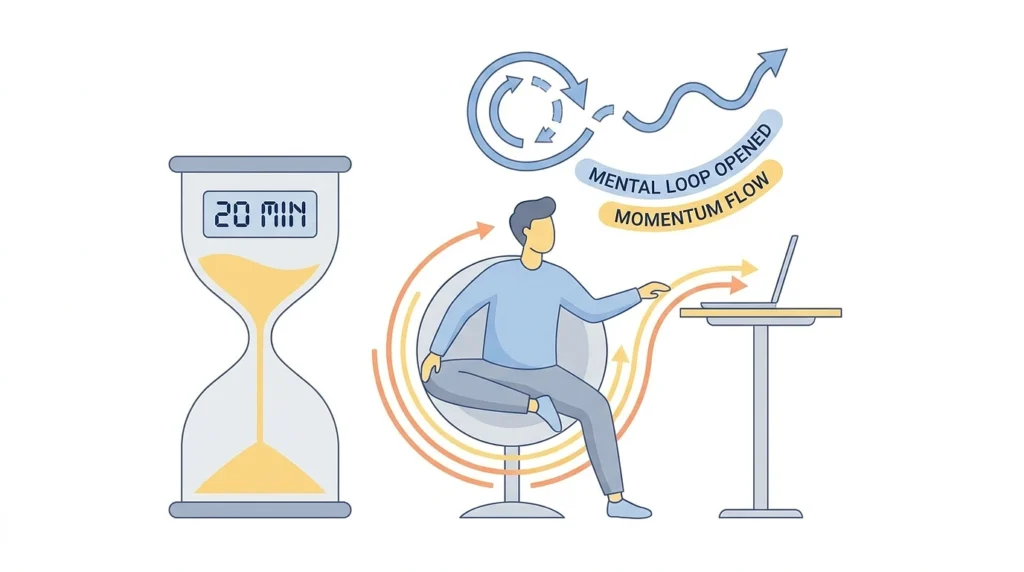
The whole strategy is this: promise yourself twenty minutes, not the whole evening. Set the timer on your phone. Sit down, work, and give yourself full permission to quit and go collapse on the couch the second it goes off.
And there is a real reason for that, it is not just willpower talking. In the 1920s a psychologist named Bluma Zeigarnik noticed something strange about waiters. They could hold every detail of a complicated unpaid order in their heads, then the instant the bill was paid, the whole thing dropped out of memory. She ran experiments on it and found people remember interrupted tasks better than finished ones, published in 1927. The useful part for us is the why. Starting a task opens a kind of mental loop, a small tension your brain keeps running because it wants the thing closed out.
So once you have started, your own head works to keep you in the chair. The hardest part of almost anything is the starting, and the twenty-minute promise is built to get you past that one barrier, because once you are moving the momentum tends to carry you. The twenty minutes was never the point. It was the cover charge.
One honest caveat. Some days twenty minutes really is all you have, the alarm sounds and you do stop. Fine. Twenty minutes of progress beats the zero you would have done, and tomorrow you run it again.
When You Are Too Overwhelmed To Move, Pick One Thing

You know the feeling. Not tired so much as flattened, so much to do that you cannot start any of it, and lying face down on the floor while the disaster unfolds starts to look like a reasonable plan. The to-do list has stopped being a tool and turned into an accusation.
When you are there, stop trying to look at the whole list. Pick one thing off it. Any one thing, the smaller the better, and just get it done. Doesn’t matter which:
- The laundry that has been glaring at you for days.
- The dishes.
- One email you have been dreading.
- The first page of a reading assignment.
Cross it off. The reason that helps is not really the chore itself, it is what finishing does to your head.
A Harvard researcher named Teresa Amabile, with Steven Kramer, had people on working teams keep a daily diary. Nearly twelve thousand entries from two hundred and thirty-eight people across several months. When they lined up everyone’s best days against their worst, the most common thing behind a good day was simply making progress on work that mattered. They named it the progress principle.
And the word that does the heavy lifting in their finding is small. It was not big wins that lifted people, it was steady ordinary forward steps, even tiny ones. That is the entire case for picking one thing. The list is still long after. The hours are still short. But you have shifted yourself from stalled to moving, and that shift counts for more than the size of whatever you crossed off.
Something about it is almost too simple, which is probably why people skip it. We assume being buried calls for some grand overhaul of the whole system. Usually it is just doing the dishes.
Neither of these buys you more hours. Nothing does. But on the nights the work will not budge, or the days the list has you pinned, one of the two has reliably gotten me moving again, and the research says that is not luck. Start the timer, or pick one thing.

