

Of the popular sleep herbs, ashwagandha has the strongest human trial evidence, with a 2021 meta-analysis of five randomized trials showing a real, if modest, improvement in sleep. Valerian and magnolia bark sit in shakier territory where the studies disagree, and lemon balm is pleasant but barely tested on its own. None of them rivals a prescription sleep aid in strength, which is mostly the point, and the herb that matters most for your safety might be whichever one interacts with a medication you already take. Talk to a pharmacist before starting any of them.
Somebody in your life swears by a sleep tea. Maybe it’s chamomile, maybe it’s a $40 bottle of ashwagandha capsules, and they will tell you it changed their nights. The tricky thing is that they might be right, and they might also be describing a placebo effect wrapped in a warm mug and a bedtime routine, and from the inside those two feel identical. So instead of another breathless list treating every herb as a miracle, here’s the same set of remedies sorted by how much actual human evidence stands behind each one. Some earn their reputation. Some are running on vibes and folklore. Both are worth knowing before you spend money.
One honest note up front, because it shapes everything below. Herbal sleep research is genuinely messy. Studies are often small, frequently funded by supplement makers, and plagued by the fact that the “ashwagandha” in one trial may contain a totally different concentration of active compounds than the bottle on your shelf. So treat every result here as directional, not gospel.
Tier One: Ashwagandha, The One With Real Trials Behind It
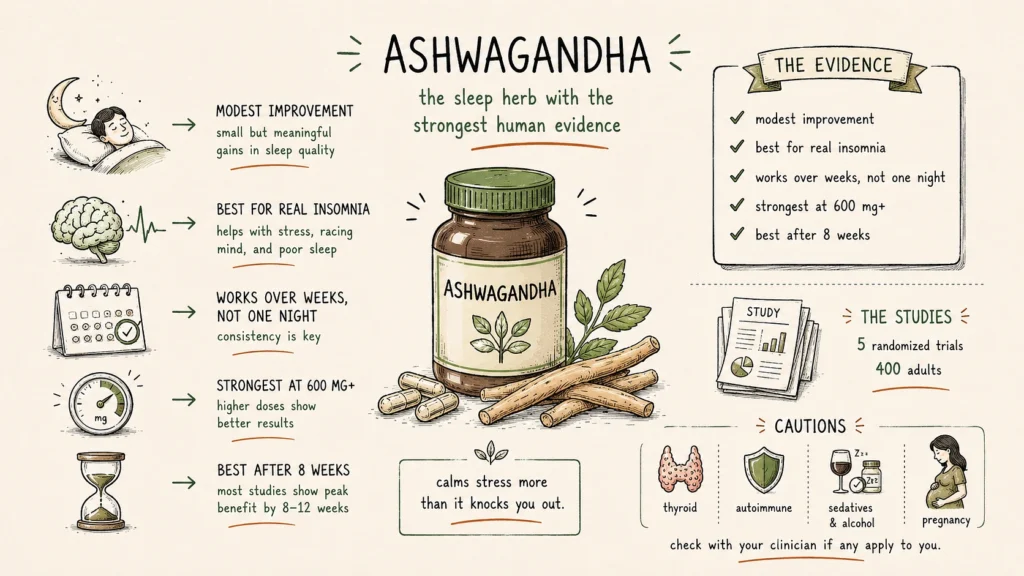
If you only try one herb on this list, the evidence points here. Ashwagandha is not a knockout sedative, and anyone selling it as one is overselling. What it appears to actually do is lower the stress response that keeps people wired at bedtime, which is a different and slower mechanism than a sleeping pill.
The reason it sits in the top tier is a 2021 systematic review and meta-analysis in PLOS ONE that pooled five randomized controlled trials covering 400 adults. It found a small but statistically significant improvement in overall sleep, and the effect was strongest in three specific situations: people actually diagnosed with insomnia, doses of 600mg a day or higher, and use sustained for at least eight weeks. That last detail is the one people ignore. This is not a tonight thing. A separate double-blind trial found it shortened the time to fall asleep and improved sleep efficiency over ten weeks of twice-daily 300mg dosing.
Here’s the part worth sitting with. The benefit was real but modest, and it showed up mainly in people who already had a sleep problem, not in healthy sleepers chasing an upgrade. If your nights are basically fine and you want them slightly better, the trials don’t really promise you much.
The safety caveats are not trivial and this is where casual supplement culture gets careless:
- Thyroid conditions. Ashwagandha can nudge thyroid hormone levels, so if you take thyroid medication or have Hashimoto’s, this is a doctor conversation, not a self-experiment.
- Autoimmune disease. It stimulates immune activity, which is exactly the wrong direction for lupus, rheumatoid arthritis, or MS.
- Sedatives and alcohol. Stacking it on top of other depressants compounds the effect.
- Pregnancy. Avoid it. There have been safety concerns, and the data isn’t there to clear it.
Tier Two: Valerian And Magnolia Bark, Where The Studies Can’t Agree
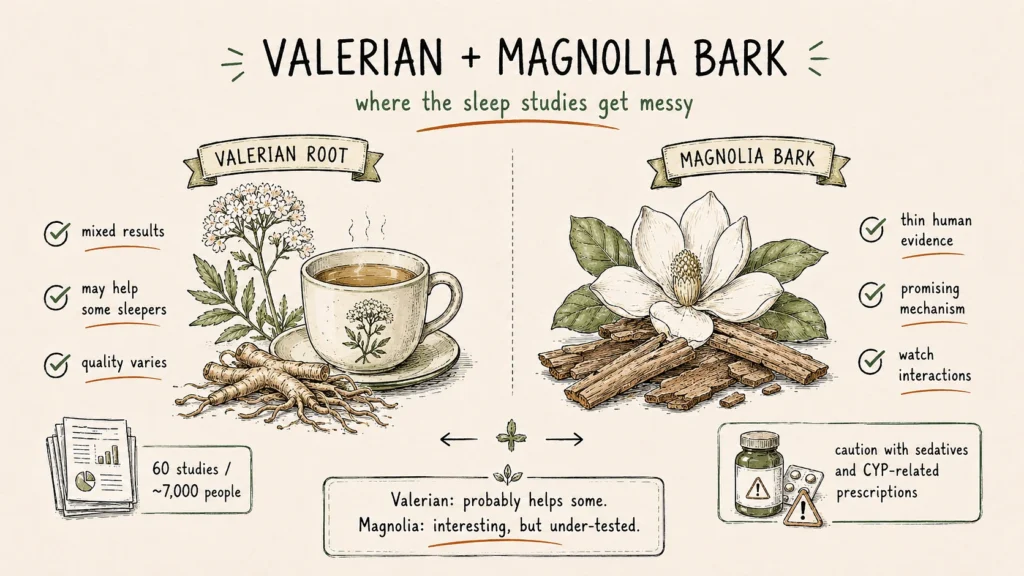
Valerian is the classic sleepytime-tea herb, and its research is a perfect illustration of why this whole field is frustrating. A large 2020 review in the Journal of Evidence-Based Integrative Medicine went through 60 studies covering nearly 7,000 people. Its conclusion was maddeningly split: the whole dried root taken consistently at 450 to 1,410mg a day for four to eight weeks tended to help, while standardized extracts taken short-term produced all over the map results. The reviewers pinned the inconsistency on wildly variable extract quality between products, which is the recurring villain of herbal medicine.
So valerian probably does something for some people using a specific preparation over weeks, and the studies are too muddy to promise more than that. Older reviews were blunter, one summarized it as safe but not clearly effective. It is at least reliably safe for most adults, which counts for something.
Magnolia bark is the interesting case where the thin version of articles like this tend to fabricate. You’ll see a confident claim floating around that a study proved a “180% increase in non-REM sleep.” I went looking for that number as a clean human clinical result and could not stand it up, and that’s the honest thing to report rather than repeat it. What the actual research shows is more limited: the bark’s compounds, honokiol and magnolol, do act on GABA receptors, mostly demonstrated in laboratory and animal studies rather than large human sleep trials. The mechanism is plausible and interesting. The human evidence is thin. Those are two different things, and good sleep content keeps them separate.
Magnolia’s interaction profile deserves real respect, though. It can amplify other sedatives, and it affects the CYP3A4 liver enzyme, meaning it can change how your body processes a long list of common prescriptions. That combination, a modest sleep benefit and a serious drug-interaction footprint, is not a great trade for most people without medical guidance.
Tier Three: Lemon Balm And The Pleasant-But-Barely-Studied Crowd
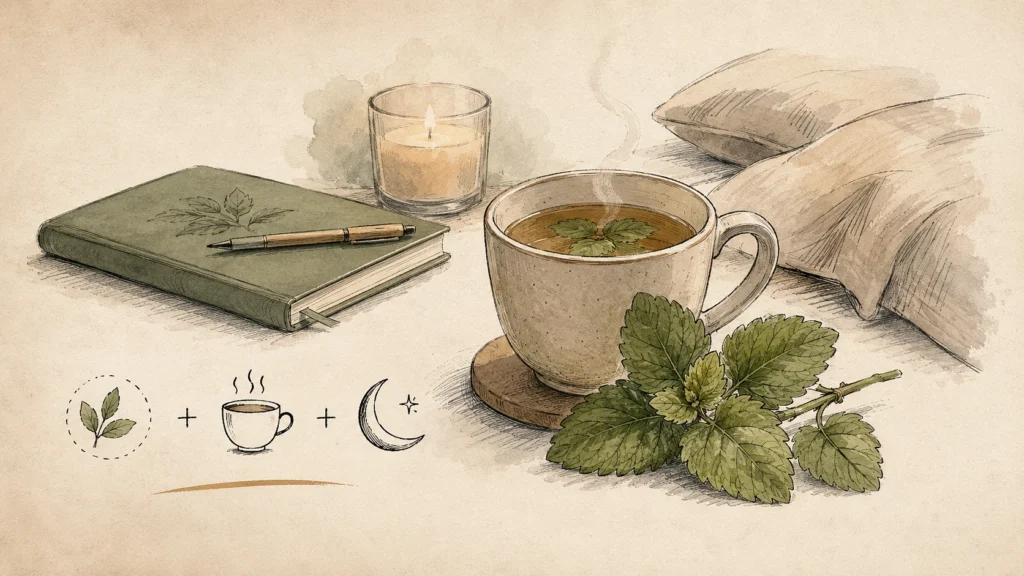
Lemon balm is lovely. The smell alone is calming, the tea is part of a decent wind-down ritual, and there’s some early evidence it eases anxiety and mild sleep complaints, often when combined with valerian rather than tested alone. But solid standalone human trials showing it reliably improves sleep are scarce. That doesn’t make it useless. It makes it a low-risk, low-evidence option that may genuinely help through relaxation and routine, which, remember, is not nothing.
This is the honest place to say something the supplement industry hates. The ritual might be doing as much work as the plant. Boiling water, the warm cup, ten quiet minutes away from a screen, the signal to your body that the day is ending, all of that improves sleep on its own, and any herb you drink gets credit for the whole package. If a nightly lemon balm tea helps you sleep, keep doing it. Just know you may be buying an excellent bedtime habit with a mild herb attached, and there’s nothing wrong with that.
What Actually Matters More Than Which Herb You Pick
Two things outrank the entire menu above, and neither costs anything.
The first is that no herb here works against serious insomnia the way people hope. If you’ve been sleeping badly for months, waking exhausted, or lying awake with genuine dread, that is a medical issue and tea is not the treatment. Chronic insomnia responds best to a specific therapy called CBT-I, cognitive behavioral therapy for insomnia, which outperforms both herbs and sleeping pills in the long run and is what sleep specialists actually recommend first. Reaching for ashwagandha when you need CBT-I is treating a broken system with a garnish.
The second is the interaction question, which is the single most important line in this article. Every herb above can interact with medications, especially sedatives, antidepressants, blood thinners, thyroid drugs, and anything processed through the liver’s CYP enzymes. “Natural” does not mean “inert,” and the people most likely to reach for sleep herbs, the stressed, the already-medicated, the chronically tired, are exactly the ones with the most to lose from a bad combination. A five-minute conversation with a pharmacist, who does this for free, is worth more than any product review.
None of this is a reason to avoid herbal sleep aids. Ashwagandha in particular has earned a fair shot for the right person. It’s a reason to walk in clear-eyed: modest benefits, weeks not minutes, real interactions, and a warm mug that’s quietly doing half the work. Sleep better on that, and you’re welcome to it.
References
- Cheah KL et al. “Effect of Ashwagandha (Withania somnifera) extract on sleep: A systematic review and meta-analysis.” PLOS ONE, 2021.
- Langade D et al. “Efficacy and Safety of Ashwagandha Root Extract in Insomnia and Anxiety: A Double-blind, Randomized, Placebo-controlled Study.” Cureus, 2019.
- Shinjyo N, Waddell G, Green J. “Valerian Root in Treating Sleep Problems and Associated Disorders: A Systematic Review and Meta-Analysis.” Journal of Evidence-Based Integrative Medicine, 2020.
- Taibi DM et al. “A systematic review of valerian as a sleep aid: Safe but not effective?” Sleep Medicine Reviews, 2007.

