


There’s a bit of chemical sleight of hand that fooled a whole generation, and it’s still fooling people, and I have a soft spot for it because it works the same way a good magic trick does. You slip on the ring, wait a few seconds, and the stone drifts from black through a murky green to a bright confident blue. The little card says blue means calm and content. It feels like the thing reached inside you and read something off. It did nothing of the sort. What it did was take your temperature, exactly like the plastic strip a nurse presses to a feverish forehead, and the calm and the passion and the moody purple were all written onto that card by a marketing department around 1975. The real chemistry is far more interesting than the magic, so let me pull the curtain back.
The “Gemstone” Is The Same Material As Your Television Screen
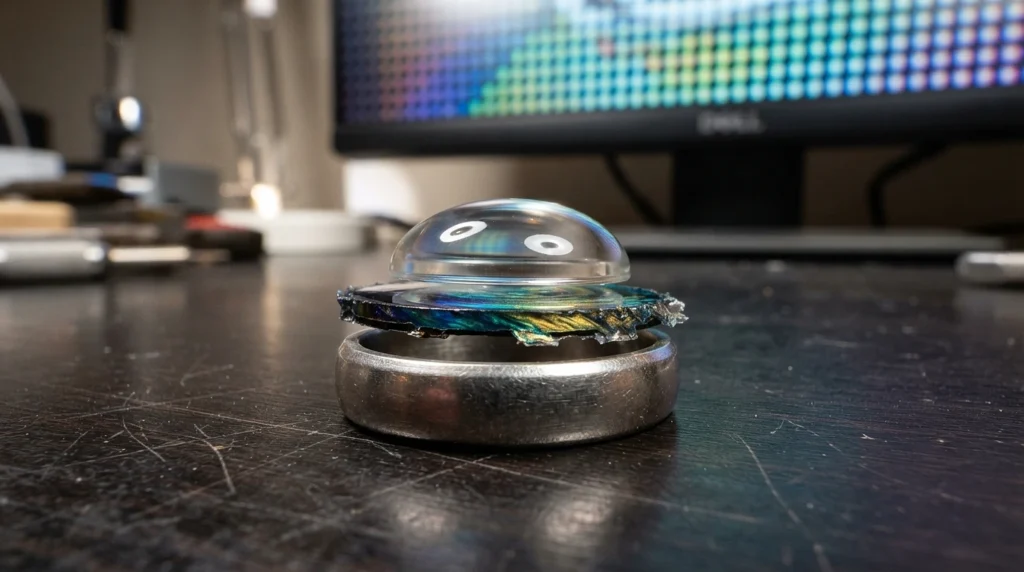
Pop the stone off, at least in your imagination, and there’s no gemstone in there at all. It’s a little sandwich. A metal band underneath, usually silver-plated. A thin strip of something called thermochromic liquid crystal laid on top. And a clear cap of glass or plastic sealing it so a splash of water can’t ruin the whole thing.
That middle layer is the entire trick, and here’s the part that delights me every time. It’s the very same class of stuff glowing in your phone and your flat-screen TV, the liquid crystals behind every LCD screen, and warming or cooling them is the whole game. Now, “liquid crystal” sounds like a contradiction, and in a lovely way it is. It’s a genuine in-between state of matter, flowing like a liquid while its molecules stay ranked up in neat orderly rows like a solid, and the particular ones chosen for a mood ring have one useful habit. Warm them or cool them and they quietly rearrange. That’s the whole engine. Nothing in that sandwich has the faintest idea whether you’re smitten, furious, or bored stiff waiting for a bus.
Warm The Crystals And They Twist, And The Twisting Is The Color
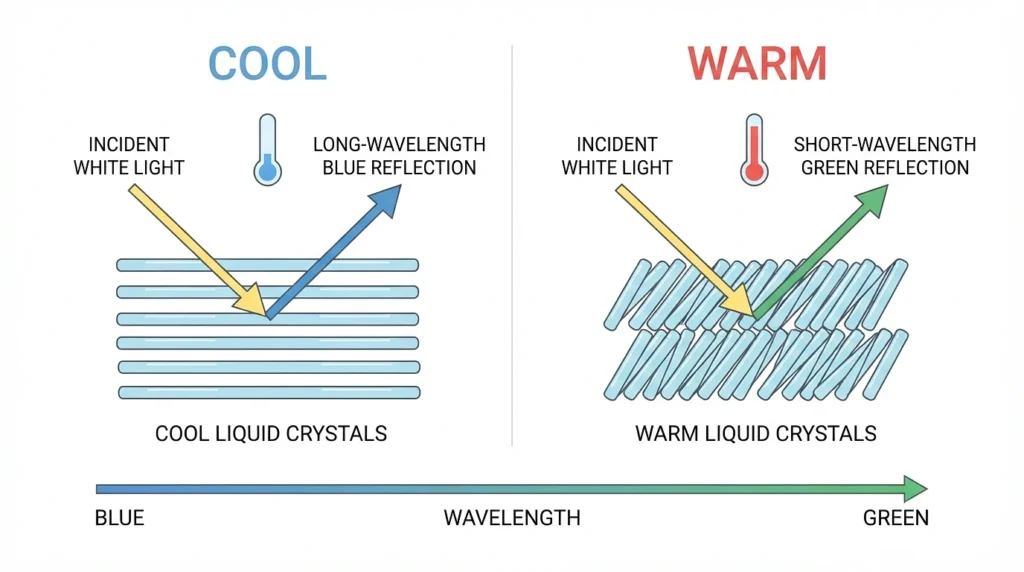
So how does a change in temperature turn into a color your eye can catch? This is where the chemistry earns its keep.
As the crystal warms it shifts through a series of phases, and in each phase the molecules stack and tilt at slightly different angles and spacings. Light dives into that structure, bounces around among the layers, and depending on precisely how the molecules are arranged, certain wavelengths get reflected back out to you while the rest are swallowed. Warmer, the spacing tightens and the reflected color slides toward the warm end. Cooler, it loosens and you drift back down through blue to black. So the color was never a dye sitting there waiting to be revealed. It’s pure optics, an effect conjured by the physical geometry of the crystals at that exact instant, and that geometry answers to one master only, temperature. Change the heat, change the twist, change the wavelength that comes back to your eye. There’s the color, start to finish.
Most of these are tuned to run their whole repertoire across a narrow band, roughly the temperatures human skin actually reaches, somewhere in the neighborhood of 90 to 100 degrees Fahrenheit, which is exactly why the ring sulks dark and lifeless in the cold and blooms into color on a warm hand.
There Is A Grain Of Truth, And It’s Worth Being Fair About
Here’s where the myth gets its toe in the door, because it’s clinging to a real thread, and I’m not in the business of dunking on a thing that’s partly right.
Your skin temperature, at the fingertips especially, genuinely does shift with your emotional state. Get anxious and your body, running an old fight-or-flight program, diverts blood inward toward the core organs, leaving the fingers cooler. Settle and relax and the blood returns and the fingers warm. Get excited or worked up or trot up a flight of stairs and circulation surges and the extremities heat up. So there really is a chain here, feeling to blood flow to finger temperature to crystal to color, and the ring is not measuring nothing.
The snag is that this signal is a whisper and it’s standing in a very loud room. That same fingertip temperature supposedly reading your soul is also being shoved around by the weather, by the hot coffee you were just cradling, by ten minutes of walking, by the simple fact that some people have cold hands, by the thermostat setting of the room. A brisk day paints your ring black while you’re perfectly cheerful. A warm mug flashes it to “passionate” red while you feel precisely nothing. The emotion is in there. It’s just being shouted down by every thermometer-worthy thing around it.
The Color-To-Mood Chart Came From Copywriters, Not Chemists
This is the part people find a touch deflating, so I’ll say it without cushioning. There is no scientific standard tying blue to serenity or red to passion. None whatsoever.
Those charts trace straight back to the original 1970s sellers, who had a temperature readout on their hands and needed it to mean something a customer would pay for, so they simply assigned warm colors to exciting feelings and cool ones to calm, and printed it on a card. It sounds plausible and it’s an invention from top to bottom. The people selling the very first ones cheerfully called the jewelry “magical” and claimed the color revealed the warmth of your character, which is splendid ad copy and not a shred of science. Warm color means warm hands. Cool color means cool hands. Everything else is decoration.
And here’s a small tangent I can’t resist, because the origin story is itself a bit murky. The history can’t even agree on who made the first one, some credit a jeweler named Marvin Wernick around 1974 after he watched doctors using liquid-crystal thermometers, others hand it to two New York entrepreneurs, Josh Reynolds and Maris Ambats, in 1975. What nobody disputes is the lineage of the technology, and it isn’t psychology, it’s the medical thermometer. The mood ring is a fever strip that went to finishing school.
What’s Really On Your Finger Is A Slow And Rather Pretty Thermometer
Strip away the mysticism and the mood ring reveals itself as a wearable liquid-crystal thermometer, exactly the same principle as those color-changing strips laid on a baby’s forehead or stuck to the side of a fish tank. Same crystals, same physics, entirely different marketing budget.
And I don’t mean that as an insult. It’s a genuinely elegant scrap of materials science that you get to wear on your hand, and it does report something perfectly true, whether your fingers are warm or cool, which is a real if humble fact about your body at that moment. It simply doesn’t know if you’re happy, and it was never built to. Treat it as a mood detector and it will lie to you every cold morning and every time you pick up a hot drink. Treat it as a thermometer that happens to be beautiful, and watch your own circulation paint the stone as you warm and cool through the day, and it turns into something better than a magic trick. It turns out to be real, which in my experience is nearly always the better story.

