


Most people arrive at counseling with a sentence about themselves that they have never once questioned.
I am someone who ruins things. I am too much. I have always been anxious. I am the strong one and I do not get to fall apart. The sentence usually predates the problem that brought them in, and it is doing far more work in their life than they realise, because a sentence like that quietly decides what you attempt, what you tolerate, and what you assume about the next thing that happens to you.
Noticing that sentence is not a small thing. It is close to the whole of what changes in good therapy.
Autopilot is Not Laziness, It is Efficiency That Outlived Its Purpose

The patterns people call autopilot were almost always useful once.
Someone who grew up managing a volatile parent learned to scan a room for mood and adjust before anything went wrong. That is a sophisticated skill and it kept them safe. Twenty years later they are exhausted at every dinner party and cannot say why, because the scanning never switched off and nobody told them it was optional.
The reason this is hard to see from the inside is that it does not feel like a choice. It feels like personality. You do not experience a coping strategy as a strategy, you experience it as who you are, and that confusion is precisely what a counselor is trained to help you untangle.
What “Rewriting The Story” Actually Refers to

This phrase gets thrown around loosely enough that it has started to sound like nothing. It has a specific origin.
Michael White and David Epston developed narrative therapy in Australia and New Zealand through the 1980s, and published Narrative Means to Therapeutic Ends in 1990. Their central move was to reject the idea that a problem lives inside a person as a defect. They treated it instead as a story, one shaped by language, family and culture, which means it can be examined and told differently.
The techniques are more concrete than the language around them suggests.
- Externalizing. Shifting from “I am depressed” to “depression is trying to take over my life.” It sounds like a word game and it is not. It separates the person from the problem, which changes what you can do about it.
- Unique outcomes. Hunting for the moments that contradict the dominant story. The week you were not anxious. The time you did set a limit. Under a story like “I always fall apart,” these get filed as flukes, and a therapist’s job is partly to stop you filing them.
- Re-authoring. Building an alternative account of your life that includes the evidence the old one ignored.
- Outsider witness practices and therapeutic letters, which bring other voices and a written record into the process.
White drew on Jerome Bruner’s work showing that people organise experience through narrative rather than through logic. That is why the story is not treated as a metaphor for change in this model. It is treated as the mechanism.
Does This Mean Pretending Things Were Fine?
No, and that is the most common misreading of the whole approach. Re-authoring is not positive thinking and it does not involve deciding that a difficult childhood was secretly good.
It means the account you have been carrying was assembled under pressure, often when you were young, with incomplete information and no ability to see yourself from outside. Some of it is accurate. Some of it belonged to someone else and you absorbed it. The work is sorting which is which, and the honest version frequently makes the past harder to look at before it gets easier.
Where The Evidence Sits, Honestly
I want to be careful here, because mental health writing tends to oversell and I would rather you knew the real shape of the research.
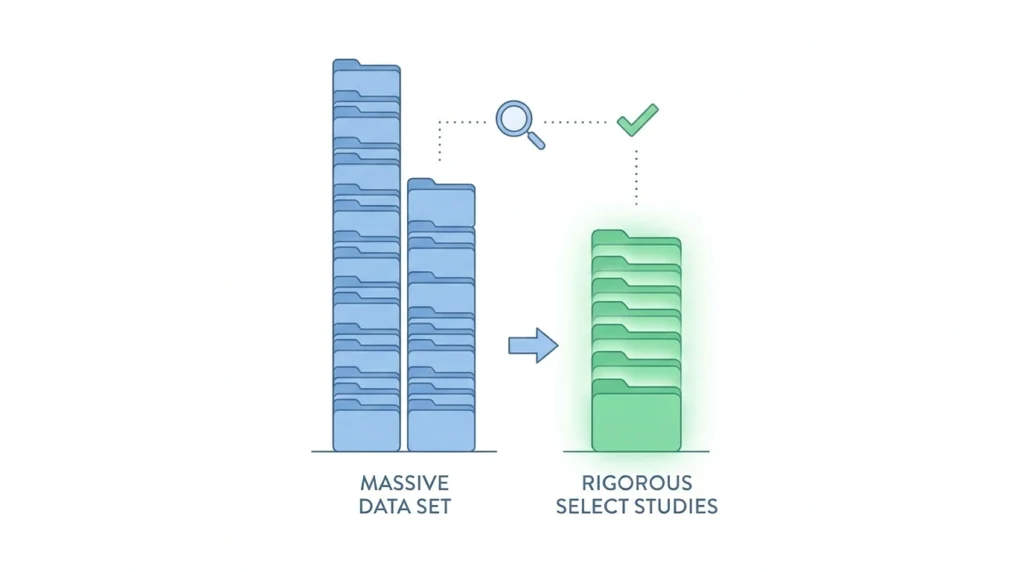
Randomised trials show positive outcomes for narrative therapy across depression, anxiety, PTSD and family conflict. A meta-analysis found significant reductions in depressive symptoms among adults with somatic disorders. A systematic review screened 461 studies published between 1995 and 2021 and found 17 that met its inclusion criteria.
The evidence base is real and it is smaller than CBT’s. Seventeen qualifying studies out of 461 screened tells you something about how much of the literature meets rigorous standards, and reviewers have noted that some studies do not clearly describe how the techniques were applied.
What that means practically is not that narrative approaches do not work. It means that if you are choosing a therapy for a specific diagnosis, the modality with the deepest evidence for that condition is a reasonable thing to ask your therapist about directly. Many counselors integrate narrative techniques into a broader approach rather than practising it in a pure form, which is probably the most common way people encounter it.
What Actually Happens in The Room
Less than people fear, and it starts slower than the title of this article implies.
Early sessions are mostly history and context. What brought you in, what has been going on, who is around you, what you have already tried. A good counselor is listening for the sentence I described at the start, and they will usually not point it out for a while, because being handed your own core belief in week two rarely lands.
The middle stretch is where the work happens, and it is often uncomfortable in a specific way. You start noticing the pattern in real time rather than afterwards, which is progress and does not feel like it. People frequently report feeling worse around this point, and it is worth knowing in advance so you do not read it as failure and stop.
You will also probably not get advice. Counselors are not withholding it out of technique, they are avoiding installing another external voice in a head that already has too many.
How Long Does it Take?
Longer than a bad week and shorter than people fear. There is no fixed number, and anyone quoting you one without knowing your situation is guessing.
What I would say is that judging it on two sessions is like judging a book on the acknowledgements. The rapport takes a few weeks to build and almost nothing meaningful happens before it does.
If You Are Deciding Whether To Go
The threshold is lower than most people set it. You do not need a diagnosis, a crisis, or a reason that sounds serious enough when said out loud.
The genuinely useful signals are quieter. A reaction that keeps outsizing its trigger. The same relationship pattern for the third time with different people. A running commentary about yourself that you would find unacceptable if you heard someone use it about a friend. Exhaustion that sleep does not touch.
If any of that is going on, it is worth a conversation with a licensed counselor or help from psychologist, and worth saying plainly in the first session that you are not sure what the problem is. That is a normal way to start rather than a disqualifying one.
And if things feel genuinely unsafe rather than difficult, that is not a waiting-list situation. Crisis lines exist for exactly that and they are staffed by people who will not make you explain yourself well before helping.
The story you tell about yourself was written by someone with less information than you have now. That is the real argument for looking at it again.

