


Somewhere in most renovated houses there is a joint where this year’s copper threads into steel from 1965. The kitchen got redone, the bathroom got moved, a spigot got added, and at some point the new Plumbing services had to meet the old plumbing.
That joint is where the trouble starts. Not in the new pipe. Not in the old pipe generally. Right at the connection, and always on the old side of it.
A remodel in Bonita Springs, Florida shows the pattern. New brass spigot, threaded straight onto the existing galvanized line, worked fine, passed inspection. Two years later the galvanized pipe behind the stucco had rotted through and flooded the lanai. The plumbers who wrote it up did the math for everyone: a $15 fitting, skipped, became a $2,000 repair.
Copper Protects Itself By Corroding The Steel Pipe It Touches
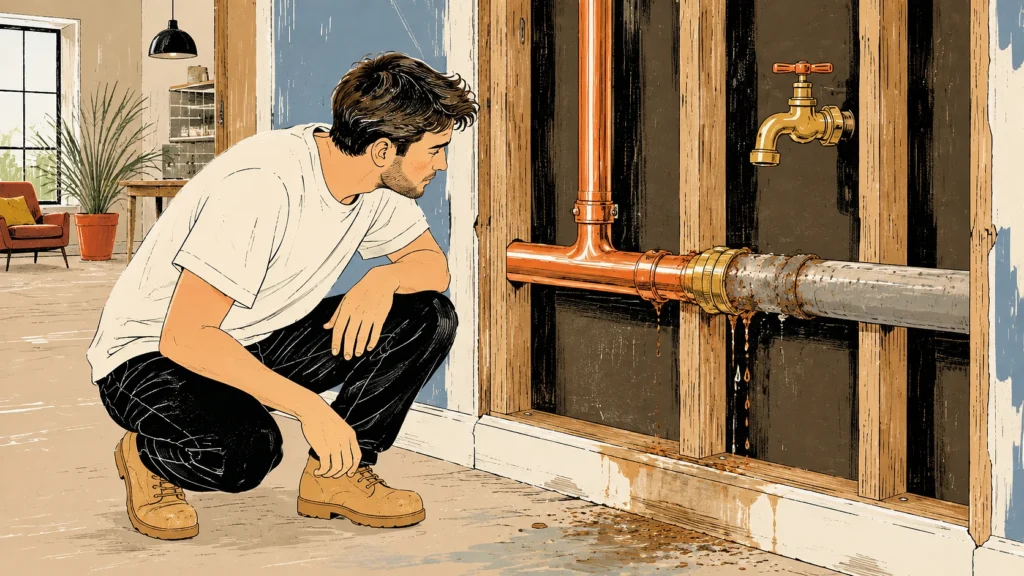
Put two different metals in contact inside a pipe full of water and the water carries a weak electrical current between them. That current has a direction. One metal gets protected. The other one dissolves to protect it.
Copper and brass sit higher in the pecking order than galvanized steel. So at a direct joint:
- The copper side stays clean. It is the winner of the exchange.
- The galvanized side corrodes fast, beginning at the joint. The zinc coat strips off, the bare steel rusts from the inside, and rust flakes start clogging your faucet aerators.
- The bore narrows, pressure drops, and sooner or later a pinhole opens up, usually inside a wall.
In a Fort Myers house, a copper line tied into an old galvanized main leaked inside the laundry wall for who knows how long. The owners found out when the baseboards warped.
The direction of the damage depends on the pairing, not on which pipe is newer. An investigator called to a hospital over green-tinted tap water found copper branch lines connected straight to new stainless steel mains. Stainless outranks copper, so this time the copper was the one dissolving, and dissolved copper was coming out of the taps. Same reaction, different loser.
The Plumbing Code Requires a Dielectric Union at Every Copper-To-Steel Joint
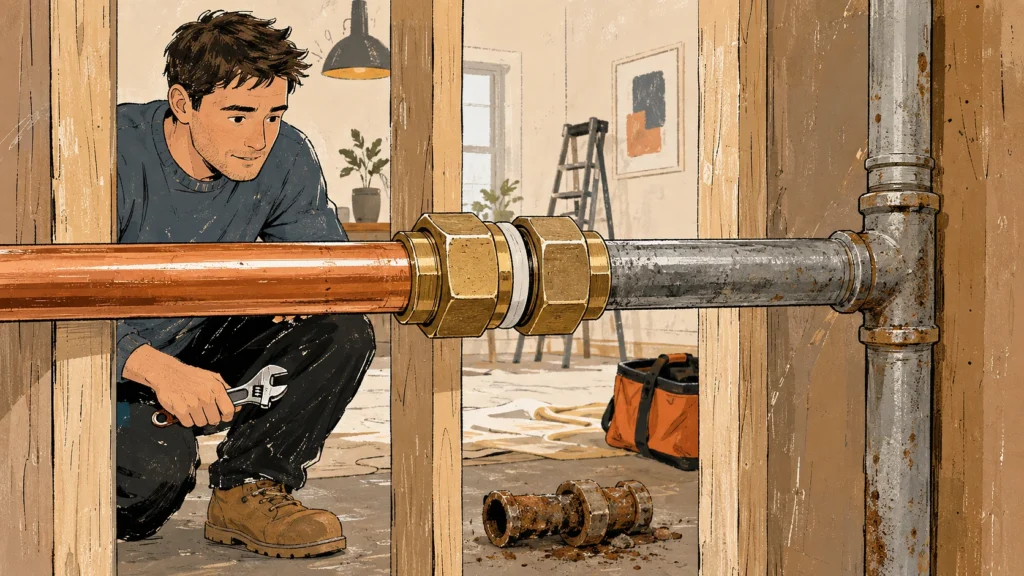
This fitting is not optional and never was.
The International Plumbing Code, section 605.23.1 says joints between copper and galvanized steel must be made with a copper-alloy fitting or a dielectric fitting or union meeting ASSE 1079. The Uniform Plumbing Code says the same. Nearly every US jurisdiction follows one of the two.
The fitting itself is simple. A dielectric union holds the two pipes together mechanically while a plastic or rubber insert keeps the metals from ever touching. No contact, no current, no corrosion. Installed properly, one lasts 20 to 50 years.
Some inspectors accept a six-inch brass nipple between the steel and the copper instead. Know what you are getting with that: the brass slows the reaction down, and the steel still corrodes to protect the brass. Slower is not stopped. The union is the only true fix.
So why does anyone still skip it? Two reasons, and I have sympathy for exactly one of them. DIY renovators have simply never heard of galvanic corrosion, fair enough. Then there are tradesmen who have decided the whole thing is overblown. The hospital contractor, asked why he left out the unions, said they were not needed “if neither material will rust.” A forty-year veteran on a heating forum admits he has installed plenty of bare joints that still look fine decades on, and the worst corrosion he ever finds is on homeowner work with no isolation at all. He is not lying. Water chemistry varies house to house and some joints get lucky for thirty years. You do not know in advance whether yours is one of them, and that uncertainty is the entire reason the code stopped leaving it to judgment.
In An Older House, The Union Can Disconnect Your Electrical Ground
Nobody warns people about this part, and it lives in precisely the houses that have galvanized pipe.
If your supply lines are galvanized, your house is probably past fifty. Houses of that age often used the metal water pipe as the ground for the whole electrical panel. Now follow the sequence: plumber roof plumber Melbourne installs a dielectric union, corrosion problem solved, and the same insert that blocks the corrosion current blocks the ground connection too. The panel is now grounded to a length of steel pipe that no longer connects to anything.
One electrician described the standard version of this mess. Street feed replaced with copper. Union installed correctly at the transition. Inspection fails for lack of ground, because the grounding conductor lands on the orphaned galvanized side.
The fix is electrical, not plumbing. Usually a driven ground rod at the service entrance, sometimes a bonding jumper placed where it will not undo the union’s work. If your renovation touches old steel pipe, the plumber in point cook and the electrician need to talk to each other before either one finishes. In my experience nobody arranges that conversation unless the homeowner forces it.
Repipe The Galvanized If You Can Afford to, Isolate It Properly If You Cannot
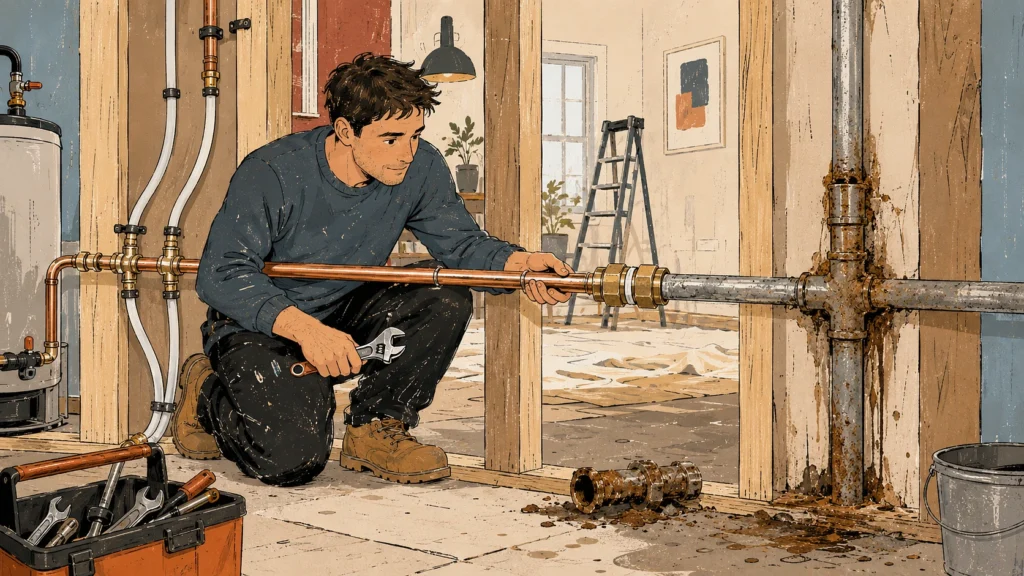
The clean answer is getting rid of the old steel altogether. Galvanized pipe old enough to need a transition fitting is corroding internally along its whole length, not just at the joint, and the renovation trend has moved toward full replacement with PEX or copper for that reason. PEX and CPVC are plastic. No metal, no galvanic anything, problem extinct.
Where a full repipe is out of budget, do the transition right:
- A dielectric union or waterway meeting ASSE 1079 at every single point where copper or brass meets the old steel.
- Water off, lines drained, sealant on the threads. Keep the torch well away from the union when soldering the copper side, because cooking the plastic insert is the most common way these get ruined during installation.
- Snug, not cranked. Overtightening cracks the insulator, and a cracked insulator fails invisibly.
- Then walk the house and find the joints that already exist. Behind the water heater. Under sinks. At outside spigots. Anywhere a past repair met the old lines. A green or rusty crust at a joint between two different-colored metals is the reaction, mid-meal.
Check the water heater no matter what else you do. Copper supply lines meeting steel tank fittings is the most common dissimilar-metal joint in any American house, and the same rule covers it.
New metal meets old metal, old metal loses. Fifteen dollars at the joint, or two thousand behind the wall. That has been the whole choice all along.
References:
- International Plumbing Code 605.23.1, copper to galvanized steel joints
- Corrosion in the Model Plumbing Codes, phcppros, including the hospital case
- Dielectric union code requirements and the brass nipple alternative, InspectAPedia
- Coastal galvanic corrosion cases including Bonita Springs, North Fort Myers Plumbing
- The problem with galvanized supply pipes, Scott Home Inspection

