


1. Find out whether your plan covers custom before you fall in love with one
This is the tip that saves the most money and the most disappointment, and it belongs first.
Medicare does not cover custom breast prostheses. It is the only prosthetic device Medicare excludes, a gap that has prompted repeated bipartisan bills in Congress to close it. Medicare covers standard off-the-shelf silicone forms. It does not cover the custom molded version.
Aetna plans generally follow Medicare guidelines here and classify custom as not medically necessary. Many Medicare Advantage plans have moved the same direction.
The better news: Blue Cross Blue Shield, United Healthcare, Cigna and most Medicaid plans do cover custom prostheses when medical necessity is documented. Florida Medicaid coverage exists but has its own frequency limits.
2. Understand what the Women’s Health and Cancer Rights Act actually gives you
The WHCRA of 1998 requires most insurance plans that cover mastectomy to also cover prostheses and treatment of physical complications including lymphedema.
Two limits worth knowing. The law does not require 100% coverage, so deductibles, copays and coinsurance still apply. And it does not bind Medicare or Medicaid, which run under their own rules.
Prostheses are billed as durable medical equipment, which means they may fall under a separate deductible from your medical benefits. That surprises people at checkout.
3. Know the difference between custom and standard before deciding you need custom
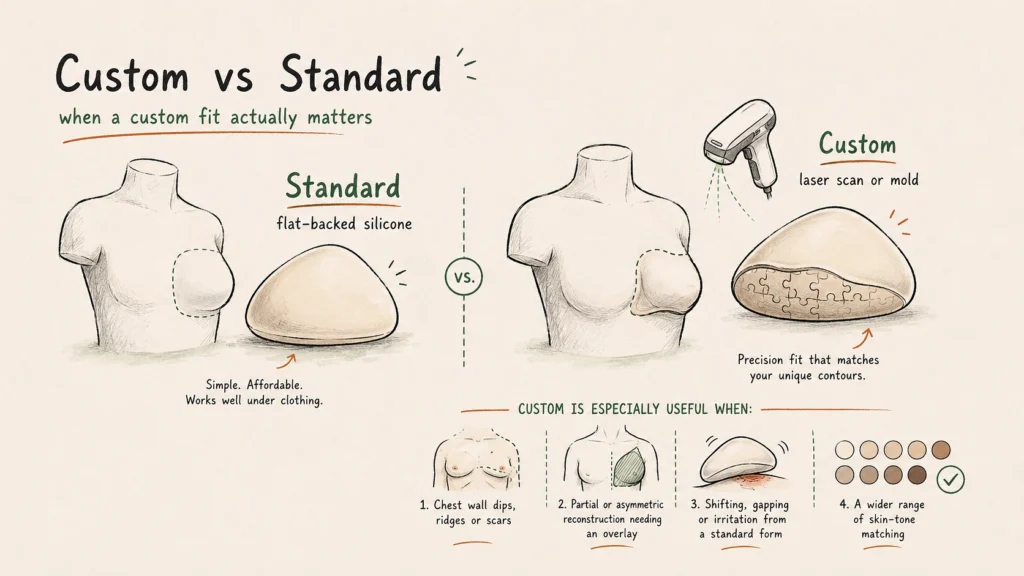
A standard prosthesis is a flat-backed silicone form in graded sizes. For most women it fits well and looks natural under clothing.
A custom prosthesis is made from a laser scan or mold of your chest wall, then produced in silicone to match that shape like a puzzle piece.
Custom genuinely earns its cost in specific situations:
- Your chest wall is not flat, with scarring, dips, ridges or radiation changes that a flat-backed form bridges over rather than sits against.
- You had a partial or asymmetric reconstruction and need an overlay to match the other side.
- Standard forms shift, gap or cause irritation no matter the size.
- You need a skin tone match that off-the-shelf ranges do not offer, which remains a real gap for women of color.
If none of those apply, a well-fitted standard form may serve you better and cost far less.
4. Get a certified fitter, not just a salesperson
Ask directly whether the person fitting you holds a certified mastectomy fitter credential. This is a specific certification, not a general retail role.
A good fitter measures you properly, understands post-surgical anatomy, knows how radiation changes tissue over time, and handles insurance verification and billing paperwork. That last part matters more than it sounds, because getting custom approved usually requires documentation from your surgeon and a fitter who knows how to submit it.
5. Wait for your chest to be ready
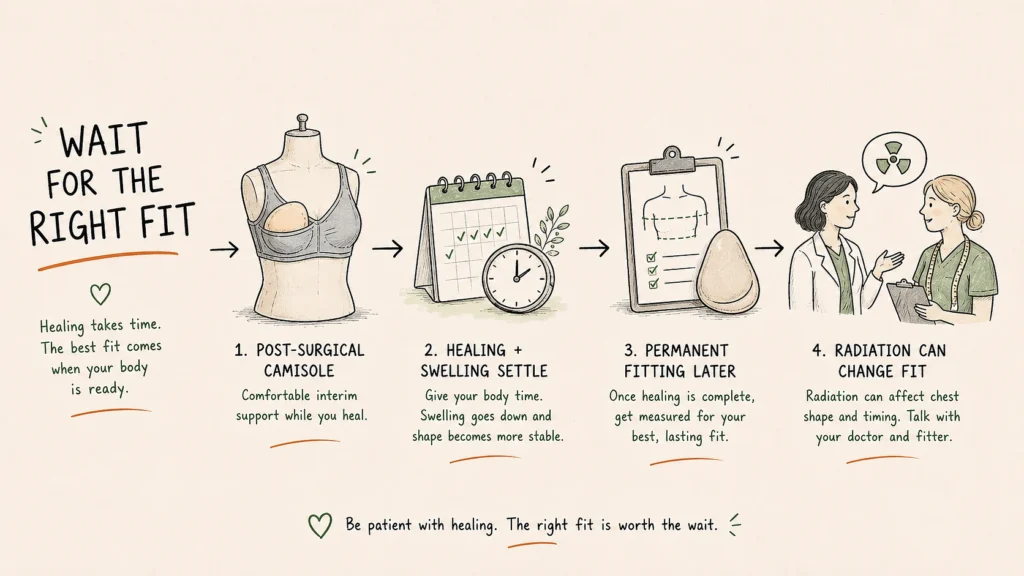
Most fitters will not fit a permanent prosthesis until surgical healing is complete and swelling has settled. Rushing produces a form that fits a temporary shape.
In the interim, ask about a post-surgical camisole with soft fill, which most plans cover. It is comfortable against fresh incisions and gets you through the weeks before a real fitting.
If you are having radiation, discuss timing with both your oncologist and your fitter, because radiation changes tissue and a form fitted beforehand may not fit afterward.
6. Bring a fitted top to the appointment
Wear or bring a knit top that fits closely, not a loose blouse.
You cannot judge a prosthesis under something baggy. A fitted knit shows you the actual silhouette, whether the form sits level with your other side, and whether there is any visible edge. Bring a bra you already own if you have one you like.
7. Ask about weight, not just size
Two forms in the same size can weigh differently, and weight matters more than most women are told.
Matching the weight of your natural breast helps posture and shoulder balance, particularly after a unilateral mastectomy, where an unmatched load can pull on your neck and back over months. Lightweight forms exist and suit some women better, especially in Florida heat or with lymphedema in the arm on that side.
These steps ensure your custom-made breast in Florida matches your body with accuracy and grace.
8. Plan for Florida heat specifically
This is the practical point that generic national guides skip.
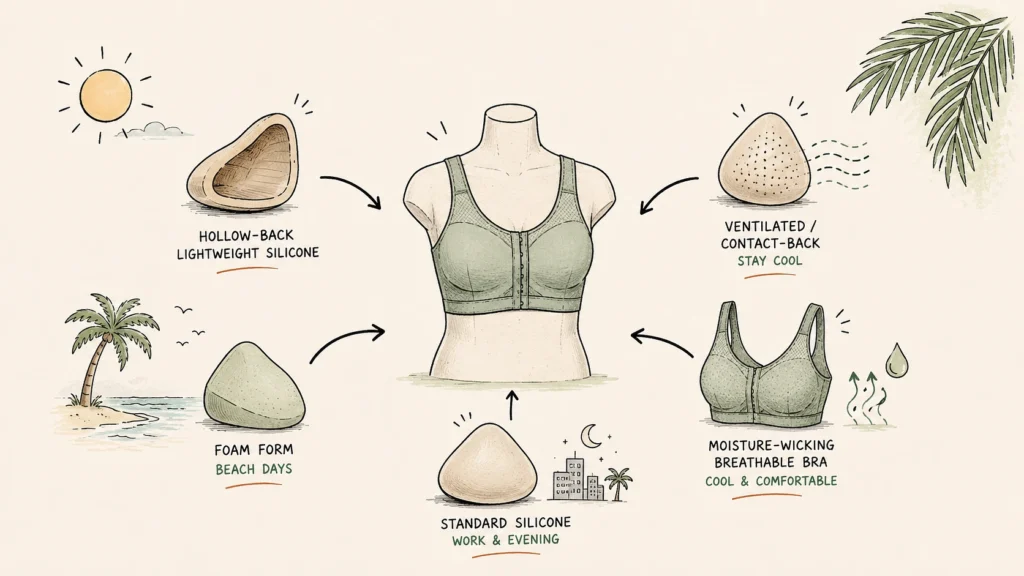
Silicone holds body heat. In a Florida summer, that is not a minor comfort issue, it is the difference between wearing your prosthesis daily and leaving it in a drawer.
Ask about:
- Lightweight or hollow-back silicone forms, which reduce heat retention and weight.
- Ventilated or contact backs, and whether an adhesive form is workable for you.
- Moisture-wicking mastectomy bras rather than standard cotton.
- Having more than one form, so a lightweight foam version handles beach days, swimming and heat while silicone handles work and evenings.
9. Know your replacement schedule and use it
Most plans, including Medicare and Medicaid, allow a silicone prosthesis every two years, a foam prosthesis every six months, and two to four mastectomy bras per year.
Custom prostheses are typically covered every two years by plans that cover them at all.
Earlier replacement is usually possible when medically necessary, including significant weight change, damage, loss or theft, but it requires documentation. Weight change is the common one nobody thinks to ask about.
Silicone forms typically last around two years with proper care, which is roughly why the schedule reads that way.
10. Ask about the things nobody thinks to ask about
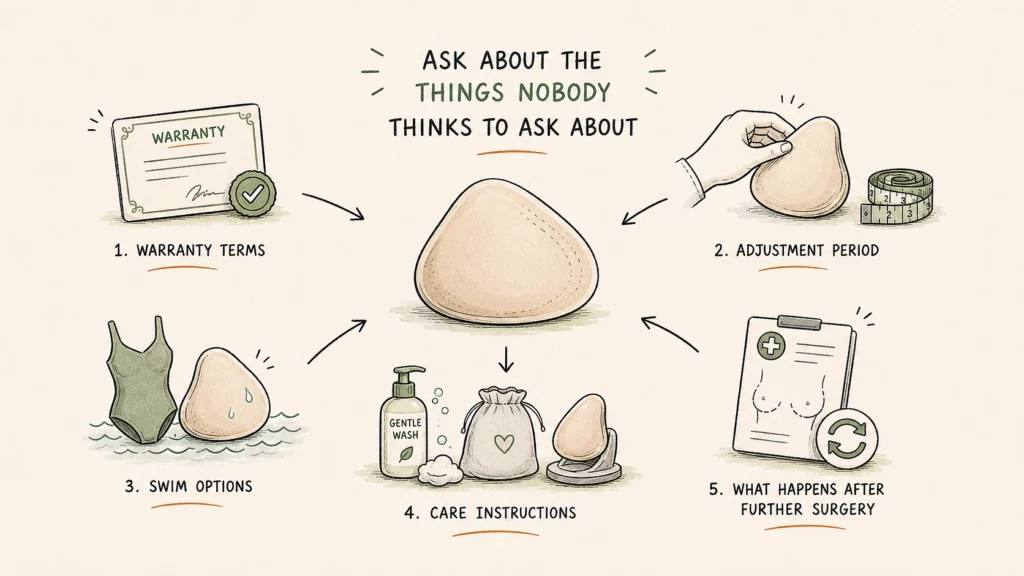
A short list from women who have been through this:
- Warranty terms, since custom forms often carry manufacturer warranties against defects.
- The adjustment period, and whether the shop will refit or modify if something is not right after a few weeks.
- Swim options, because chlorine and salt water degrade some materials and dedicated swim forms exist.
- Care instructions, since proper washing and storage genuinely extends the lifestyle of a form you may need to make last two years.
- What happens if you have further surgery, which can change your chest wall and make a custom form no longer fit.

