


| Distance band | Typical per mile | Typical total, open carrier | Example route |
|---|---|---|---|
| Under 500 miles | $1.40 to $2.20 | $400 to $750 | Houston to Dallas, $350 to $550 |
| 500 to 1,500 miles | $0.80 to $1.20 | $750 to $1,400 | Chicago to Tampa, $900 to $1,300 |
| Over 1,500 miles | $0.40 to $0.95 | $1,000 to $1,950 | Los Angeles to New York, $1,300 to $1,900 |
| Enclosed trailer | add 30 to 60 percent | across every band | mostly for high value cars |
| Vehicle will not start | add $150 to $300 | special loading equipment | both ends of the trip |
Those are 2026 market averages for an operable sedan, and the first thing worth noticing is that the per mile rate falls as the trip gets longer. The carrier’s fixed costs, fuel, hours, insurance, the deadhead miles to reach you, spread across more distance. A 300 mile hop is the most expensive driving you will ever buy by the mile.
The national average sits near $1,150 to $1,215, and open transport handles about 93 percent of all shipments, which is worth knowing before anyone upsells you.
Now, the horror stories. Almost every one I have read traces back to a single confusion that the industry does very little to clear up.
Most People Who Think They Hired A Trucking Company Actually Hired A Broker
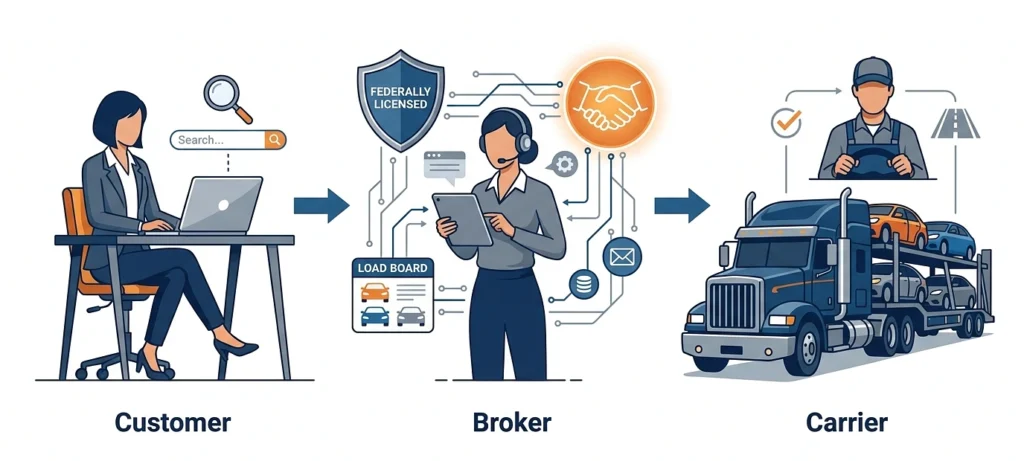
Definition first, because everything else depends on it. A carrier owns the truck and physically hauls your car. A broker arranges the transport and never touches the vehicle travel. Both are federally licensed, both are legitimate, and they carry completely different responsibilities when something goes wrong.
Here is how the arrangement actually functions. You get a quote online, usually from a broker. The broker posts your vehicle on a national load board called Central Dispatch, where carriers with trucks already running that corridor shop for freight that fits their route. A carrier accepts it. The broker’s margin, typically somewhere around $100 to $300, sits inside the number you were quoted.
That model is not a scam. It is how the industry moves cars efficiently, since a single carrier cannot cover every route in the country and an empty trailer is a losing trailer. Brokers must hold broker authority from the FMCSA and maintain a $75,000 surety bond, which exists to protect you if they take your money and fail to perform.
But the liability split is where people get hurt, so read this part twice.
The carrier holds the legal responsibility for your car. Under the Carmack Amendment, motor carriers are held to a strict federal standard for cargo loss and damage, and claims get filed against the carrier’s motor truck cargo insurance. The broker is generally not liable for damage, because the broker never had possession of the vehicle. A broker can face liability for negligent selection if they put your car with a carrier they should have known was unfit, but that is a harder and slower road than a straightforward cargo claim.
So Which Should You Use?
Either, honestly, as long as you know which one you have and you verify the carrier before the truck arrives. What you should not do is assume the friendly person who sold you the quote will be the one held responsible for a scratched bumper in Tulsa.
What Actually Moves Your Quote, And Where The Sales Pressure Is
Distance sets the baseline and the table above covers it. After that, a short list of real variables:
- Vehicle size. Trucks and SUVs add roughly $100 to $200, with pickups averaging closer to $279 more than a sedan, because they eat trailer space.
- Season and corridor. Rates run hottest in spring and summer, and snowbird routes swing hard, with New York to Florida averaging around $1,315 in February against $1,215 in October. The cheapest booking windows fall late September through early November and mid January through mid February.
- Location type. Metro to metro is cheapest since trucks already run those lanes. Rural pickup means a carrier detours for one car, and you pay for the detour.
- Flexibility on dates. A firm one day pickup window costs more than a three day range, every time.
The pressure point to watch for is the lowball quote. A broker who wins your booking with an unrealistically low number then has to find a carrier willing to haul at that rate, and carriers simply decline unprofitable loads. Your car sits. Then comes the call explaining that the price needs to rise to get you moving. A quote that beats every competitor by a few hundred dollars is not a bargain, it is a bid that may never get picked up.
The Bill Of Lading Is The Document That Decides Every Damage Claim
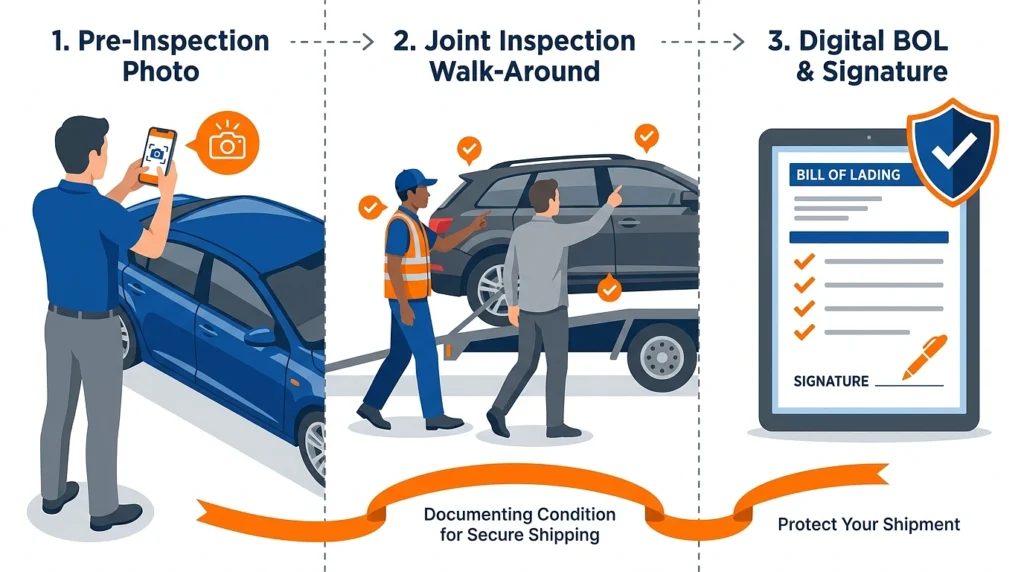
This is the part of the process that people rush through in a driveway while a driver waits, and it is the single most protective thing you will do all week.
The bill of lading, usually called the BOL, is the contract and the condition report combined. At pickup, you and the driver inspect the car together and record every existing scratch, dent, chip, and scuff. At delivery, you inspect again against that record. Anything new is the carrier’s responsibility. Anything already noted is not.
Which means the inspection at pickup is what determines whether damage found at delivery counts as new or pre existing. That single sentence is the whole reason claims succeed or fail.
Do the pickup inspection properly:
- Wash the car first. Dirt hides damage, and damage that was not documented did not happen as far as the paperwork is concerned.
- Photograph every panel in good light, wide shots for context and close ups for detail, with a timestamp.
- Walk the inspection with the driver rather than letting them fill it out alone, and read what they wrote before signing.
- Take the roof and the undercarriage too, since those are the panels nobody photographs and the ones people argue about later.
- Keep your copy. A digital BOL is fine, just make sure you have it before the truck leaves.
At delivery, the discipline matters even more, because there is a moment of social pressure when a tired driver wants a signature and you want your car back.
Inspect before you sign. If there is new damage, note it on the bill of lading at delivery, in writing, before signing anything, and photograph it right there. Signing a clean delivery receipt and calling about a dent the next morning puts you in a fight you will probably lose. Claims typically resolve in two to four weeks when the documentation is complete, and complete means the pickup photos, the delivery photos, and both BOL copies.
One more thing people learn the expensive way. Personal belongings left in the car are usually excluded from cargo coverage entirely. Empty the vehicle.
Verify The Company Yourself, In About Four Minutes
Everything above assumes you know who you are dealing with, and the federal database makes that free to check.
Ask for the MC or USDOT number and look it up in the FMCSA SAFER system. Confirm the operating authority reads active, check whether they hold broker authority or carrier authority, and look at the safety record and crash history if it is a carrier. Worth knowing about a recent change here, since it confuses people reading older guides: as of October 2025 the FMCSA stopped issuing new MC numbers and ties new operating authority to the USDOT number instead. Existing MC numbers remain valid, so a company having one is not a red flag, and a newer company lacking one is not either.
Then ask for the certificate of insurance and confirm the motor truck cargo line is active and covers your vehicle’s value. If you are working with a broker, you have the right to know which carrier was assigned and to refuse a carrier whose record you do not like. Ask for that assignment before pickup, not after.
The last piece of advice is the one I would give a friend, and it is unglamorous. Refuse to be rushed at the two moments that matter, the inspection at pickup and the inspection at delivery, even when the driver is impatient and you feel awkward about the delay. Those ten minutes are your entire legal position. Everything else in this process, the quote, the calls, the tracking updates, is logistics. That paperwork is protection.

