

Walk down the wellness aisle and lavender is doing an impossible amount of work. It’s on the pillow spray that promises sleep, the roller bottle that promises calm, the bath soak that promises to melt your stress, the candle that promises to fix your evening. When one plant is sold as the answer to everything, my instinct is to assume it’s the answer to nothing, that we’re looking at pretty marketing draped over a nice smell.
Lavender is the rare case where that instinct is half wrong. Some of what it’s sold for actually holds up in real clinical trials, better than almost anything else on that shelf. And some of it is exactly the fluff you’d expect. The interesting part, the part nobody selling you a candle mentions, is that the same oil that has genuine anti-anxiety data also has a documented hormone problem. So let me sort the real from the wishful, claim by claim, because the gap between them is wide.
The Anxiety Claim Is The Strong One, And It Surprised Me
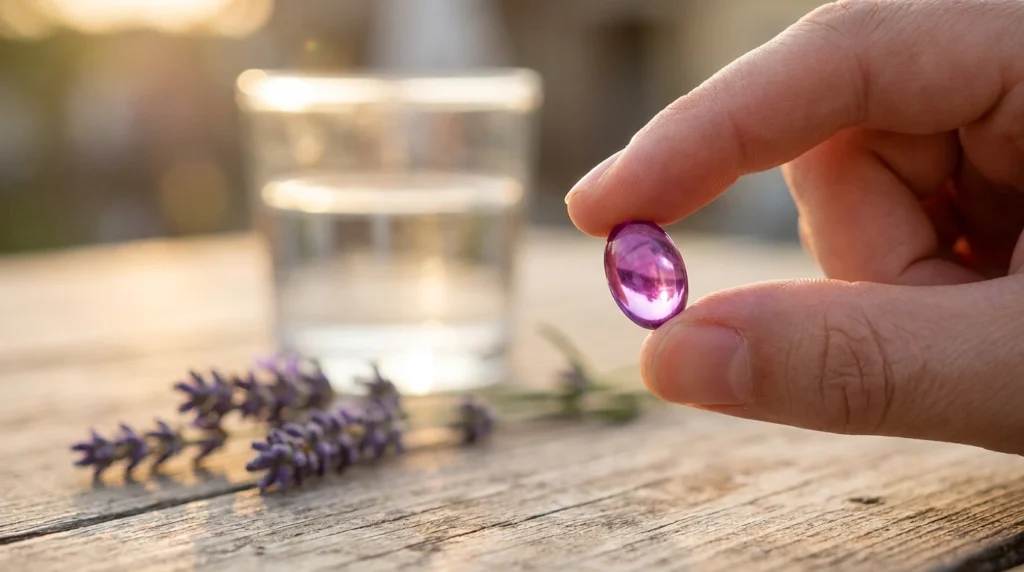
Start with the benefit that has the most serious science behind it, because it’s not the one I expected to be writing up. There’s a standardized lavender oil capsule called Silexan, made from Lavandula angustifolia flowers, and it has been put through the kind of trials most herbal products never face: randomized, double-blind, placebo-controlled, the works.
Here’s what those trials found. Taken orally at 80 mg a day for ten weeks, Silexan beat placebo at reducing anxiety, and in head-to-head studies it performed on par with lorazepam and with paroxetine, a benzodiazepine and an SSRI respectively. That’s not a small claim. Those are real prescription anxiety medications, and a lavender extract matched them on the standard anxiety rating scale without the sedation or the dependence risk that comes with a benzo. A meta-analysis pooling five of these trials backed the effect up. The anxiolytic response started showing after about two weeks.
I want to be careful here, because this is the spot where a health and wellness would sprint ahead of the evidence. A few honest asterisks. Much of this research traces back to the company connected to the product, which doesn’t make it wrong but does mean independent replication matters and the reviewers themselves keep asking for more of it. And this is 80 mg of a standardized capsule swallowed daily, a registered medicinal product in Germany, not the drugstore bottle you dab on your wrist. The trial result does not transfer to sniffing a roller ball and hoping. Still, as far as “does this plant do anything real for anxiety,” the answer is a genuine yes, which puts lavender in rare company.
Sleep: Real Signal, Softer Evidence
The pillow-spray promise is on shakier but not empty ground. A 2025 meta-analysis of clinical trials on lavender for sleep in older adults found that in nine of ten studies lavender significantly improved sleep scores, with a meaningful effect on the standard Pittsburgh Sleep Quality Index. Every one of those studies used inhalation rather than a capsule, which is at least the way people actually use the stuff.
So why am I calling it softer? Because the sleep literature is a mess of small studies, short intervention windows, and wildly different setups, and the quality varies enough that even the reviewers who find an effect hedge it as preliminary. One systematic review of trials in women concluded lavender aromatherapy helped sleep quality while lavender tea did nothing, which tells you the delivery method and the specifics matter a lot. The honest read: there’s a real signal that inhaled lavender helps people fall asleep and sleep a bit better, particularly people who are stressed or older, but it’s a modest, help-at-the-margins effect, not a sedative. If your insomnia is serious, a nice smell is not the treatment.
The Claim Nobody Puts On The Label: Lavender Can Act Like A Hormone
Now the part that made me stop and actually respect the plant a bit, in the way you respect something that turns out to be more chemically active than its cozy branding suggests.
Lavender oil is not inert. Researchers at the National Institute of Environmental Health Sciences, part of the NIH, have shown in lab studies that it has estrogenic and anti-androgenic activity, meaning it can mimic estrogen and blunt testosterone signaling. That’s not homeopathy-tier hand-waving. It’s the same category of concern we apply to industrial endocrine disruptors.
And it has shown up in real children. A New England Journal of Medicine report documented prepubertal gynecomastia, breast tissue growth, in three young boys whose only common exposure was topical products containing lavender oil. In each case the breast growth resolved after they stopped using the lavender products. A later 2019 study in the Journal of Clinical Endocrinology & Metabolism added more cases, including young girls with premature breast development, and traced the activity to specific chemical components of the oil. The lead researchers flagged that those same components appear in dozens of other essential oils, so this isn’t uniquely a lavender problem, but lavender is where the case reports keep landing.
To keep it in proportion, because I don’t want to hand anyone a panic prepubertal gynecomastia is rare, the strongest cases involve repeated topical use on children, and nobody is claiming a whiff of a lavender candle will hurt an adult. But it does mean the “totally safe, it’s natural” framing is false. A compound active enough to rival an anxiety drug is active enough to nudge hormones, and you can’t really have one without accepting the other. If you’ve got a young child, I’d keep lavender products off their skin and hair, and that’s not a fringe opinion, it’s what the NIEHS material points toward.
So What Actually Earns A Place, And What’s Just The Smell
Putting it flat, because the whole point of this piece is which claims survive contact with evidence:
| The claim | How strong the evidence is | What the research actually shows |
|---|---|---|
| Reduces anxiety | Strong, for the standardized capsule | 80 mg/day Silexan matched lorazepam and paroxetine in randomized trials |
| Improves sleep | Moderate, mostly inhaled | Meta-analyses show better sleep scores, but small studies and modest effect |
| Calms via aromatherapy generally | Weak to moderate | Some arousal-lowering effect on inhalation; heavily dependent on setup |
| Endocrine / hormone activity | Real, and a safety flag | Documented estrogenic effects; case reports of breast growth in children |
| Cures / detoxes / heals broadly | None worth citing | Marketing, not medicine |
A few practical things that fall out of all this:
- If you want the anxiety benefit that’s actually been tested, it’s the oral standardized capsule at a real dose, and that’s a conversation to have with a doctor, not a purchase to make on vibes, especially if you’re already on an antidepressant or anti-anxiety medication.
- For sleep and general calm, inhaled lavender is cheap, pleasant, and low-risk for adults, and the worst case is it just smells nice and does little. That’s a fine bet to make.
- Keep it away from young children’s skin and hair. This is the one place where “it’s just lavender” can genuinely go wrong.
The thing I keep coming back to is that lavender’s real story is more interesting than the wellness version. The candle industry wants you to believe it’s a gentle nothing that soothes you. The actual chemistry says it’s a mild but genuine bioactive, strong enough to compete with a prescription in a trial and strong enough to move a child’s hormones in a case report. Treat it like the former and you’ll be underwhelmed. Treat it like the latter, a real substance with real effects and real limits, and you’ll actually get the good out of it without pretending the caveats don’t exist.

