


Two bottles sit on the same bathroom shelf in a lot of men’s houses. A niacinamide serum bought half-sceptically, and a hair supplement bought with actual hope.
The serum will probably work. The supplement probably will not, and the reason has nothing to do with which brand either one is.
It comes down to what each product can physically reach, and how fast the tissue underneath it turns over. That is the whole comparison, and it is worth understanding before spending another year on the wrong bottle.
Why Niacinamide Moves Quickly

The Mechanism Sits Close to The Surface
Niacinamide is vitamin B3 applied topically, and it works on structures sitting within the outer layers of skin. Nothing has to be absorbed into the bloodstream, transported, and delivered to a distant organ. It is applied roughly where it acts.
It also works through several pathways at once, which is unusual and is why it appears in so many products.
- Sebum regulation. Niacinamide appears to inhibit 5-alpha reductase, the enzyme converting testosterone into DHT, which drives sebaceous glands to produce oil.
- Barrier repair. It stimulates ceramide production, the lipids holding skin cells together, and lowers transepidermal water loss.
- Pigment control. It inhibits the transfer of melanosomes from melanocytes into keratinocytes, which is how pigment gets deposited into skin cells.
- Inflammation. It suppresses cytokine pathways involved in redness.
That DHT connection is worth pausing on, since it is the same hormone driving male pattern baldness. Niacinamide is not treating your hairline. It is affecting an enzyme that also governs how oily your face gets.
The Clinical Timelines Are Short
The research is unusually specific about when things happen.
A study on 2 per cent topical niacinamide found significant reductions in sebum excretion rate and visible pore size after four weeks, replicated across Japanese and Caucasian cohorts. Work published in the British Journal of Dermatology showed 2 per cent applied for four weeks significantly increased stratum corneum ceramide levels and reduced water loss in people with dry skin.
Pigmentation takes longer. Hakozaki’s work found statistically significant hyperpigmentation improvement at 5% and above, and studies showing the most dramatic results generally ran 8 to 12 weeks.
| What you want fixed | Concentration with evidence | Realistic timeline |
|---|---|---|
| Oiliness and pore appearance | 2 per cent upward | 2 to 4 weeks |
| Barrier repair, dryness, tightness | 2 per cent | around 4 weeks |
| Redness and irritation | 2 to 5 per cent | 4 to 8 weeks |
| Dark marks left by old spots | 5 per cent minimum | 8 to 12 weeks |
Note what 10 per cent does not buy you. Higher concentrations are common on shelves and are not supported by meaningfully stronger evidence than 5%, while irritation risk rises. Five per cent is the sensible target for most men.
Why Hair Supplements Do Not
The Biology is Slower by Design
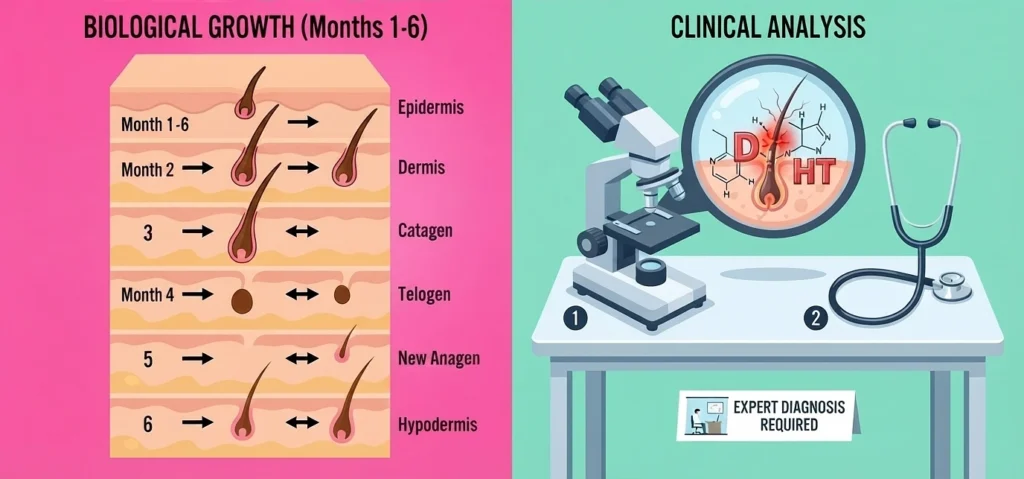
Hair grows in cycles, and the growing phase lasts years. Whatever you take today affects hair that emerges months from now, because you are influencing a follicle rather than a visible strand. Any honest hair intervention is measured in three to six month blocks minimum, and that floor exists regardless of what the supplement contains.
So even a supplement that works cannot demonstrate it quickly. The comparison in the headline is partly a comparison of tissue turnover speed.
The Evidence Problem is Separate and Worse
Here is where I get blunt, because the supplement aisle is genuinely misleading men.
Biotin works if you are deficient. Deficiency is rare. Research consistently finds that supplementation improves hair in people with a documented biotin deficiency or a specific metabolic disorder, and shows little to no benefit in people with adequate levels, which is most men eating an ordinary diet. Egg yolks, nuts and legumes all contain it, and gut bacteria produce some as well.
More pointedly, male pattern baldness is not a nutritional supplementation. It is genetic and hormonal, driven by follicle sensitivity to DHT. No amount of biotin addresses that mechanism, which is why clinics report seeing patients spend months on supplements while the actual cause goes untreated.
There is also a practical hazard people do not expect. High-dose biotin interferes with laboratory tests, including troponin and thyroid assays. The FDA has issued warnings, and a falsely low troponin result can mask a heart attack. If you take it, tell your doctor and the lab.
What Actually Has Evidence for Hair
Not a comfortable answer, and worth stating plainly since the article would be half-useless without it.
The interventions with real clinical support for pattern hair loss are minoxidil and finasteride, both of which also take months to show results and both of which come with their own considerations. Finasteride is prescription and has side effect discussions worth having properly. Minoxidil is topical, widely available, and requires indefinite continued use.
If your hair is genuinely thinning, the productive move is a diagnosis rather than a supplement, because pattern loss, stress-related shedding and autoimmune causes look similar in a mirror and need completely different treatment. That is a conversation with a doctor or dermatologist, and having it early matters more than which bottle you pick.
What This Means for a Men’s Routine

Spend on the skin product, get a diagnosis for the hair. That inverts how most men allocate their money and attention, and it follows directly from the evidence.
A workable minimum:
- A 5 per cent niacinamide serum once daily, which addresses oiliness, barrier and redness simultaneously and is among the best tolerated actives available.
- Sunscreen, which does more for how skin looks over a decade than any serum.
- Consistency over concentration, since the studies producing the strongest results ran 8 to 12 weeks of daily use rather than higher percentages.
- No hair supplement unless a blood test showed a deficiency, in which case treat the deficiency rather than the hair.
One honest caveat on the headline. Niacinamide fixes oiliness, barrier function and dark marks. It does not fix acne on its own, it does not replace treatment for a genuine skin condition, and anything persistent or painful belongs with a dermatologist rather than a serum.
The uncomfortable summary is that men tend to underinvest in the thing that responds in a month and overinvest in the thing that was never going to respond at all. Swapping those two around is most of the improvement available.

