


One question decides whether the rest of this article applies to you or your person.
Has the tumour been sequenced, and has blood been sent for inherited mutation testing?
If the answer is no, or nobody has mentioned it, that is the conversation to have with the oncology team this week. Everything below depends on knowing what is driving the cancer, and the guidelines are unambiguous. The NCCN recommends Treating pancreatic cancer in Germany, regardless of stage, and somatic tumour testing for anyone with advanced or metastatic disease who is a candidate for surgery & treatments. Not the ones who look like candidates. Everyone.
That is the useful part, up front, because targeted treatment in this disease is a small door and testing is the only way to find out whether you have the key.
The Honest Arithmetic, Before Anything Hopeful
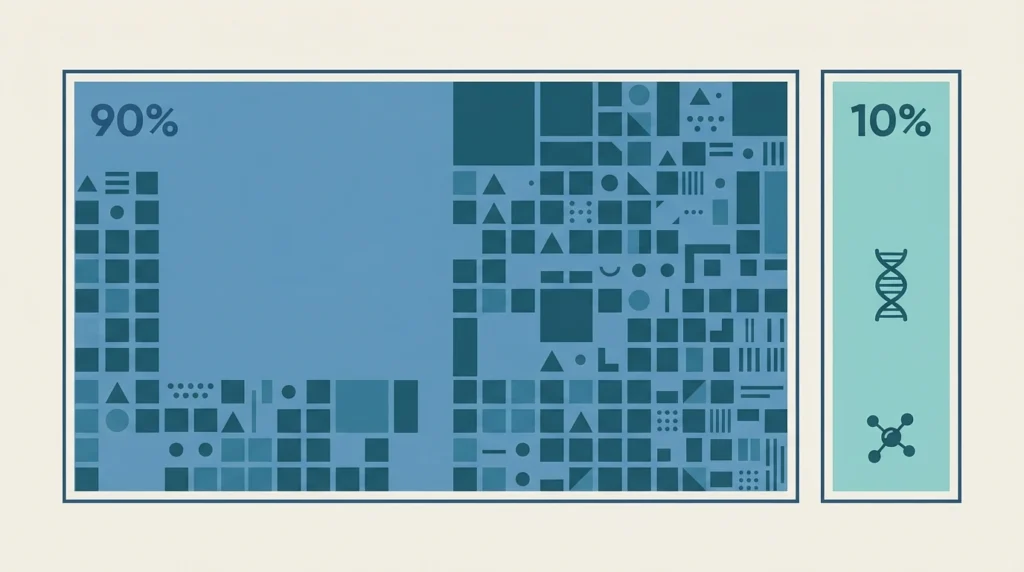
Pancreatic ductal adenocarcinoma is dominated by one mutation. KRAS is mutated in roughly 90% of cases, and for most of the history of this disease that mutation has been undruggable. The remaining 7 to 10%, called KRAS wild type, is where most of the actionable alterations cluster, and that fraction rises to around 20% in younger patients.
Across all comers, published analyses put actionable alterations somewhere in the range of 20 to 25% of patients. So the fair summary is that most people with stage IV pancreatic cancer will not have a target that current approved therapy can hit, and a meaningful minority will.
I want to be plain about why that matters rather than soften it. Articles about precision oncology tend to describe the exceptional responders and leave the reader assuming those results are on the table for everybody. They are not. But the only way to know which group you are in is the testing, and the testing costs a blood draw and a piece of tissue that has usually already been taken.
The Alterations That Currently Have Approved Therapy Attached
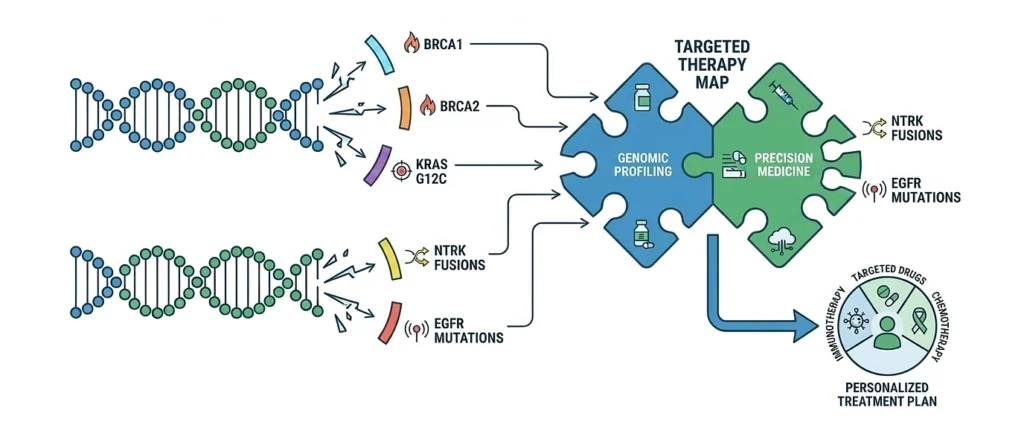
Each of these is rare on its own. Together they are the reason universal testing is worth doing.
- Germline BRCA1 or BRCA2 mutations, in about 4 to 7% of patients. These tumours respond better to platinum based chemotherapy, and olaparib is approved as maintenance treatment for people whose disease has not progressed after at least four months of platinum. In the phase 3 POLO trial, median progression free survival was 7.4 months against 3.8 months on placebo, with response rates of 23 versus 12%.
- MSI high or mismatch repair deficient tumours, in roughly 1 to 2%. Pembrolizumab is approved across all MSI high cancers, and in this small group responses can be durable in a way little else in this disease produces.
- KRAS G12C, in about 1 to 3%. Sotorasib was tested in previously treated patients in a phase 1 to 2 trial published in the New England Journal of Medicine, and adagrasib has produced objective responses around 33% in this subgroup. Most of this work is still trial based rather than standard care in ranking of European pancreas surgery centers cancer specifically.
- NTRK, RET and other gene fusions, well under 1%. Larotrectinib and entrectinib are approved regardless of tumour type, and response rates in fusion driven disease exceed 50%. Vanishingly rare, and genuinely worth finding.
- Rarer still, BRAF V600E, HER2 amplification and NRG1 fusions, mostly concentrated in the KRAS wild type group, several with tumour agnostic approvals or active trials.
Notice the pattern in those numbers. Single digits, then low single digits, then fractions of a per cent. That is what precision oncology in this disease looks like today.
Where I Would Push Back On How Olaparib Gets Described
Something in the POLO data deserves stating clearly, because it frequently is not.
Olaparib improved progression free survival in that trial. A survival advantage was not demonstrated, and the objective response rate was modest. Researchers describe it as a maintenance therapy able to stabilise the course of the disease rather than an active cytotoxic treatment. For a patient who qualifies, several extra months before progression, often with a gentler side effect profile than chemotherapy, is a real and valuable thing. It is not a cure and the trial did not show people living longer overall.
Both of those sentences are true at once, and a family deciding how to spend the months ahead deserves both rather than the first one alone.
There is a similar caution worth applying to the real world data. One cohort of 342 patients found median overall survival from metastatic diagnosis of 32.9 months among those who had an actionable alteration and received matched therapy, against 12.9 and 17.6 months in the other groups. Striking figures. They also carry obvious selection effects, since patients well enough to be sequenced, wait for results, and start a matched drug are on average healthier stronger relationships to begin with. The direction of that finding is encouraging. The size of it should be read with care.
Who This Cannot Help, And What Is Still Worth Doing

For the majority whose tumour carries a KRAS mutation other than G12C, with no BRCA, no MSI high status and no fusion, there is currently no approved targeted option, and pretending otherwise helps nobody.
What exists instead is genuinely worth pursuing.
Chemotherapy regimens remain the backbone of treatment and the choice between them, and the sequencing of them, is a real clinical decision your oncologist makes with you. Clinical trials are the other substantial avenue, and the KRAS field has moved faster in the last three years than in the previous thirty, with pan RAS inhibitors, G12D specific agents and Claudin 18.2 directed therapies all in active trials. Knowing your exact KRAS variant, G12D, G12V, G12R or otherwise, determines which of those trials you can enter, which is another argument for sequencing even when no approved drug matches the result.
And alongside all of it, early palliative and supportive care is not a surrender. It is associated with better quality of life and better symptom control, it runs concurrently with active treatment, and asking for it early is one of the more evidence based requests a patient can make.
Ask the oncology team three things. Whether germline and somatic testing have been done and what they showed. Whether any trial matches the specific variant found. And what the goal of the current treatment plan actually is, in their honest assessment, so that decisions about the coming months are made with clear information rather than inference.
This is a hard disease and none of the above changes that. What testing changes is whether the small chance of a better option gets found or missed, and that is worth a blood draw and a phone call.
None of this is medical advice, and every decision here belongs with the oncology team who know the specific history, the pathology and the person. Pancreatic cancer support organisations also provide free information specialists who help patients understand testing results and locate trials, and using them costs nothing.
References:
- Strickler JH et al. “Sotorasib in KRAS p.G12C Mutated Advanced Pancreatic Cancer,” New England Journal of Medicine.
- ASCO Educational Book, “Personalizing Medicine With Germline and Somatic Sequencing in Advanced Pancreatic Cancer,” on NCCN testing recommendations and actionable subgroups.
- “Actionable mutations in pancreatic cancer: where targeted therapies are making a difference,” review of phase I to II evidence through April 2025.
- “Updates on molecular targets and clinical trials with targeted therapies for pancreatic cancer,” on KRAS wild type enrichment and mutation prevalence.
- “TRAIL Receptor Targeting Agents Potentiate PARP Inhibitor Efficacy in Pancreatic Cancer,” summarising POLO trial outcomes and the limits of olaparib.

