


I ruined a suit’s big day at my cousin’s wedding in Phoenix. Navy wool, properly tailored, the good one. I’d packed it the way everyone packs a suit, folded in half at the waist and half again, laid flat on top of everything like a lasagna, and when I pulled it out at the hotel it had a crease across both thighs so sharp you could have sliced bread with it. Two hours before the ceremony. The hotel iron made it worse, because hotel irons exist to punish optimism, and I spent the reception looking like I’d sat in a waffle press.
The unfair part is that my uncle, seventy-one years old, flew in from Detroit with a suit in a duffel bag. A duffel. His came out fine. And when I asked him about it he said something I’ve been chewing on ever since: “You folded yours. I wrapped mine.” He didn’t have better luggage. He didn’t have better fabric. He had a completely different theory of what causes a wrinkle, and his theory was right.
A Wrinkle Is a Bend That Went Too Far
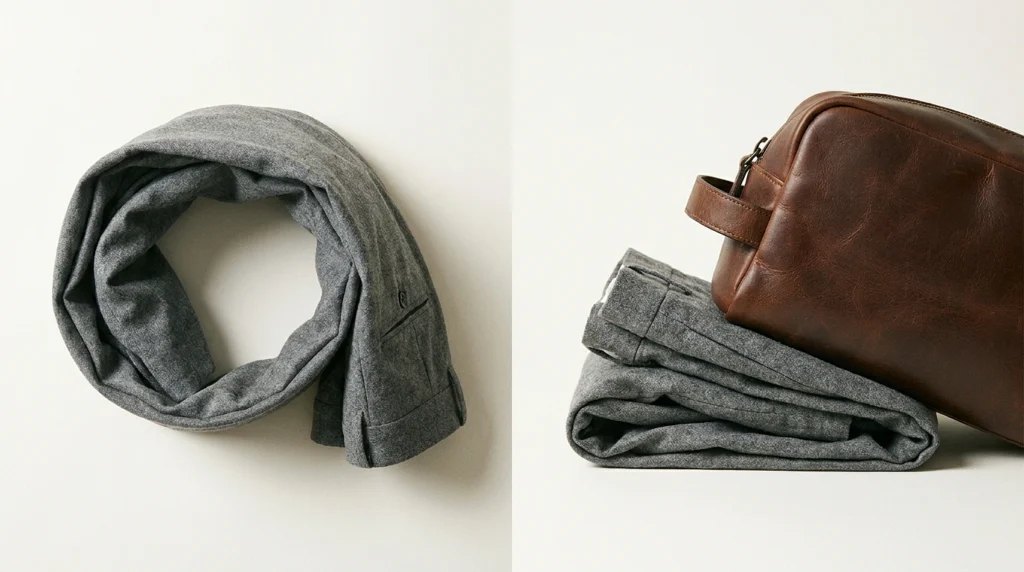
Here’s the thing nobody tells you when you buy a suit, and it changes how you pack forever once it clicks. A wrinkle isn’t caused by folding. It’s caused by folding sharply, and then applying pressure and time. Fibers can bend and recover, that’s what fibers do all day while you wear the thing. What they can’t recover from is being bent past a certain angle, pinned there under the weight of your toiletry bag for six hours in a cargo hold, often with a little cabin humidity helping the new shape set.
Think of a garden hose. Coil it in a big loop and it’s fine, does it a hundred times, no memory of the event. Kink it at one point and you’ve got a permanent weak spot. Your trousers are the hose. The crease across my thighs in Phoenix wasn’t a fabric failure, it was a kink, one concentrated point where the cloth folded back on itself at basically zero radius with a shaving kit sitting on top of it.
Where Fabric Actually Fits In
Which is why the usual advice, buy wool because it resists wrinkles, only takes you halfway. It’s true that wool springs back better than linen or cotton, my navy suit really was the right fabric. But even the best wool creases at a hard fold under pressure. The honest division of labor looks like this:
- Fabric decides how fast the small stuff falls out. Wool sheds minor travel rumples overnight on a hanger; linen collects them like souvenirs.
- Fold points decide whether you get the big permanent ones. A zero-radius fold under pressure will crease anything, including the finest wool ever sheared.
- Pressure and time are the accomplices. The same fold with nothing stacked on it, for a two-hour hop, often walks away clean.
I had great fabric and terrible fold points. My uncle had a duffel bag and no fold points at all.
What “Wrapped, Not Folded”
So here’s the family secret, which turns out to be an old tailor’s trick that half the menswear world knows and nobody told me. Every fold in your packing needs a wide radius, something round tucked into the bend so the fabric curves instead of kinks. Everything bends around something soft. Nothing creases, because nothing kinks. In my uncle’s duffel, his clothes were basically a swiss roll.
The Trouser Roll, Step by Step
- Roll two t-shirts into a log, tight enough to hold shape, and lay your trousers out flat.
- Place the log across the knee line, since that’s where the fold has to happen anyway.
- Fold the trousers over the log, so the bend wraps a soft cylinder instead of closing on itself.
- Lay the bundle in last, on top, with nothing heavy resting on it. The fold survives the flight because there’s no kink to set.
The Jacket Is Its Own Animal
A tailored jacket has shape built into it, padding and canvas pressed into a curve on purpose. You can’t roll it and you shouldn’t flatten it. The move is the shoulder-through-shoulder inside-out fold: turn one shoulder partly inside out, nest the other shoulder into it so the lining faces outward, then fold the jacket once around a rolled sweater. This works because it protects the built structure, one shoulder cradling the other so the chest canvas supports itself. Fold a jacket flat like a shirt and you’re creasing the one part of the garment no iron can rescue.
The Small Tricks That Are All the Same Trick
Once you know the wide-radius principle, you see it hiding inside every packing tip that actually works:
- Tissue paper or a dry-cleaner bag between fold layers. Sounds fussy, works for two reasons: the padding widens the bend, and the slippery plastic keeps fabric from gripping itself. Wrinkles need friction to lock in place.
- Bundle wrapping, where you wrap your whole wardrobe around a soft core, biggest garments outermost. It’s the swiss roll scaled up, and travelers who commit to it get slightly evangelical, which I now understand.
- Rolling casual clothes. Rolling isn’t magic; it’s just a fold with an infinite radius. That’s why it works for t-shirts and fails for structured jackets, which have no interest in becoming cylinders.
About the Suitcase in the Title
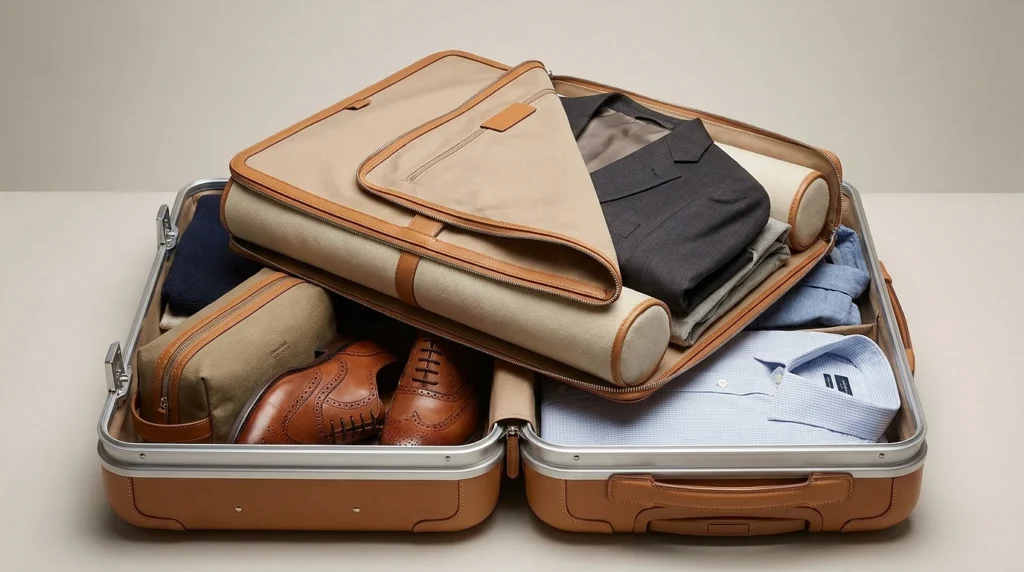
Now the part where I admit the luggage industry figured this out before my uncle did, they just charge more for it.
A suiter, if you’ve never met the term, is a suitcase or insert with a dedicated garment section, usually a padded trifold or bifold panel the suit lies into. Look closely at a decent one and every design choice is a bend-radius decision:
- The fold bars are padded rollers, not edges, so trousers bend around a cylinder exactly like the t-shirt log.
- The panel folds in thirds at cushioned points instead of in half at one sharp line.
- The garment section is separated from your shoes and dopp kit, because the other half of the wrinkle equation, pressure, comes from your own belongings stacked on the fold.
- Half-fold garment bags put their one hinge below the jacket’s structured zone, sacrificing the trouser line, which can be padded, to spare the chest, which can’t.
So Do You Actually Need One?
Honest answer, and it depends on your calendar, not your wardrobe. If you travel with tailoring more than a few times a year, the dedicated garment section earns its money, mostly because it makes good technique automatic instead of a craft project at 6 a.m. If you fly with a suit twice a year, the rolled-t-shirt method in whatever bag you already own performs the same physics for free. The suitcase isn’t buying you new science. It’s buying you the science pre-installed.
The Landing Ritual, Since Nothing Is Perfect
Whatever you pack in, unpack like it matters. The first ten minutes in the every room decide how the suit looks tomorrow:
- Hang the suit immediately, jacket on a proper hanger with shoulders supported, trousers by the cuffs if the hanger allows, since their own weight pulls minor bends straight.
- Run the shower hot for a few minutes with the bathroom door shut and the suit hanging inside, letting steam relax whatever small bends survived the trip.
- Know the limit. Steam works on fibers that bent but didn’t break. It does nothing for a true crease, which is the entire point of everything above this line: the battle is won or lost at packing time, at the fold points. The hotel bathroom is just the victory lap.
I still have the navy suit. The thigh crease eventually pressed out at an actual cleaner, mostly. And I still pack it folded, but folded around a rolled towel now, lining out, tissue in the bends, laid in last so nothing sits on it. Took me one ruined wedding to learn what my uncle knew from fifty years of flying cheap: the suit doesn’t care what it’s folded in. It cares what it’s folded over.

