


Somewhere further up the chain, with coffee in a bag with a nice story on it, the auditor, sitting at a table with five identical cups, a spoon, and a form, decided how much that coffee was worth. Not poetically. Numerically, a number out of a hundred that would go on to decide whether the farmer growing it would be paid that year’s commodity price, or multiples thereof.
That number comes from a fairly rigid piece of paper called the SCA cupping form, and the thing worth understanding up front is how little of the process is about whether the taster personally enjoys the coffee. It’s built to strip that out. The whole design is an attempt to make a subjective thing, taste, behave like something you can measure and reproduce, and it mostly succeeds, with some cracks I’ll get to.
Eighty Is The Line: It Isn’t Arbitrary
Start with the number everyone quotes, because that’s the one that’s counted commercially. Eighty points. If it’s scored lower than 80 out of 100 points, in the world of specialty coffee this is considered commodity grade, regardless of what’s printed on the bag.
As a rule, anything less than 80 points isn’t specialty coffee, and a lot of coffee sold as “premium” would quietly fail if it ever went across a proper cupping table. It’s a matter of dollars, not just prestige. A coffee scoring the lower mid-80s can reach several times the price of one scoring in the high 70s, and sometimes it all comes down to 0.5 points in just one category. That’s the part people find hard to believe until they see it. For the whole farm’s economy, it can depend on a grader’s quarter-point.
The Coffee Shows Up Naked
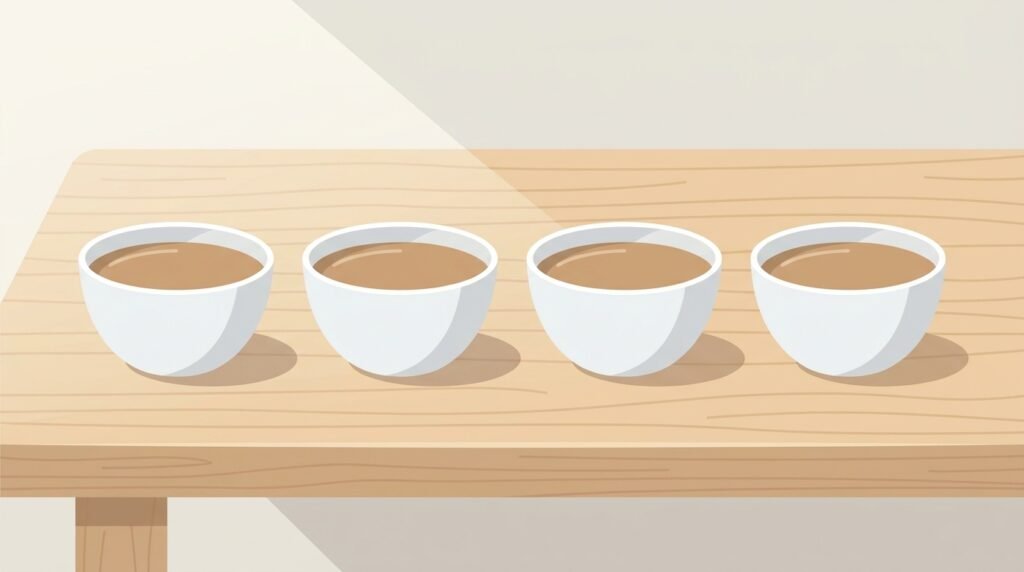
The first rule is, it’s blind. There is no brand and no story behind the coffee, no one is saying “this is a rare Gesha from a famous farm.” The cupper is not supposed to know who made the coffee, because when you know a coffee is expensive and celebrated, you start tasting what you expect to taste.
They were all roasted light. They were also roasted for grading, and that’s where people get a little confused. A grading roast is not designed to be good, it’s designed to get out of the way so you can taste the actual bean underneath. A good roaster can flatter a good coffee, but they can’t come back from a dull cup. The point of the light grading roast is to ensure that nobody’s hiding a mediocre green bean under a nice dark roast. You taste the bean, not the roaster’s talent.
Ten Things Are Judged, Three Of Which Concern The Level Of Consistency
And that’s where the form itself comes in: the classic SCA sheet divides this coffee into ten scores. Each of those attributes is scored on a 6 to 10 (in quarter-point steps) scale. Add them up, make the deductions, and that gives you your score.
They are fragrance and aroma, flavor, aftertaste, acidity, body, balance, uniformity, clean cup, sweetness and an overall impression score, which is basically the cupper’s holistic gut read.
Most of those are what you’d expect, but a few are worth explaining because they don’t mean what a normal person assumes.
Acidity is a big one. When it comes to coffee acidity is not a bad word and it does not mean sour. Brightness is the liveliness that gives a Kenyan coffee a sparkling flavor and gives a flat one the taste of cardboard. Rather than evaluating how strong it is, a coffee grader examines the pleasantness and balance of the coffee.
Then there are the trio that trip up the novices: uniformity, clean cup and sweetness. They are all good, but they are not about flavor in the abstract. So you can brew five cups of the same coffee and, if one of them is off, tastes different, has a defect, isn’t sweet where the others are sweet, that cup drags the score down. It’s a check on the coffee being consistently itself, cup after cup, which, for a buyer purchasing a whole lot, actually matters more than one heroic cup on a good day.
The Actual Tasting Is Stranger Than You’d Think
You first grind it and then smell the dry grounds, then you pour hot water (c. 93C) over the coffee. You wait until the crust of grounds has formed on the top.
Wait four minutes. Break the crust with a spoon, pressing your nose into it, because the moment you’re going to smell the coffee the most is when you break that crust. Skim off any remaining floating grit, and wait again, because the coffee has to cool.
Temperature is doing more work here than anyone expects. The form is essentially evaluated in passes as the liquid cools. Different things become apparent at different temperatures. Acidity emerges hot. Sweetness and body come forward as it cools to something like a warm drink. And the coffee at its coolest, around body temperature, is where faults show up that were covered by the heat of the drink. A coffee that is really nice when served hot, but turns unpleasant as it cools, is telling you something, and a cupper is listening carefully.
And yes, the slurping is real and it isn’t showmanship. You take a spoonful and bring it to your mouth and slurp hard enough to spread the coffee over your whole palate. That aeration helps push the aromatic compounds up to the back of your nose and down the retro-nasal passageway, where most of what we call flavor is detected. Your tongue can only taste sweet, sour, salty, bitter, and savory (the umami flavor) compounds. Everything else, the blueberry, the jasmine, the cocoa, is your nose reading it from the inside. The slurp is just the fastest way to get the coffee there.
Defects Can End It Before It Starts
The score-out-of-100 frame hides the fact that points can be deducted even if you never had any to begin with. For that, luckily, there is a column. Taints are off-note but small, and faults are bigger and uglier. This means that even one fermented, moldy, or phenolic cup can ruin an otherwise good coffee.
But often this is not the farmer’s fault. The cherries may have been dried on dirty plastic, gone through a hasty quick fermentation, or been dumped in a damp warehouse. You can grow a genuinely excellent coffee and turn an 87 into a 78 somewhere between the tree and the bag, through one careless step. That’s the quietly brutal part of the system. The bean is brilliant and the process can still throw the score away.
The Form Is Being Rewritten As We Speak
Here’s the part a lot of older explainers miss, and it’s worth knowing if you’re reading about this in 2026. That classic ten-attribute form I just walked through is on its way out.
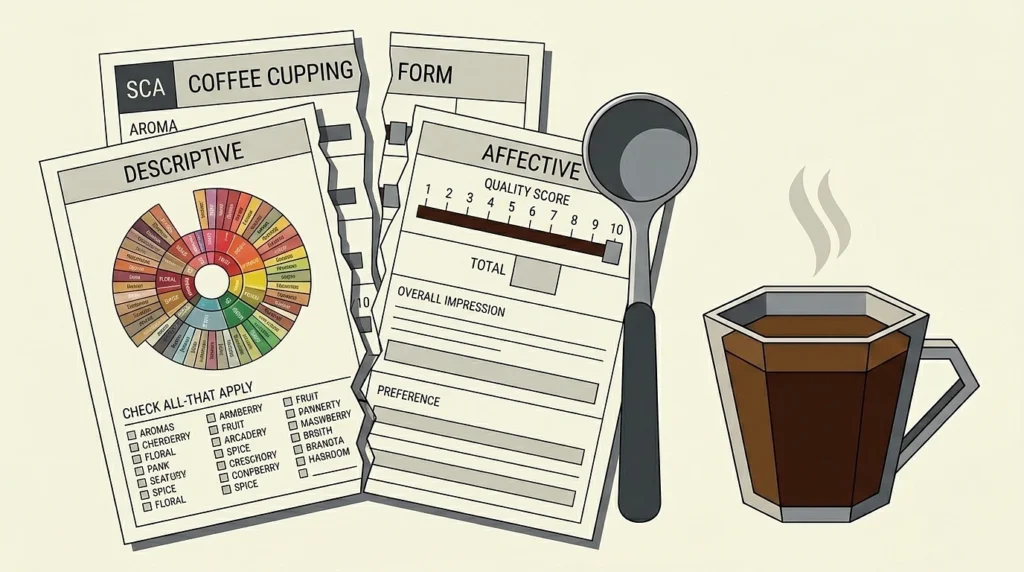
The SCA has been revising a coffee grading system called the Coffee Value Assessment. The assessment has two acts, the first of which is to describe what the coffee tastes like and how intense each part is. The second is an affective measure where the quality score comes from. The old single form mixed these two things together. You were describing and judging in the same breath. Sensory science says you get cleaner results when you keep them apart. So, the descriptive side is driven by the flavor wheel and check-all-that-apply list, rather than one cupper’s adjectives.
The question is whether the industry widely accepts it, or sticks with the comfortable 100-point sheet of paper that everybody’s been used to for decades. Institutions take a long time, and a lot of the trade has muscle memory. But this is the direction.
What The Number Can And Can’t Tell You
So now you know what “87 points” means. It means a blind panel, a light grading roast, five cups, a spoon, a slurp, a form parceling the experience into aroma and acidity and body and the rest, minus whatever defects slipped through the cracks in the panel’s tasting process.
What it doesn’t tell you is whether you’ll like it. An 88 built on wild, funky, fruity acidity might not be your cup at all, while an honest, clean 84 with cocoa and a soft body could be exactly the thing you reach for every morning. Score is relative to professional standards, not personal enjoyment. These are genuinely different questions, and the form was built around answering the first of them, not the second. The second one is, still thankfully, yours.

