


Somebody has actually weighed this, which is the part most consultations skip over. Edelhoff and Sorensen prepared teeth for different restoration designs and then measured what was gone, and their 2002 paper in the Journal of Prosthetic Dentistry reports that complete coverage all ceramic and metal ceramic crown preparations required removal of 63% to 72% by weight of the total unprepared crown, while preparations for ceramic veneers and resin bonded prostheses removed 3% to 30% by weight. Sit with those two ranges for a second, because the gap between them is the whole decision. A crown is not a slightly larger veneer, it is closer to two thirds of the visible tooth being ground away.
Permanent is the accurate word for both, by the way. Enamel contains no living cells and does not regenerate, so whatever gets removed on preparation day is gone for the rest of your life, and the tooth underneath will need a restoration on it from then on.
The Same Comparison In Millimetres, Because The Percentages Hide Where It Happens
Percentages describe volume, but the number your dentist is working to is a depth, and the depths tell you something the percentages do not. Preparation depth for porcelain laminate veneers runs approximately 0.3 to 0.7 mm and varies from the incisal edge down to the cervical margin, and studies of remaining enamel confirm that most anterior teeth still have enough enamel for bonding when reduction stays within 0.3 to 0.5 mm at the midfacial third and 0.7 to 1.0 mm at the incisal third.
| What is being removed | Veneer preparation | Crown preparation |
|---|---|---|
| Volume of the visible tooth | 3% to 30% by weight | 63% to 72% by weight |
| Surfaces involved | The facial surface, sometimes the incisal edge | All the way around, including the back of the tooth |
| Typical depth | 0.3 to 0.7 mm, varying by third | Deep enough to take the tooth down to a post shaped stump |
| What it is usually bonded to | Enamel, if the preparation is controlled | Dentin, because the enamel is largely gone |
Enamel Is The Part That Makes The Restoration Hold, And It Runs Out Quickly
Staying inside enamel is not a purity contest, it is a mechanical requirement. Porcelain bonded to dentin has been reported at roughly 75% lower bond strength than porcelain bonded to enamel, and preparations leaving 50% of the enamel substrate show significantly higher bond strength than those leaving 25%. The size difference this creates is genuinely surprising when you first read it, because a 0.5 mm thick porcelain veneer bonded to enamel has demonstrated higher fracture strength than a 1.0 mm thick porcelain bonded to dentin. Thinner on enamel beats thicker on dentin, so a conservative preparation is not just kinder to the tooth, it is producing a stronger result.
The trouble is that enamel is not evenly distributed. It is thickest near the incisal edge and thins out as it approaches the gum line, which is exactly where the margin of a veneer has to sit, and one study found that freehand preparation reduced proximal and cervical enamel by more than 0.5 mm in the vast majority of cases, exposing dentine in most of the teeth. So the same nominal 0.5 mm can be sitting comfortably in enamel at the middle of the tooth and already into dentin near the gum.
Two Dentists Preparing The Same Tooth Do Not Remove The Same Amount
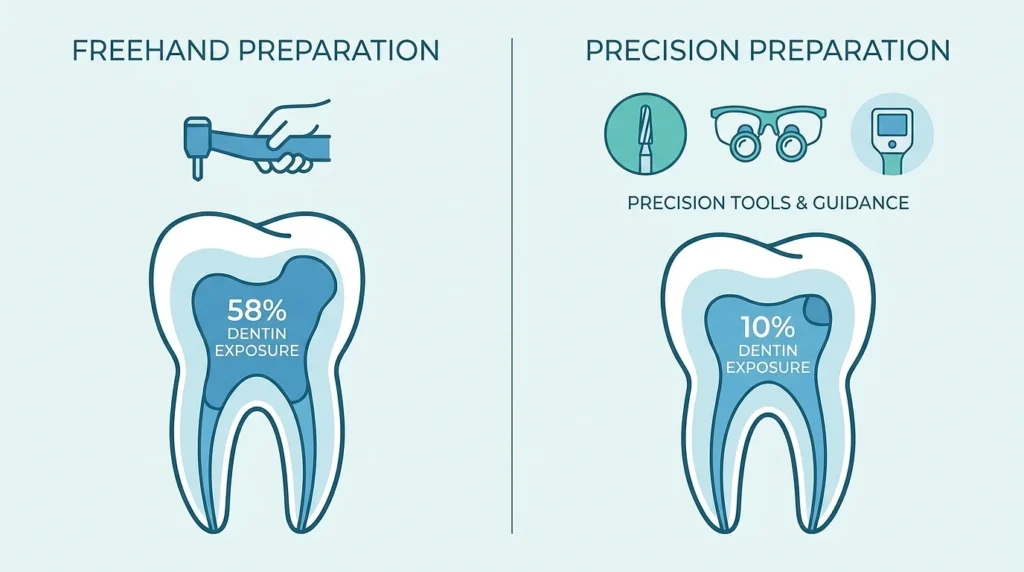
This is the finding that should change how you choose a provider, and it is not a comfortable one. In a study where maxillary central incisors were all prepared to the same target depth of 0.6 mm with a 0.3 mm cervical chamfer, the amount of dentin actually exposed was then measured by operators of different experience levels, and for the window preparation design the general practitioner group recorded 58.05% dentin exposure while the prosthodontist group recorded 10.55%. Same tooth type, same instruction, roughly a fivefold difference in how much dentin ended up uncovered.
So when people ask whether veneers are conservative, the honest answer is that the design is conservative and the execution varies. Ask who is preparing your teeth and what they are preparing to. The specific things I would ask about are whether they are using depth cutting burs rather than judging by eye, whether they are preparing through a mock up or aesthetic pre evaluative temporary so the reduction follows the planned final shape instead of the original tooth, and how they handle the cervical margin where the enamel is thinnest. A dentist who is doing this work properly will be pleased you asked. One who is irritated by the question has answered it.
No Preparation Veneers Exist But The Candidacy For Them Is Narrow
Ultrathin veneers in the 0.3 to 0.5 mm range placed with little or no reduction are real and they are documented, and they work well for closing small gaps, minor reshaping, enamel defects and light discoloration. They stop working when the teeth are already crowded or protrusive or heavily discoloured, because a shell added on top of a tooth that is already too far forward makes it further forward, and covering deep staining needs opacity that a very thin ceramic cannot deliver without looking flat. Some practices market no preparation as though it suits everyone, and it suits a specific and fairly narrow set of starting points. If your teeth are slightly small or slightly gapped, you may be a genuine candidate. If you are looking at veneers because your front teeth stick out, adding thickness to the front of them is not the fix you are hoping for.
What The Tooth Loses In The Years After The Preparation
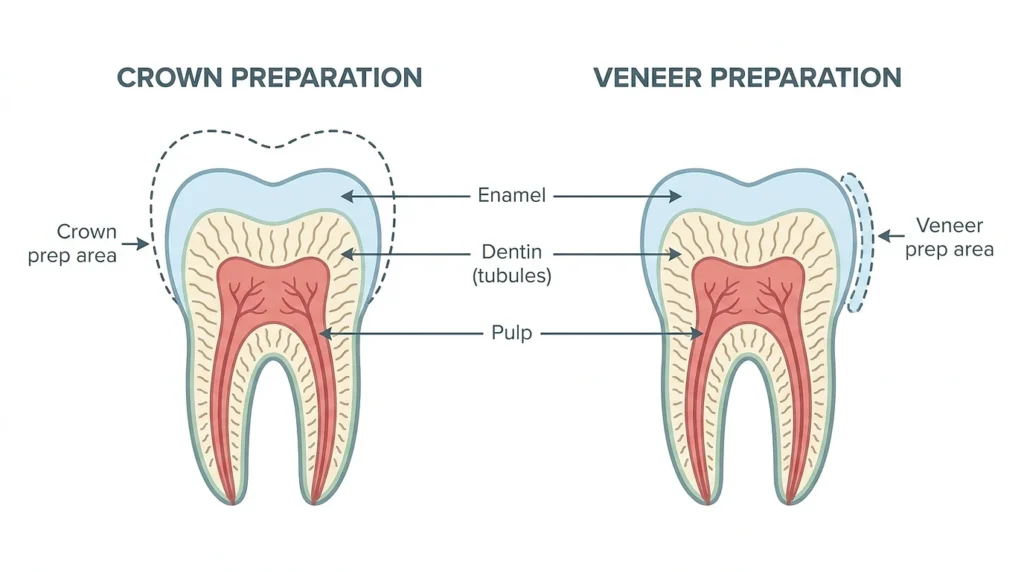
Preparation day is not the end of the cost to the tooth, and this is the part that separates the two options more than the initial millimetres do. Cutting a tooth down for a crown opens dentinal tubules and the pulp does not always tolerate it. Past studies have shown crowned teeth carrying an 8% to 15.6% probability of pulpal pathology over ten years, and a longer term look at vitality found that pulp vitality survival was 84.4% at ten years and 81.2% at fifteen years for single metal ceramic crowns, dropping to 70.8% and 66.2% when the tooth was a bridge retainer. Roughly one crowned tooth in five or six is needing root canal treatment within fifteen years, which then costs more and weakens the tooth further.
The large claims analysis is more reassuring on the whole, since a review of 88,409 crowns placed between 2008 and 2017 found a 90.41% probability of tooth survival after nine years, with the majority of untoward events being nonsurgical root canal therapy. The risk is real without being alarming. It is simply higher than the equivalent risk for a bonded veneer sitting on intact enamel, because less of the tooth is being disturbed in the first place.
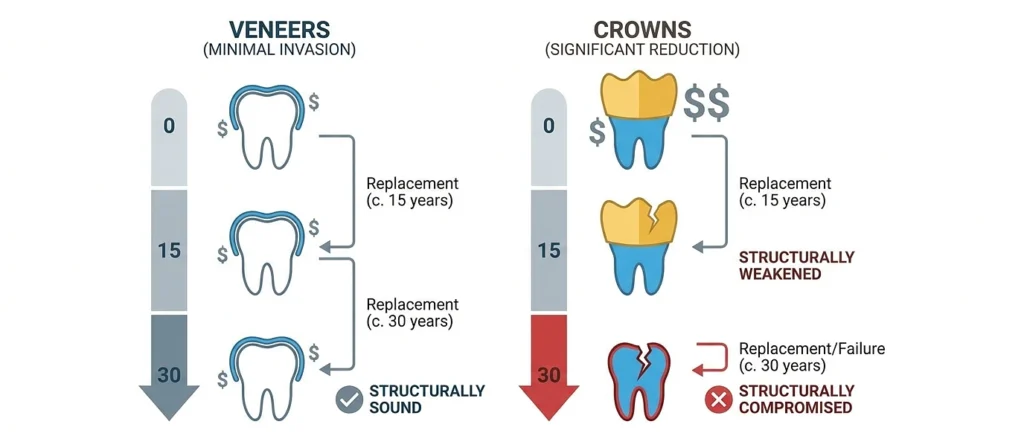
Then there is the replacement cycle, which nobody escapes. Ceramic restorations fail eventually, and every replacement takes a little more tooth as the dentist cleans up the margin, so the question is never whether the tooth loses more, it is how many times that happens across your life. Porcelain veneers are typically quoted at 15 to 20 years, with peer reviewed work showing 91% survival at 20 years and lithium disilicate veneers reaching 96.81% survival at 10.4 years.
The Money, Since The Cheaper Quote Is Rarely The Cheaper Decision
Pricing in the United States this year sits at roughly $800 to $2,500 per tooth for porcelain veneers, with no preparation options including Lumineers at $800 to $2,000, while a dental crown typically runs $1,000 to $3,500 per tooth. The national midpoint for porcelain lands near $1,400 per tooth, and insurance usually treats anything cosmetic as your problem rather than theirs.
Where the arithmetic turns is over thirty years. A veneer replaced twice is still a veneer on a tooth that mostly still exists. A crown replaced twice is a tooth that has been reduced, possibly root treated, and is a candidate for a post and core, and at that point you are managing a structurally compromised tooth rather than a cosmetic one.
Who Each Option Is Genuinely For
The choice is usually made by the tooth rather than by preference, and it comes down to how much healthy structure is standing before anyone picks up a handpiece.
- A veneer suits a tooth veneers that is basically sound and mostly enamel, where the complaint is colour, shape, small chips, mild spacing or minor rotation.
- A crown becomes the reasonable option when the tooth has already lost significant structure to decay or fracture, has had root canal treatment, or is carrying large old fillings that leave nothing to bond a veneer onto.
- A tooth that only needs a small correction and gets a crown anyway has been overtreated, and the two thirds figure at the top of this article is what that overtreatment costs.
- A tooth that is badly broken down and gets a veneer instead has been undertreated, because bonding a thin shell to a weak substrate is not going to hold.

