


For about fifteen years now the advice has floated around every men’s-health corner of the internet, half warning and half locker-room joke keep the phone out of your front pocket or you’ll cook your sperm. It has the ring of something that ought to be true. The phone is warm, it’s throwing off radiation, and it’s sitting a few inches from the one organ men are told runs cooler than the rest of the body on purpose. The logic writes itself.
So when the largest study ever to actually test the pocket question came out, I expected it to confirm the warning. It didn’t. It found something more interesting, and a little more inconvenient for anyone who wants a clean headline, because the study says the pocket is probably fine and also says the phone might not be, and those two things are not a contradiction once you see what it measured.
Let me take the whole thing apart, because the details are where this gets worth your time.
What The Study Actually Was
The paper came out on October 31, 2023, in Fertility and Sterility, and the reason it carries more weight than the scary studies that came before it is simple: size and who they studied. Rita Rahban at the University of Geneva, working with the Swiss Tropical and Public Health Institute, pulled data from 2,886 young men, ages 18 to 22, recruited from the general population as part of army conscription screening. That last part matters more than it sounds. Most earlier phone-and-fertility studies grabbed their subjects from fertility clinics, which means the men were already there because something was wrong. Rahban was blunt about why that wrecks the results, calling out the selection bias and the small samples that had left the whole field inconclusive for years. Take your data only from men with fertility problems and you can’t say anything clean about phones and the general population.
So this was a big, general-population sample, and the men reported how often they used their phones and, crucially for the pocket myth, where they kept them.
What It Found On Frequency, And What It Found On Location
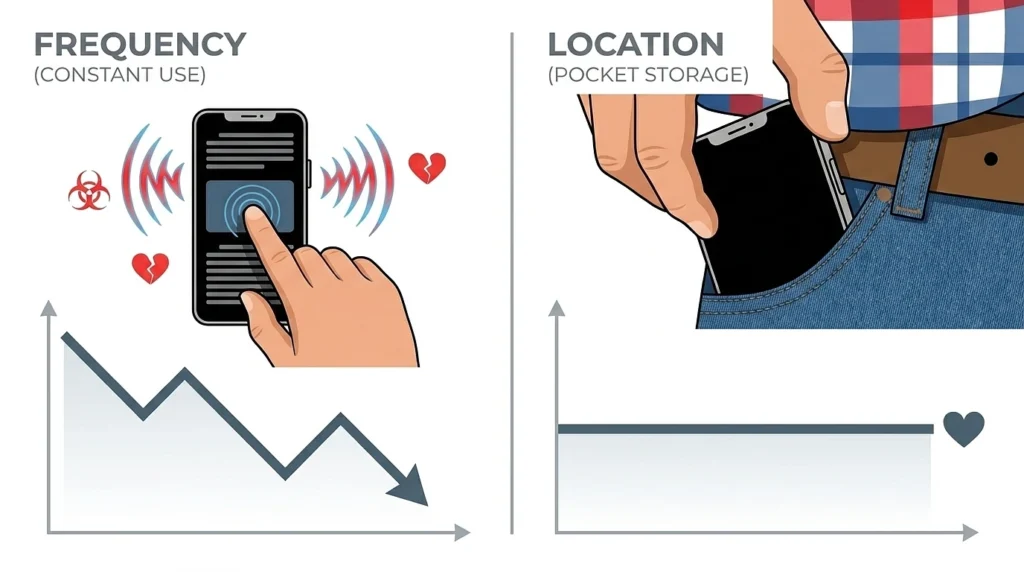
Here’s the split that the title hangs on, and I want to keep the two findings clearly apart because almost every write-up smears them together.
On frequency, there was a real association. Men who said they used their phones more than twenty times a day had lower sperm concentration and lower total sperm count than men who used them once a day or less. Rahban’s group found the heaviest users were more likely to fall below the World Health Organization’s reference numbers for fertile men. That’s the finding that generated all the “phones lower sperm count” headlines, and it’s genuine.
On location, nothing. Carrying the phone in the front pants pocket, the exact thing everyone’s been warned about, was not associated with worse semen quality compared with carrying it elsewhere. The pocket, the belt, the jacket, it didn’t move the numbers. The thing we were all told to worry about turned out to be the thing the data shrugged at.
Sit with how odd that is for a second. If the damage were coming from proximity, from heat or radiation cooking the testes at close range, then pocket carriers should have been the worst off, and they weren’t. The harm signal tracked how much the phone was used, not how close it sat to the anatomy in question. That points away from “your pocket is a microwave” and toward something else going on, or toward the association not being a simple cause at all.
The Caveat Rahban Put On Her Own Pocket Finding
I’m not going to let the pocket result sound cleaner than she did, because she was careful about it and I’d rather you trust me than oversell this. Rahban pointed out that almost everybody in the study, around 85 percent, kept their phone in their pants pocket. Only a small slice carried it away from the body. When one group is huge and the comparison group is tiny, you can’t draw a really robust conclusion about the difference between them, and she said exactly that. So the honest version isn’t “science has proven pockets are perfectly safe.” It’s “the biggest study to look found no pocket effect, with the fair warning that too few men kept phones off-body to settle it for good.”
That’s a weaker, truer statement than the headline, and it’s the one I’d stand behind.
Why The Phone Might Matter Even When The Pocket Doesn’t
If it isn’t proximity, what’s the proposed mechanism? This is where the researchers themselves get appropriately unsure, and I like that they don’t pretend otherwise. Rahban and the urologist Ranjith Ramasamy, who reviewed the work, floated a few possibilities: disruptions in cellular metabolism, DNA damage, oxidative stress, and thermal effects. But Ramasamy added the sentence that should be stapled to every phone-and-sperm scare story, that most of these mechanisms come from rodent studies or from human sperm exposed in a dish, neither of which reflects what actually happens inside a living man carrying a phone through his day.
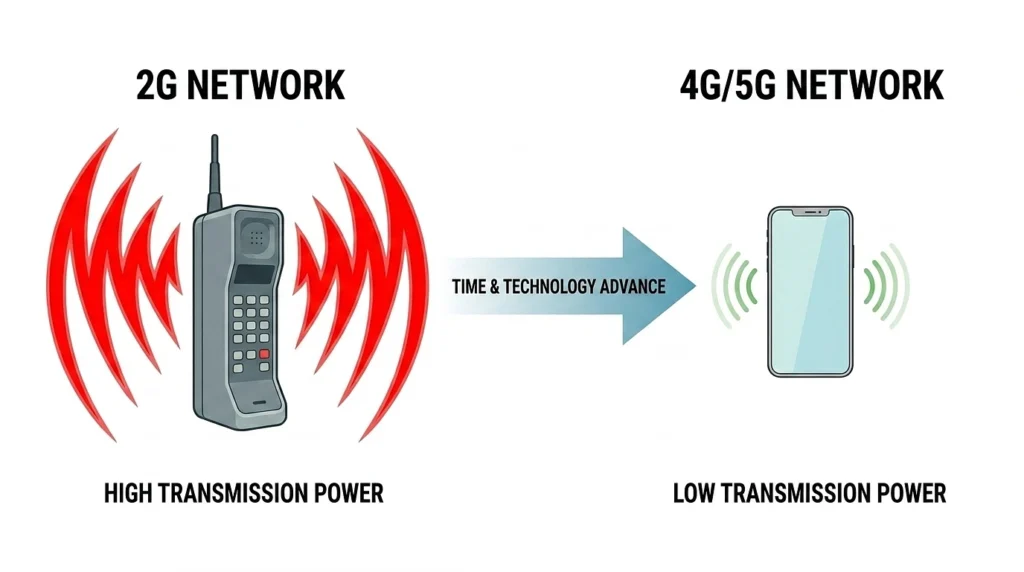
There’s also a genuinely fascinating wrinkle buried in the data that makes me think the story is about signal, not location. The association between heavy use and lower sperm count was strongest in the earliest part of the study period and faded in later years. The researchers think that lines up with the shift from 2G to 3G to 4G networks. Martin Röösli, one of the Swiss TPH scientists, explained that older 2G phones transmitted at maximum power far more aggressively, so on average the radiation exposure from a 2G phone ran something like 100 to 500 times greater than a modern phone. If the effect shrinks as phone transmission power drops, that’s a hint the effect, whatever it is, tracks how hard the phone is broadcasting, not whether it’s touching your leg.
I find that more persuasive than the pocket theory ever was, and it’s testable, which is the best thing you can say about a hypothesis.
The Thing This Study Cannot Tell You
Now the part I refuse to skip, because it’s the difference between reporting a study and hyping one. This was a cross-sectional, self-reported study, and both of those words are limitations with teeth.
Cross-sectional means they took a single snapshot. They looked at phone use and sperm quality at the same moment, which means they genuinely cannot tell you which came first or whether one caused the other. A dozen things could sit underneath both numbers at once:
- Heavy phone users might sleep worse, and poor sleep independently drags down sperm quality.
- The most glued-to-the-screen men might move less, weigh more, or eat worse, all of which hit fertility on their own.
- Stress drives both compulsive phone use and lower semen quality, so it could be quietly authoring both columns.
Self-reported means the entire exposure measurement rests on young men accurately remembering and honestly stating how often they poked at their phones, which, come on. Nobody knows their real screen number, and Rahban knows that’s the soft spot. It’s exactly why her team has already launched a follow-up study designed to measure electromagnetic exposure directly rather than trusting a guy’s estimate, and to separate out the kinds of use, calls versus browsing versus texting, that might matter differently.
So the correct reading of even the frequency finding is “there’s a real association worth chasing,” not “phones proven to lower sperm count.” Association from a snapshot is a reason to do the next study, not a reason to panic.
Where That Leaves You If You’re Actually Trying For A Baby
Strip it all down and here’s what I’d tell a friend who’s worried. The pocket thing you’ve been warned about for years is the part with the least evidence behind it, and the biggest study to check found nothing there. If keeping your phone off your body costs you nothing and buys you peace of mind, fine, do it, it’s free. But it isn’t where the action is.
The larger truth this study sits inside is the one worth your attention. Sperm counts across the developed world have roughly halved over the last fifty years, from an average around 99 million per milliliter down toward 47 million, and the drivers researchers actually have decent evidence for are the unglamorous ones: smoking, alcohol, weight, heat, stress, and a soup of environmental chemicals. If you’re planning for a kid and you want to help your odds, those are the levers with real weight behind them, and they’re worth a conversation with a doctor far more than the question of which pocket your phone rides in. The phone might turn out to matter a little, the next study will say more. Your bodyweight, your cigarettes, and your stress almost certainly matter more, and we’ve known that for a long time.

